

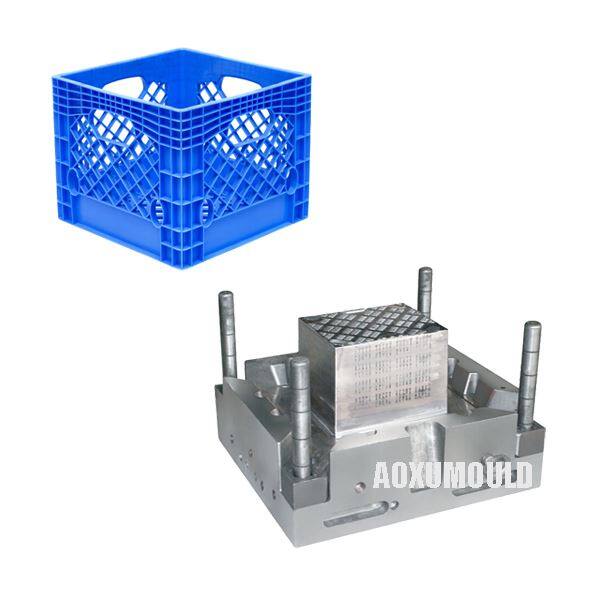
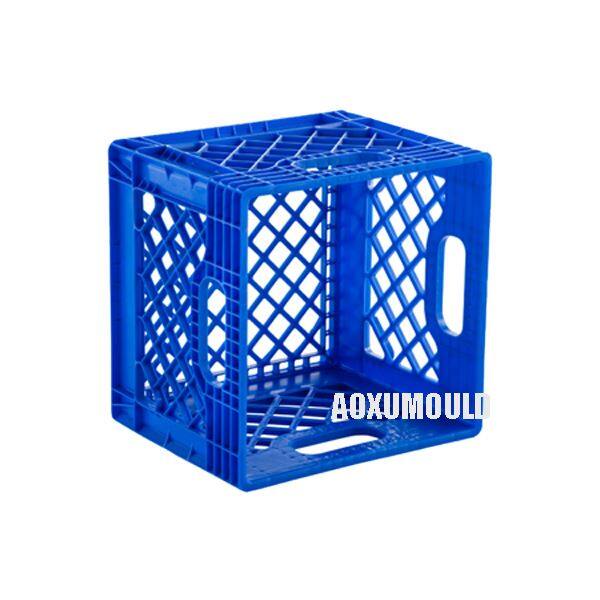
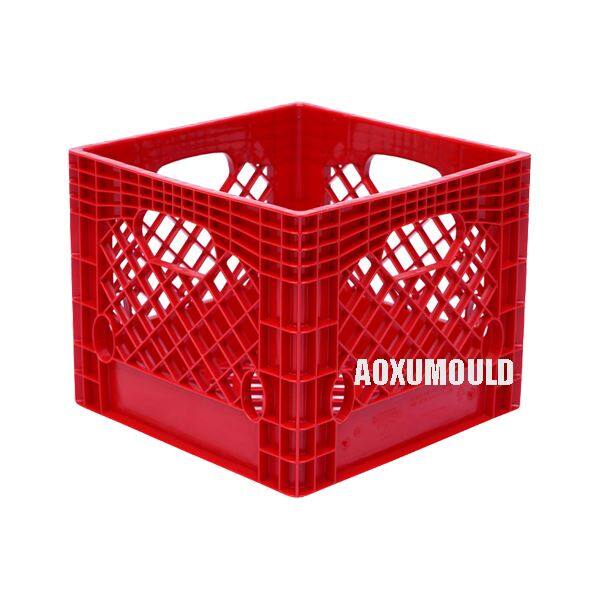
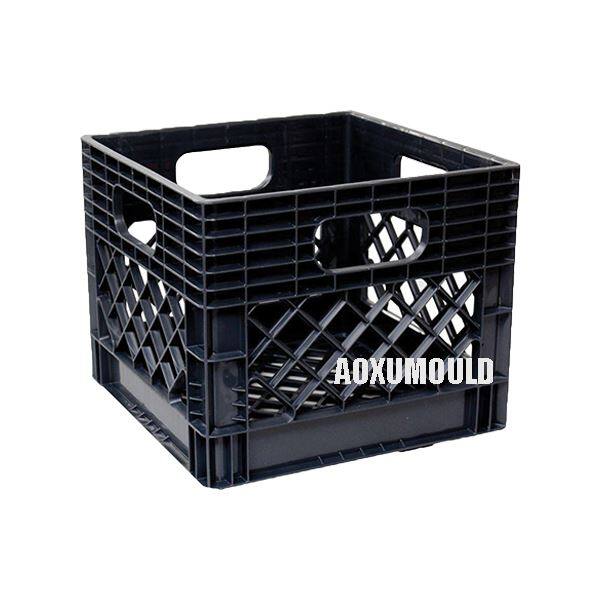
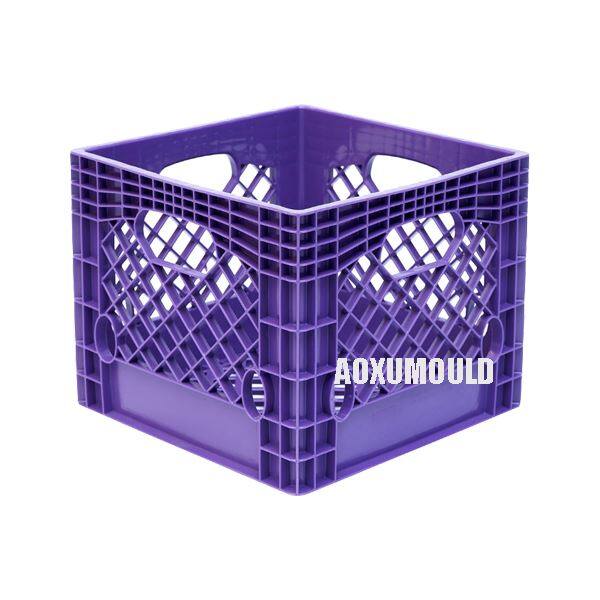
Mould Specifications
|
Mould name |
Ventilated Milk Crate Mould |
|
Crate material |
HDPE/PP, plastic |
|
Crate size |
330X330X280mm |
| Crate weight |
1.2kg |
|
Mould material for cavity &. Core |
P20, 718, H13 |
|
NOs of cavity |
1 cavity |
|
Injection system |
Hot runner |
|
Suitable injection machine |
680T |
|
Mould size |
650X650X580mm |
|
Mould lifetime |
more than 500,000pcs |
Features of Ventilated Milk Crates

1. Ventilation Holes/Slots
Allow air circulation to prevent moisture buildup and spoilage.
Help in quick drainage if liquids spill or crates are washed.
2. High-Strength Material
Typically made from HDPE (High-Density Polyethylene) or PP (Polypropylene) for:
Impact resistance (withstands drops and rough handling).
Weather resistance (UV-stabilized options for outdoor use).
Chemical resistance (safe for food contact).
3. Stackable & Nestable Design
Interlocking rims for secure stacking, even when loaded.
Nestable when empty to save storage and transport space.
4. Reinforced Structure
Ribbed walls for extra strength without adding weight.
Thick corners to resist cracking under heavy loads.
5. Ergonomic Handles
Easy-to-grip handles for manual lifting and carrying.
Some designs include angled handles for better weight distribution.
6. Standardized Sizes
Designed to fit industry-standard milk bottles (e.g., 1-gallon, 1/2-gallon).
Common dimensions: ~13" x 13" x 11" (varies by region/application).
7. Custom Branding Options
Embossed or printed logos for brand identification.
Color customization (commonly white, blue, or red).
8. Reusable & Eco-Friendly
Long lifespan (resistant to wear and corrosion).
100% recyclable at end-of-life.
Design For Product &. Mould

1. Define Crate Specifications
Dimensions (L × W × H) – Standard sizes (e.g., 13×13×11 inches) or custom.
Wall Thickness (typically 2.5–4mm for HDPE/PP).
Ventilation Pattern (hole size, shape, and spacing for airflow).
Stacking & Interlocking Mechanism (ridges/lips for stability).
2. Select the Mould Material
Core & Cavity Steel:
P20 Steel – Good for medium production runs.
H13 Tool Steel – High durability for long runs.
Mould Base: Standard LKM (DME) or HASCO systems for easy assembly.
3. Design the Mould Structure
A. Parting Line & Core/Cavity Design
Parting Line: Divides mould into two halves (fixed & moving).
Core Side: Forms the inner crate structure (handles, ribs).
Cavity Side: Forms the outer surface (logos, textures).
B. Ventilation Hole Design
Slots or Round Holes (5–15mm diameter).
Draft Angles (1–2°) for easy ejection.
Pins or Lifters to form holes without undercuts.
C. Ejection System
Ejector Pins – Push the crate out after cooling.
Stripper Plate – Helps release deep crates smoothly.
D. Cooling System
Water Channels near high-heat areas for uniform cooling.
Baffles & Bubblers for efficient heat dissipation.
E. Feed System (Gating)
Hot Runner System (for high-volume production).
Cold Runner (simpler, but generates waste).
Gate Location (usually at the bottom to minimize visible marks).
4. Structural Reinforcement
Ribs & Gussets – Added to walls for strength without extra weight.
Corner Supports – Prevent cracking under load.
5. Test & Validate the Design
Moldflow Analysis – Simulates plastic flow to avoid defects (warping, sink marks).
Prototype Testing – Checks functionality (stacking, ventilation, weight capacity).
Manufacturing Process of Ventilated Milk Crate Mould

1. Design & Engineering
3D Modeling: CAD software (e.g., SolidWorks, UG NX) is used to design the mould, including core/cavity, ejector system, and cooling channels.
Moldflow Analysis: Simulates plastic flow to prevent defects (warping, air traps, sink marks).
DFM (Design for Manufacturability) Review: Ensures the mould is optimized for production efficiency.
2. Material Selection
Mould Base: Standard LKM or HASCO mould bases (pre-hardened steel).
Core & Cavity:
P20 Steel – Cost-effective for medium production.
H13 Tool Steel – High durability for long runs.
3. CNC Machining
Rough Machining: Blocks of steel are milled into the basic shape.
Precision Machining: CNC milling & turning for fine details (ribs, handles, holes).
EDM (Electrical Discharge Machining): Used for intricate ventilation holes and sharp corners.
4. Polishing & Texturing
Manual Polishing: Smooths surfaces to ensure easy plastic ejection.
Texture Application: Adds grain or logo details (if required).
5. Assembly & Fitting
Ejector System: Pins, sleeves, and plates are installed.
Cooling System: Water channels are connected for temperature control.
Sliders & Lifters: Added if the design has undercuts.
6. Trial & Testing
First Shot Test: Produces sample crates to check for defects.
Adjustments: Fine-tuning ejection, cooling, and gate positions.
Final Approval: Customer verification before mass production.
Mould Components
Mould Steel

Hot Runner System

Standard Parts

Package &. Delivery

Why We Ask Customers to Provide Samples or Drawings for Ventilated Milk Crate?
1. Ensures Your Exact Specifications Are Met
Avoid Miscommunication – Descriptions can be subjective, but a sample or CAD file provides exact dimensions, hole patterns, wall thickness, and structural details.
Functional Accuracy – Guarantees critical features (ventilation slots, stacking lips, handles) work as intended in real-world use.
2. Saves Time & Reduces Costs
Eliminates Guesswork – Engineers don't need to "interpret" your needs, reducing redesigns.
Fewer Prototype Revisions – Prevents costly mould modifications after production begins.
Faster Turnaround – A clear reference speeds up the entire process.
3. Confirms Material & Structural Integrity
Material Testing – If you provide a sample, we can verify:
Plastic grade (HDPE, PP, etc.).
UV resistance, food safety compliance.
Impact strength and durability.
Load Testing – Ensures the crate can handle stacking and transport demands.
4. Faster & More Accurate Quotations
No Surprises – Suppliers can provide precise pricing (instead of rough estimates).
Clear Expectations – Both parties agree on design details upfront.
5. Avoids Legal & Compliance Risks
Prevents IP Issues – Ensures your design doesn't infringe on existing patents.
Meets Industry Standards – Confirms compliance with FDA, EU, or other regulations (if required).
Key Benefits for You (The Customer)
-Get exactly what you need – No "close enough" designs.
-Save money – Fewer revisions = lower costs.
-Faster production – No delays from back-and-forth clarifications.
-Reduce risk – Ensures compliance and functionality.
FAQ
>1. What materials are used for ventilated milk crate moulds?
Mould Steel: P20, H13, or stainless steel (for corrosion resistance).
Plastic Material for Crates: Typically HDPE (High-Density Polyethylene) or PP (Polypropylene) for durability and food safety.
>2. Can you customize the mould design?
Yes! We offer:
Custom sizes, shapes, and hole patterns.
Branding options (logos, text embossing).
Adjustments for stacking mechanisms or load capacity.
>3. Can you assist with crate design optimization?
Yes! We provide DFM (Design for Manufacturability) analysis to improve durability and reduce costs.
>4. How long does it take to manufacture a mould?
The lead time for a custom mould can vary depending on the complexity of the design and the current workload of our manufacturing facility. Typically, our team can produce and deliver a custom mould within45-55 days from the approval of the final design.
>5.Do you offer support and maintenance services for your ventilated milk crate moulds?
A: Yes, we provide ongoing support and maintenance services for our clients to ensure the optimal performance and longevity of their moulds. Our team is available to address any issues or concerns that may arise and to provide guidance on proper care and maintenance of the moulds.
>6. How do I request a quote?
Please provide:
Crate dimensions, material, and hole design.
Expected annual production volume.
Any special requirements (e.g., UV resistance).
Customers' Feedback


