

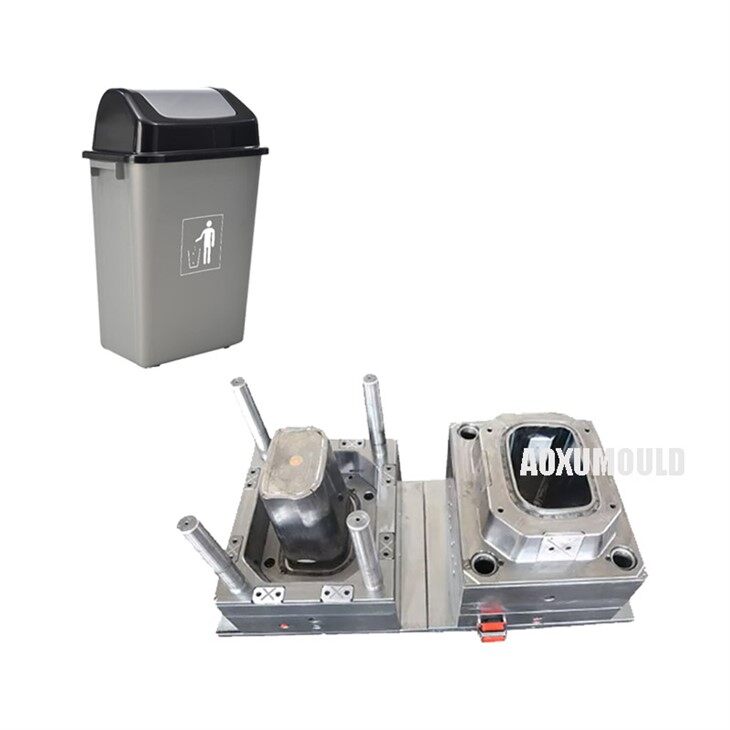
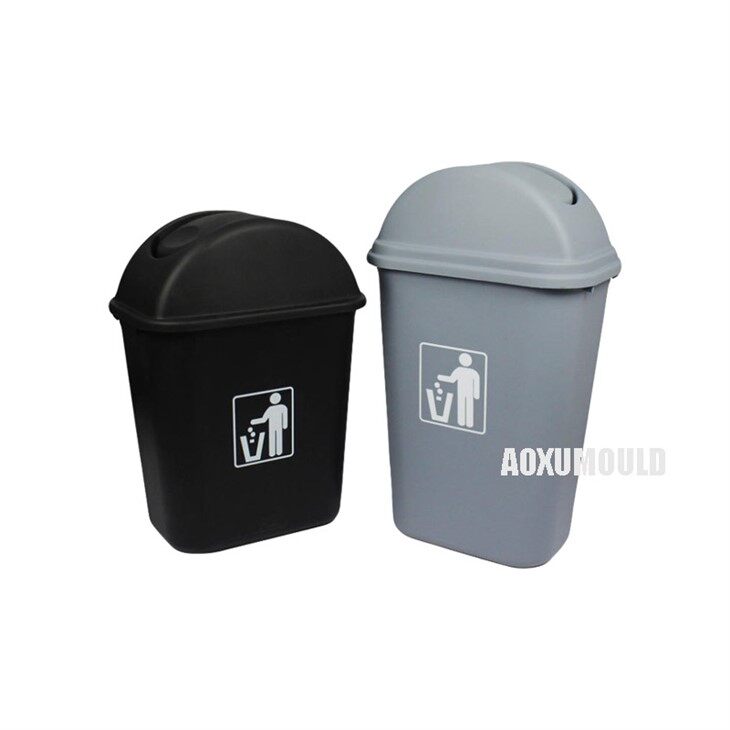
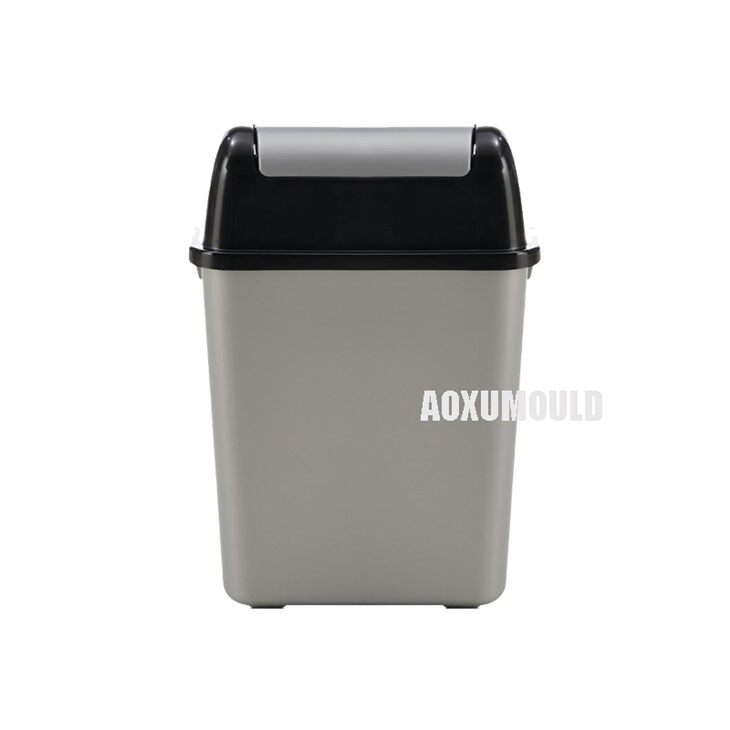
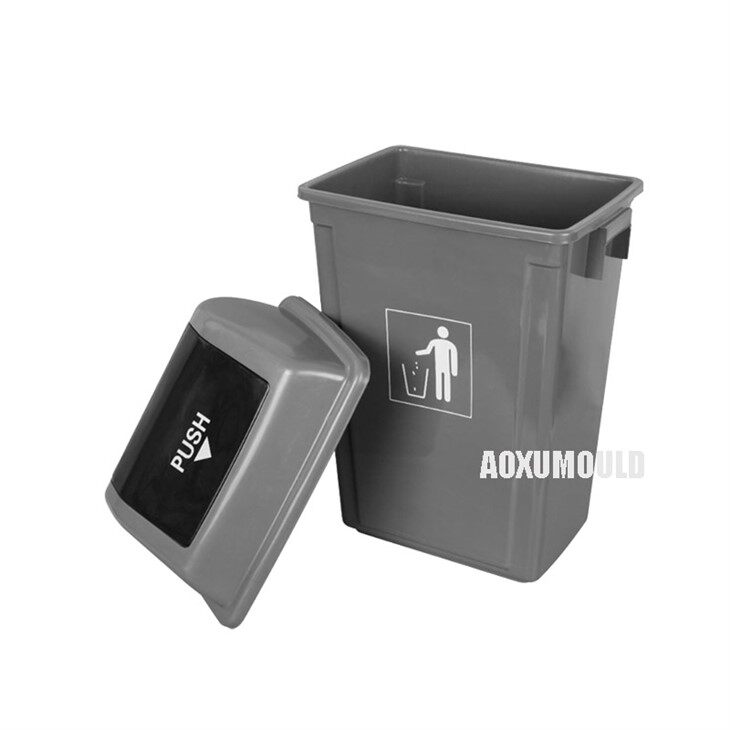
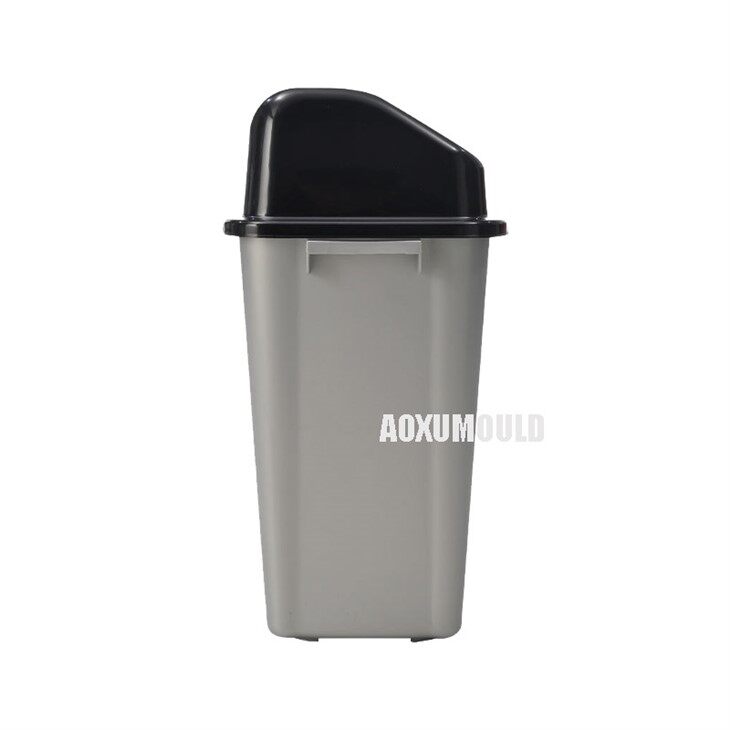
Mould Specifications
|
Mould name |
Swing Dustbin Mould |
|
Product material |
HDPE, plastic |
|
Product Size |
455X320X750mm |
| Product weight |
1.09kg |
|
Mould material for cavity &. Core |
P20, 718, 2738 |
|
NOs of cavity |
1 cavity |
|
Injection system |
Cold runner |
|
Suitable injection machine |
1000T |
|
Mould size |
680X550X960mm |
|
Mould lifetime |
more than 500,000pcs |
|
T1 Time |
After design is finalized, 55 days |
Can Swing Dustbin Moulds Be Used for Commercial Purposes?
 Yes, swing dustbin moulds can absolutely be used for commercial purposes, and they are widely employed in industries that require durable, high-quality waste bins for public or heavy-duty use.
1. Commercial Applications of Swing Dustbin Moulds
Hospitality Sector – Hotels, restaurants, and cafes use swing-top bins for hygiene and convenience.
Healthcare Facilities – Hospitals and clinics need touchless or pedal-operated bins for infection control.
Office & Corporate Spaces – Pedal bins keep workspaces clean and hands-free.
Public Areas – Airports, malls, and parks use heavy-duty swing bins with robust designs.
Industrial & Manufacturing Units – Factories require large-capacity, chemical-resistant bins.
2. Key Features for Commercial-Grade Moulds
Reinforced Hinges & Lids – Withstands frequent use (e.g., stainless steel inserts for durability).
Larger Capacity Designs – 30L to 120L+ bins for high-traffic areas.
Anti-Microbial Coatings – For healthcare or food-service environments.
Custom Branding – Logos, colors, or RFID tags for asset tracking.
3. Material & Mould Adjustments for Commercial Use
Plastic: Heavy-duty HDPE or PP with UV stabilizers (for outdoor bins).
Mould Steel: Hardened steel (H13, S136) for extended lifespan (1M+ cycles).
Reinforced Bases: Thicker walls or ribbed structures for stability.
>Need help designing a commercial-grade mould? Share your requirements (capacity, material, usage environment), and I'll guide you further!
Designs For Product &. Mould

Manufacturing Process of Swing Dustbin Mould

1. Design & Engineering
-3D CAD Modeling
The dustbin's shape, hinge mechanism, and lid are designed using software (e.g., SolidWorks, UG NX).
Mold Flow Analysis is performed to predict plastic flow, cooling, and potential defects (warping, sink marks).
-DFM (Design for Manufacturing) Review
Ensures the mould can be machined efficiently (draft angles, wall thickness, ejection points).
2. Material Selection
Mould Base: Hardened steel (e.g., P20, H13, S136) for longevity (500K+ cycles).
Inserts & Cores: Beryllium copper for high-heat areas (hinge sections).
Plastic Material: Typically PP, HDPE, or ABS (chosen for flexibility, impact resistance).
3. CNC Machining (Mould Fabrication)
-Rough Machining:
The steel block is cut into a rough shape using CNC milling.
-Precision Machining:
EDM (Electrical Discharge Machining) for intricate details (hinge slots, textures).
High-Speed CNC for fine contours and smooth surfaces.
-Grinding & Polishing:
Ensures a mirror finish for easy plastic ejection.
4. Mould Assembly & Fitting
Core & Cavity Alignment: The two halves must fit perfectly to avoid flash (excess plastic).
Slider/Lifter Mechanisms: Added for undercuts (e.g., pedal-operated bins).
Ejection System Setup: Ejector pins, air valves, or stripper plates are installed.
5. Trial Testing (T1 Samples)
First-Shot Inspection:Plastic is injected, and samples are checked for defects (warpage, sink marks, hinge function).
Adjustments: Mould may be modified (polishing, cooling channel tweaks) for optimal performance.
Mould Maintenance
Regular Cleaning – Prevents residue buildup.
Lubrication – Ensures smooth slider/ejector movement.
Reconditioning – Worn-out components (e.g., ejector pins) are replaced.
How Many Molds Does the Swing Dustbin Can Consist of?
The number of moulds required to produce a swing dustbin depends on its design complexity, components, and production efficiency. Here's a breakdown:
1. Basic Swing Dustbin (Single Mould)
Simple flip-top bins (one-piece body + integrated hinge)
1 mould (for bin + lid as a single unit, using living hinges).
Example: Small household bins with a thin, flexible PP hinge.
2. Standard Swing Dustbin (2-3 Moulds)
Most common setup:
Mould 1: Bin body (main container)
Mould 2: Swing lid (with hinge sockets)
Mould 3 (optional): Separate hinge component (if not integrated).
3. Complex Commercial Bins (3+ Moulds)
For heavy-duty or multi-part bins:
Mould 1: Bin body (reinforced ribs, thicker walls)
Mould 2: Lid (with metal hinge inserts)
Mould 3: Pedal mechanism (for foot-operated bins)
Mould 4: Inner bucket (removable liner)
Mould 5: Accessories (locks, sensors, wheels).
Why Choose Us?
1. Industry-Leading Expertise
15+ Years in Mould Manufacturing – Specialized in household & commercial bin moulds.
2. High-Quality Moulds, Long Lifespan
Premium Materials – We use hardened steel (H13, S136) and beryllium copper for high-wear areas.
500,000+ Cycle Guarantee – Our moulds outperform competitors in durability.
Precision Machining – ±0.02mm tolerance for flawless bin production.
3. Customization & Smart Design
DFM (Design for Manufacturing) Analysis – Optimize your mould for cost & performance.
Living Hinge Expertise – We design self-opening, durable lids that last.
Multi-Cavity & Family Moulds – Reduce per-unit costs in mass production.
4. Faster Delivery & Competitive Pricing
55–65 Days Standard Lead Time.
Transparent Pricing – No hidden fees; we maximize cost-efficiency.
5. Rigorous Quality Control
100% Inspection – CMM, mold flow analysis, and 50K+ hinge cycle tests.
T1 Samples Before Mass Production – Verify quality before full commitment.
6. End-to-End Support
From Design to After-Sales – We assist with:
Material selection (PP, HDPE, ABS).
Mould maintenance & repair.
Packaging & logistics.
7. Global Clientele & Proven Success
Satisfied Customers – Including OEMs in Europe, USA & Asia.
Case Studies Available – See how we improved efficiency for similar clients.
FAQ
>1. What types of swing dustbin moulds do you manufacture?
We produce injection moulds for various swing-top dustbins, including:
Pedal-operated bins (foot pedal mechanism)
Touchless sensor bins (infrared or motion-sensor lids)
Standard flip-top bins (manual swing lid)
Custom-shaped bins (round, rectangular, designer styles)
>2. What materials are used for the moulds?
Our moulds are made from:
Hardened steel (P20, H13, S136) – For long lifespan (500,000+ shots)
Beryllium copper – For high-heat dissipation in critical areas
>3. What plastic materials are suitable for swing dustbins?
Commonly used plastics:
PP (Polypropylene) – Flexible, durable, ideal for living hinges
HDPE (High-Density Polyethylene) – Impact-resistant, chemical-resistant
ABS (Acrylonitrile Butadiene Styrene) – Sturdy, glossy finish
>4. Can you customize the mould design?
Yes! We offer:
Custom sizes, shapes, and capacities
Branding options (logos, textures, embossing)
Special features (odor control, anti-bacterial coatings, soft-close hinges)
>5. Do you provide trial samples before mass production?
Yes! We offer T1 samples (first trial shots) for approval before full production.
>6. How long does it take to manufacture a swing dustbin mould?
The manufacturing time for a swing dustbin mould can vary depending on the complexity of the design and the materials used. However, on average, it can take 55 to 65days to complete the manufacturing process.
>6. What is the cost of manufacturing a swing dustbin mould?
The cost of manufacturing a swing dustbin mould can vary depending on factors such as the materials used, the complexity of the design, and the quantity ordered. It is best to contact us for a quote based on your specific requirements.


