

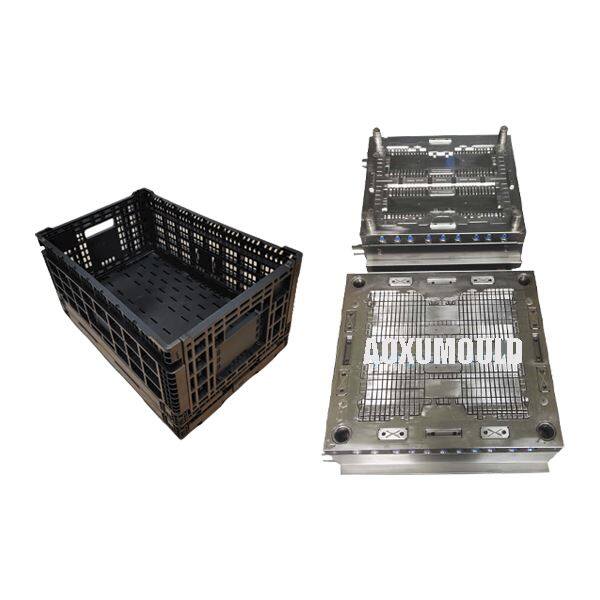
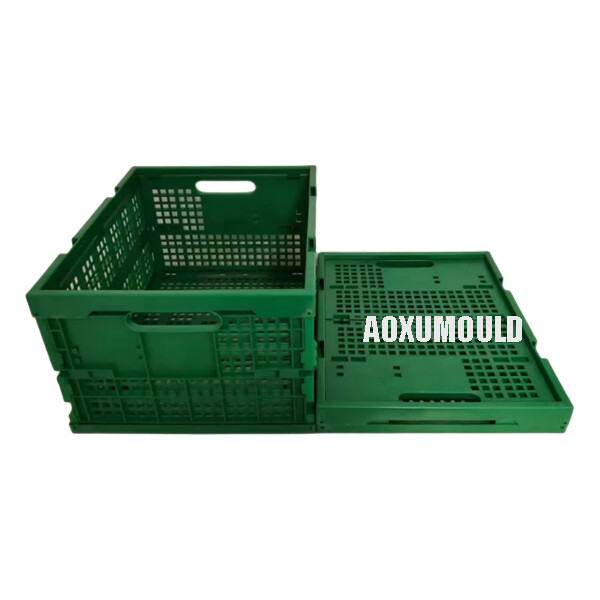
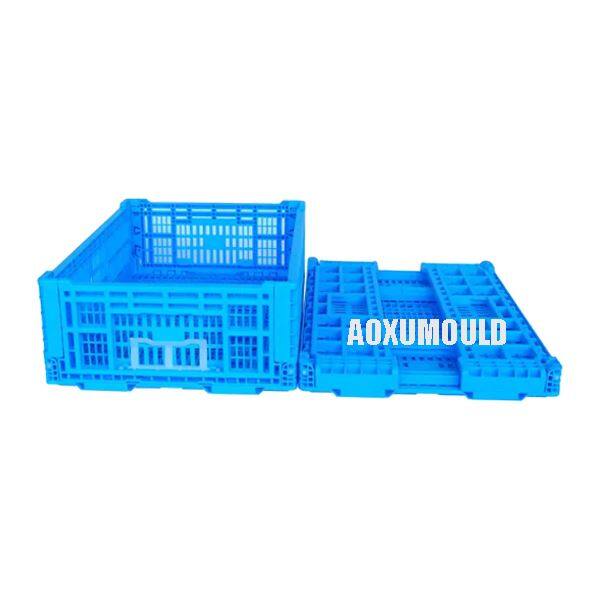
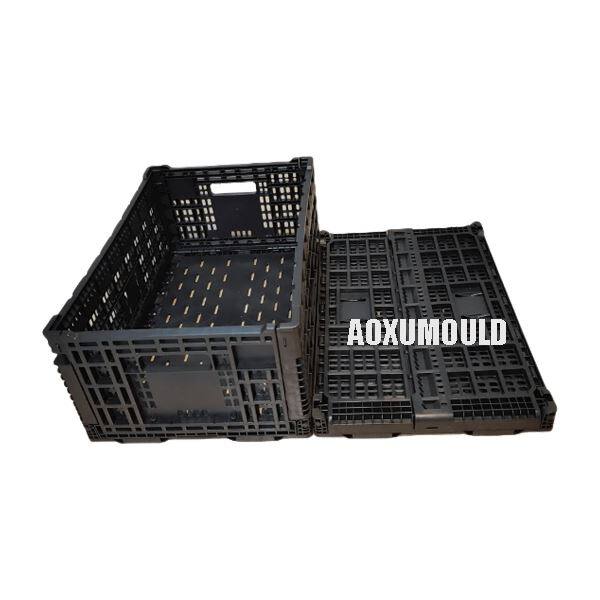
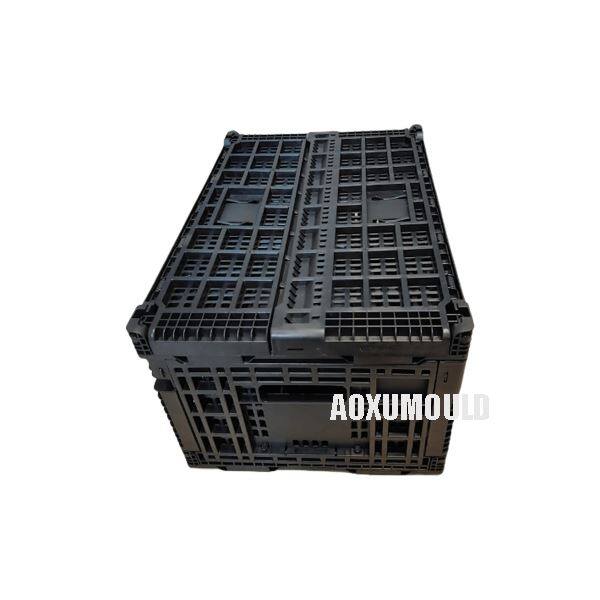
Mould Specifications
|
Mould name |
Collapsible Crate Mould |
|
Crate material |
HDPE/PP, plastic |
|
Crate size |
670X370X250mm |
| Crate weight |
3.5kg |
|
Mould material for cavity &. Core |
P20, 718, 2738 |
|
NOs of cavity |
1 cavity |
|
Injection system |
Hot runner |
|
Suitable injection machine |
1000T |
|
Mould size |
1050X630X580mm |
|
Mould lifetime |
more than 500,000pcs |
Parts of a Collapsible Crate

1. Main Structural Components
A. Base (Bottom Panel)
-Function: Primary load-bearing surface.
-Design Features:
Ribbed or grid pattern for strength.
Anti-slip feet or texture for stability.
Drainage holes (in food/agricultural crates).
B. Side Panels (Collapsible Walls)
-Function: Form the crate's walls and fold inward.
-Design Features:
Living hinges (thin, flexible sections) for folding.
Interlocking grooves to keep walls extended.
Hand grips for easy carrying.
C. End Panels (Fixed or Foldable)
-Function: Provide structural rigidity.
-Design Variations:
Fixed end panels (for heavy-duty crates).
Foldable end panels (fully collapsible designs).
2. Folding & Locking Mechanisms
A. Hinges
Types:
Living hinges (molded-in plastic, most common).
Pin hinges (metal/plastic pins for heavy-duty crates).
B. Locking System
Purpose: Keeps crate rigid when expanded.
Common Types:
Snap-fit locks (plastic clips).
Push-button latches (for secure locking).
3. Handling & Stacking Features
A. Handles
Types:
Cut-out handles (molded into sidewalls).
Overmolded grips (for comfort).
B. Stacking & Nesting Features
Stacking: Interlocking rims or lips.
Nesting: Tapered walls for compact storage when folded.
4. Reinforcements & Functional Add-Ons
A. Reinforcements
Ribs & gussets → Prevent bending under load.
Thickened corners → Impact resistance.
B. Ventilation & Drainage
Perforated walls → Airflow (for produce/food).
Drainage holes → Liquid escape (dairy/fishing crates).
Designs For Product &. Mould

Advantages of Collapsible Crates
Space Saving – Can be folded when not in use.
Stackable & Nestable – Optimizes storage and transport.
Reusable & Durable – Long-lasting compared to cardboard or wood.
Customizable – Logos, textures, and colors can be moulded in.
Molding Process Of Collapsible Crate Mould

1. Material Selection & Preparation
Primary Materials:
Polypropylene (PP) - Best for living hinges (500,000+ flex cycles)
High-Density Polyethylene (HDPE) - For heavy-duty applications
Material Prep:
Dry pellets at 80-100°C for 2-4 hours (critical for PP)
Add UV stabilizers for outdoor crates
2. Production Process Flow
Clamping (500-2000 ton press)
Injection (High-speed fill for thin walls)
Packing (Holding pressure 50-70% of injection)
Cooling (Critical for hinge areas)
Ejection (Stripper plate preferred)
Post-Processing (Gate trimming, hinge flex testing)
3. Common Production Issues & Fixes
|
Problem |
Root Cause |
Solution |
|
Hinge cracking |
Material degradation |
Reduce melt temp by 10°C |
|
Walls sticking |
Insufficient draft |
Increase to 2° minimum |
|
Warped base |
Uneven cooling |
Add cooling channels |
|
Weak locks |
Short shot in features |
Increase pack pressure |
Test Video of Collapsible Crate Moulds
Mould Components
Mould Steel

Hot Runner System

Standard Parts

Package &. Delivery

Key Factors Affecting Collapsible Crate Mould Cost
1. Mould Design Complexity
Hinge Mechanism (living hinges vs. mechanical hinges)
Number of Slides & Lifters (for undercuts and collapsible features)
Wall Thickness & Rib Design (affects cooling time and material use)
Draft Angles & Ejection System (impacts demolding efficiency)
2. Mould Material & Durability
Steel Grade (P20, H13, stainless steel)
Surface Treatment (polishing, hardening, coatings)
Expected Lifespan (cycle count before refurbishment)
3. Production Volume & Cavity Count
Single vs. Multi-Cavity Moulds (affects per-unit cost)
Family Moulds (multiple parts in one mould)
Hot Runner vs. Cold Runner Systems (material waste reduction)
4. Manufacturing Precision & Finishing
Tolerances & Surface Finish (SPI standards, textures)
Conformal Cooling Channels (reduces cycle time)
Moldflow Analysis & Simulation (optimizes design before production)
5. Special Features & Customization
Branding & Logos (engraved or textured)
Interchangeable Inserts (for different crate sizes/styles)
Automation Compatibility (robotic ejection, quick-change systems)
FAQ
1. What types of collapsible crate moulds do you offer?
We specialize in manufacturing injection moulds for:
Foldable plastic crates (4-sided, 2-sided collapse)
Stackable and nestable crates
Heavy-duty industrial crates (with reinforced walls)
Custom-designed crates (branding, handles, vents, etc.)
2. What materials are best for collapsible crates?
Most crates are made from:
PP (Polypropylene) – Lightweight, durable, and flexible.
HDPE (High-Density Polyethylene) – Impact-resistant, food-safe.
Recycled plastics – Eco-friendly options available.
>3. Can you customize collapsible crate injection moulds?
Yes, we can customize collapsible crate moulds according to your requirements, including size, shape, color, and logo imprinting.
>4. How long does it take to manufacture collapsible crate injection moulds?
The manufacturing time for collapsible crate injection moulds depends on the complexity and size of the mould, but we strive to provide quick turnaround times. Typically it will take 45-55days for T1 time.
>5. Do you provide trial samples before mass production?
Yes, we offer T1 samples for approval before full production.
>6. What after-sales support do you provide?
Mould maintenance & repair
Technical guidance (injection parameters, troubleshooting)
Spare parts supply
>7. What are the payment terms?
TT, 40% deposit, 30% to be paid before sending sample, 30% balance before mold delivery.
Customers' Feedback


