

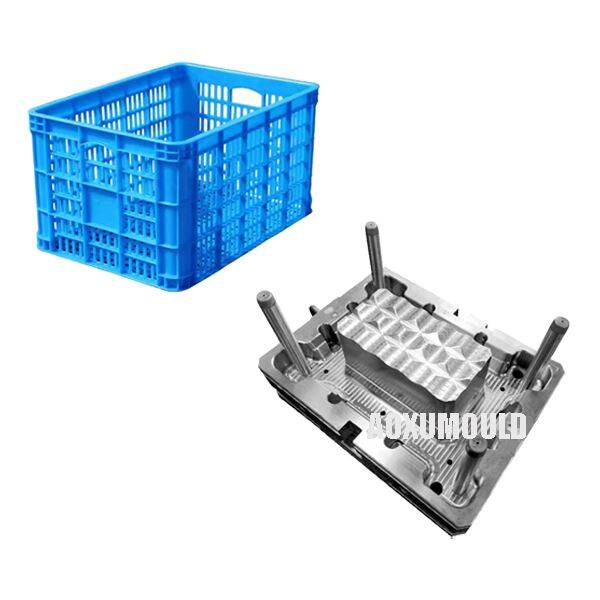
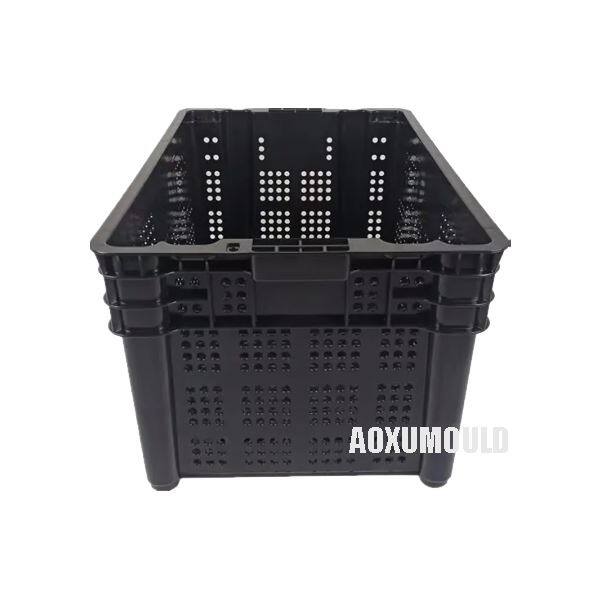
Mould Specifications
|
Mould name |
Plastic Crate Mold |
|
Crate material |
HDPE/PP, plastic |
|
Crate size |
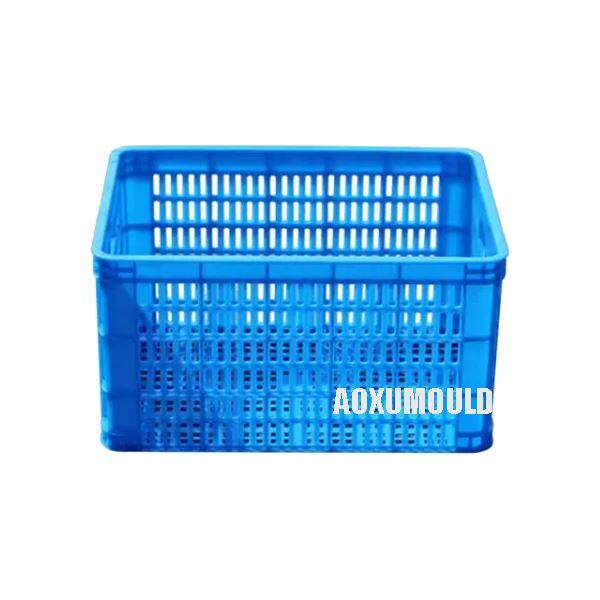
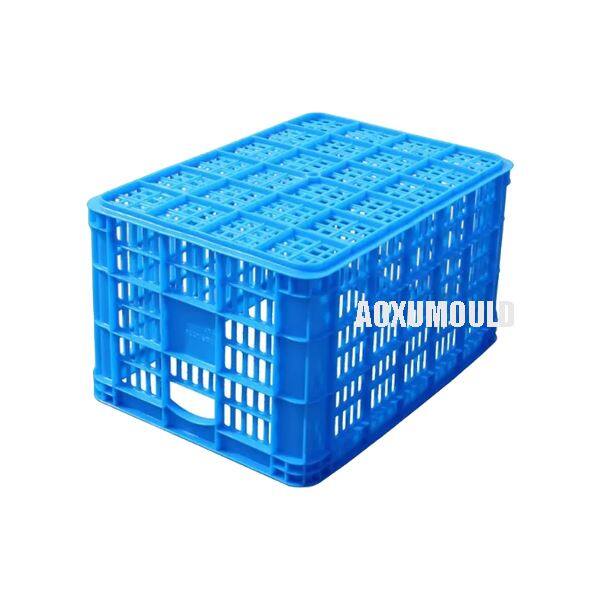
450X320X258mm |
| Crate weight |
1.15kg |
|
Mould material for cavity &. Core |
P20, 718, 2738 |
|
NOs of cavity |
1 cavity |
|
Injection system |
Cold/Hot runner |
|
Suitable injection machine |
680T |
|
Mould size |
720X600X550mm |
|
Mould lifetime |
more than 500,000pcs |
Mold Components of Plastic Crate Mold

1. Core & Cavity (Mold Base)
Core: The male part of the mold that shapes the inner structure of the crate.
Cavity: The female part that forms the outer surface.
Material: Hardened steel (P20, H13, S136) for wear resistance.
2. Ejection System
Ejector Pins: Push the finished crate out of the mold after cooling.
Ejector Plate: Holds and moves the ejector pins uniformly.
Return Pins: Reset the ejector system for the next cycle.
3. Cooling System
Cooling Channels: Circulate water or oil to cool the mold quickly, reducing cycle time.
Baffles & Bubbler Tubes: Improve cooling efficiency in deep sections.
4. Venting System
Vent Grooves/Pins: Allow trapped air and gases to escape, preventing defects like burns or voids.
5. Guide Pins & Bushings
Ensure precise alignment of the core and cavity to avoid mismatches.
6. Sprue, Runner & Gate System
Sprue: Entry point for molten plastic.
Runners: Channels that distribute plastic to multiple cavities.
Gates: Control the flow of plastic into the cavity (common types: edge gate, submarine gate).
7. Slide Mechanisms (for complex crates)
Sliders & Lifters: Used if the crate has undercuts (e.g., handles or locking features).
Angled Lifters: Retract to release undercuts during ejection.
8. Support Pillars & Plates
Support Pillars: Prevent mold deflection under high injection pressure.
Clamping Plates: Hold the mold securely in the injection molding machine.
9. Hot Runner System (Optional)
Maintains molten plastic in the runners, reducing waste and cycle time.
Which Plastic Material to Produce Crates?

1. Polypropylene (PP)
-Properties:
Lightweight yet strong
Good chemical & moisture resistance
Excellent impact resistance (even at low temperatures)
Can be made UV-stabilized for outdoor use
-Common Uses:
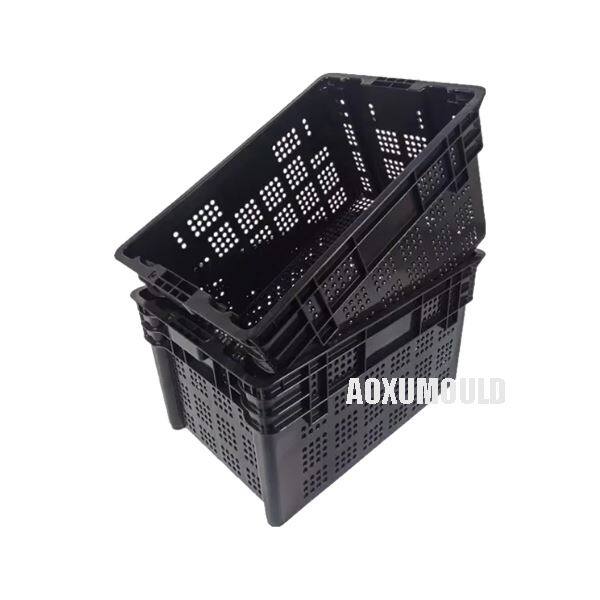
Stackable/nestable storage crates
Food-grade crates (FDA-approved variants available)
Logistics and warehouse crates
2. High-Density Polyethylene (HDPE)
-Properties:
High strength-to-weight ratio
Excellent resistance to chemicals & moisture
Good UV resistance (for outdoor crates)
Recyclable & food-safe options available
-Common Uses:
Heavy-duty industrial crates
Milk crates & beverage containers
Agricultural produce crates
3. Low-Density Polyethylene (LDPE)
-Properties:
Flexible & lightweight
Good impact resistance
Resistant to acids and alkalis
Less rigid than HDPE/PP
-Common Uses:
Lightweight foldable crates
Non-structural storage bins
4. Acrylonitrile Butadiene Styrene (ABS)
-Properties:
High rigidity & toughness
Good surface finish (for aesthetic crates)
Resistant to scratches & impacts
More expensive than PP/HDPE
-Common Uses:
High-end retail display crates
Automotive parts storage
Designs For Product &. Mould

Key Points for Designing a High-Quality Plastic Crate Mold
1. Crate Design & Functionality
A. Wall Thickness
Optimal Range: 2.5–4mm (ensures strength while minimizing material usage).
Uniformity: Avoid thick-thin transitions to prevent sink marks and warpage.
B. Ribs & Reinforcements
Rib Design: Should be 60–70% of main wall thickness to prevent sink marks.
Bosses & Reinforcements: Strengthen handles, corners, and stacking features.
C. Draft Angles
Minimum 1–2° draft for smooth ejection (prevents sticking).
Higher angles (3–5°) for textured surfaces.
D. Stacking & Nesting Features
Interlocking rims for secure stacking.
Tapered walls for easy nesting (if required).
2. Mold Structure & Components
A. Core & Cavity Design
Hardened steel (H13, S136, P20) for durability.
Mirror polishing for smooth crate surfaces.
B. Ejection System
Ejector pins placed under ribs/bosses for even force distribution.
Stripper plates for large crates to avoid deformation.
C. Cooling System
Conformal cooling channels for uniform cooling (reduces cycle time).
Baffles & bubblers in thick sections to prevent hotspots.
D. Venting
Vent slots (0.02–0.04mm deep) to release trapped air.
Porous vents in deep sections to avoid burn marks.
Gate & Runner System
Hot runner system (for high-volume production, reduces waste).
Cold runner options (for simpler designs).
Gate location: Preferably at the non-visible side (e.g., bottom edge).
Mould Components
Mould Steel

Hot Runner System

Standard Parts

Package &. Delivery

Why We Ask Customers to Provide Samples or Drawings for Ventilated Milk Crate?
1. Clean the mould regularly: After each production cycle, it is important to clean the mold thoroughly to remove any residue or debris that may have accumulated. Use a soft brush or cloth to gently clean the mould and ensure that all surfaces are free of contaminants.
2. Inspect the mould for wear and tear: Regularly inspect the mold for any signs of wear and tear, such as cracks, scratches, or dents. Address any issues promptly to prevent further damage and ensure the quality of the molded products.
3. Lubricate moving parts: To prevent friction and wear, lubricate the moving parts of the mold regularly with a suitable lubricant. This will help increase the lifespan of the mould and ensure smooth operation during the molding process.
4. Store the mould properly: When not in use, store the mould in a clean and dry environment to prevent damage from moisture or dust. Storing the mold properly will help maintain its quality and prolong its lifespan.
5. Follow recommended maintenance schedule: Consult the manufacturer's guidelines for recommended maintenance practices and schedule regular maintenance checks to ensure the optimal performance of the mold.
By following these maintenance practices, you can ensure the longevity and efficiency of your plastic crate mold, ultimately leading to the production of high-quality plastic crates for a variety of applications. Proper maintenance is key to maximizing the lifespan of your mold and achieving consistent results in your production process.
FAQ
>1. What types of plastic crates can your moulds produce?
We manufacture moulds for:
Stackable/Nestable Crates (logistics, agriculture)
Heavy-Duty Industrial Crates (automotive, warehouses)
Ventilated Produce Crates (food-safe, USDA/FDA compliant)
Foldable/Collapsible Crates (space-saving storage)
Custom Crates (with logos, handles, or unique dimensions).
What materials are best for plastic crate moulds?
We recommend:
PP (Polypropylene) – Lightweight, durable, cost-effective.
HDPE (High-Density Polyethylene) – UV-resistant, heavy-duty.
ABS – High-end, impact-resistant crates.
>3. Can you customize plastic crate designs according to our specific requirements?
Yes, our team of experienced designers and engineers can work closely with you to create custom plastic crate designs that meet your unique specifications and requirements.
>4. How long does it typically take to complete a plastic crate injection mould project?
The timeline for completing a plastic crate mold project can vary depending on the complexity of the design and the quantity of crates needed. Typically it will take 45-55days.
>5. Can you provide samples of your plastic crate products?
Yes, we can provide samples of our plastic crate products for your review and approval before proceeding with full-scale production.
>6. How do you ensure the quality of your plastic crate products?
We have a rigorous quality control process in place to ensure that every plastic crate produced meets our high standards for quality and durability. This includes regular inspections and testing throughout the manufacturing process.
>7. What file formats do you accept for mold design?
We work with: .STEP, .IGES, .STP, .X_T, or even hand sketches.
Customers' Feedback


