

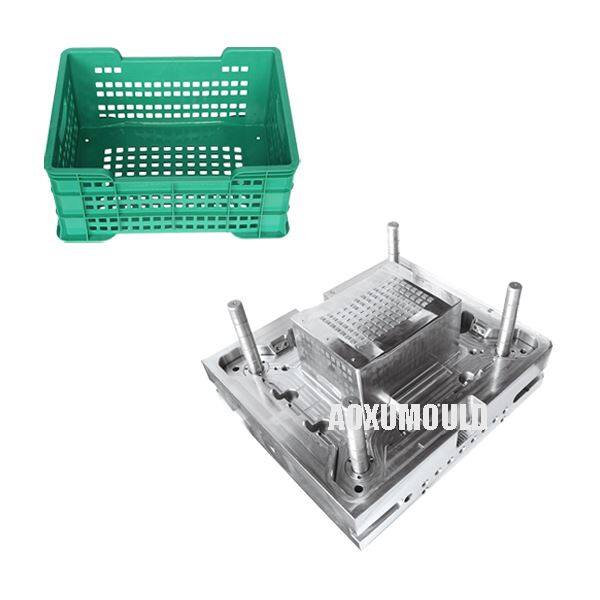
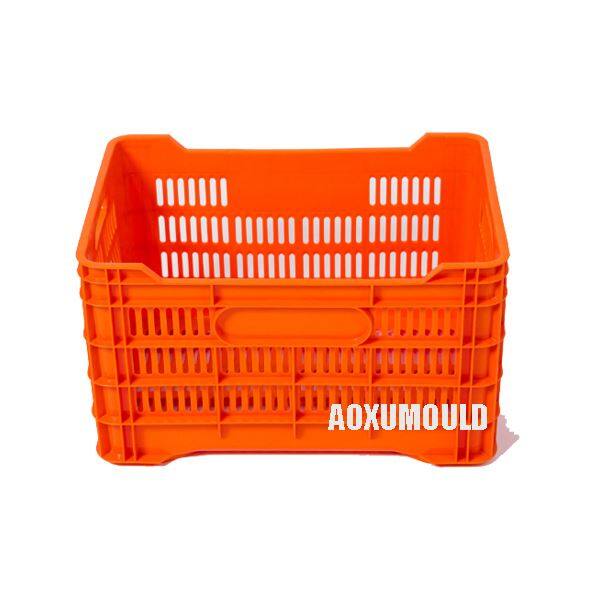
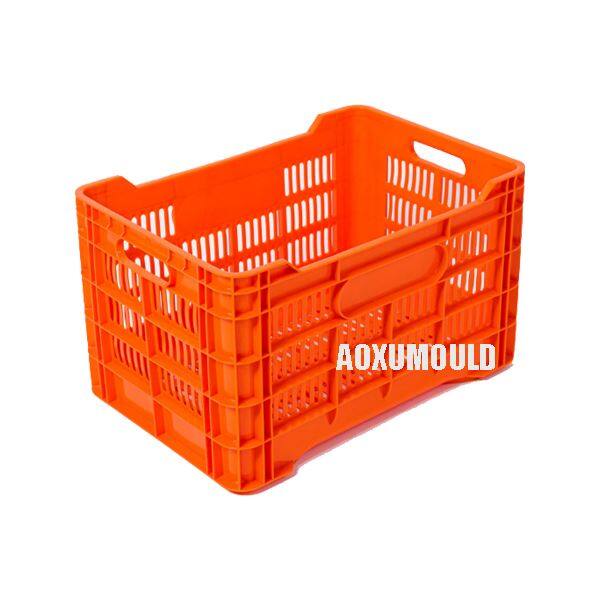
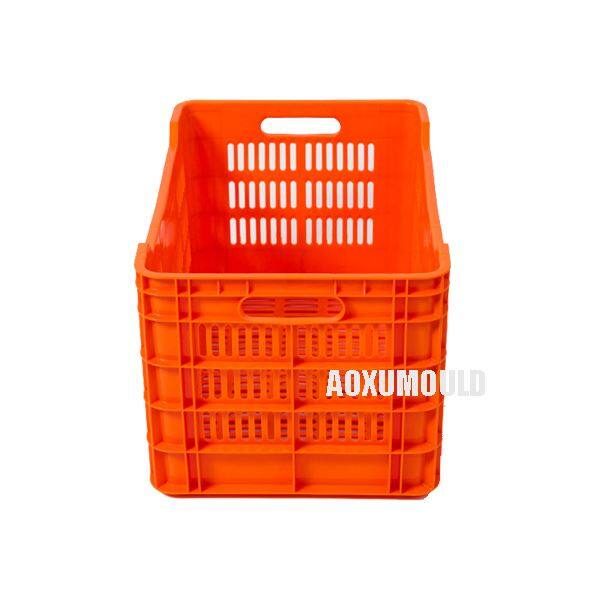
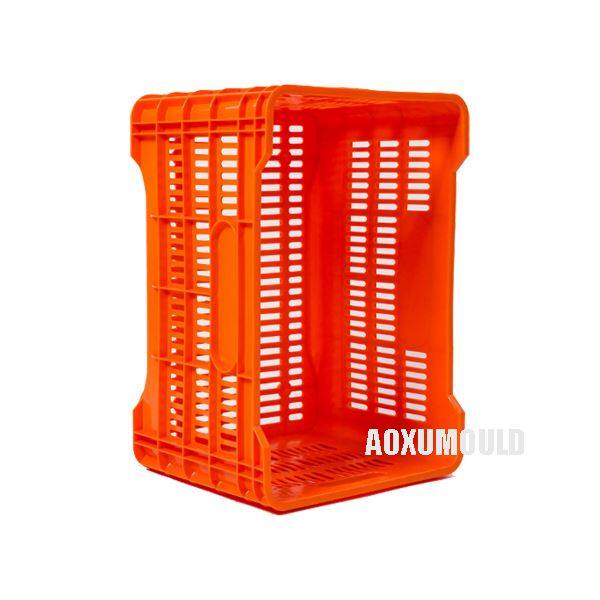
Mould Specifications
|
Mould name |
Crate Mold |
|
Crate material |
HDPE/PP, plastic |
|
Crate size |
550X370X330mm |
| Crate weight |
2.1kg |
|
Mould material for cavity &. Core |
P20, 718, 2738 |
|
NOs of cavity |
1 cavity |
|
Injection system |
Hot runner |
|
Suitable injection machine |
480T |
|
Mould size |
780X650X600mm |
|
Mould lifetime |
more than 500,000pcs |
What Type of Crate Molds Can You Make?

1. Standard Stackable Crate Molds
Used for making general-purpose storage crates with interlocking designs.
Features: Reinforced walls, ribbed structures, and smooth surfaces.
Applications: Warehousing, logistics, and retail storage.
2. Heavy-Duty Industrial Crate Molds
Designed for high-load capacity (e.g., automotive parts, machinery storage).
Thicker walls, extra ribs, and reinforced corners for durability.
Materials: HDPE, PP with glass fiber for added strength.
3. Ventilated (Perforated) Crate Molds
Crates with holes or mesh patterns for airflow.
Used in agriculture (fruit/vegetable crates), fisheries, and beverage storage.
Prevents moisture buildup and allows easy cleaning.
4. Folding/Collapsible Crate Molds
Produces space-saving crates that fold when not in use.
Hinged or interlocking design for easy storage.
Common in logistics and returnable transport packaging (RTP).
5. Nestable Crate Molds
Crates designed to nest inside each other when empty, saving storage space.
Often used in beverage, dairy, and poultry industries.
Custom Logo/Design Crate Molds
Crates with branding, embossed logos, or unique shapes.
Used in retail, supermarkets, and promotional packaging.
7. Specialized Industry-Specific Crate Molds
Milk Crates – Durable, stackable, and often made from FDA-approved HDPE.
Automotive Parts Crates – Custom compartments for components.
Bottle & Beverage Crates – High-impact designs with dividers.
Materials Used for Crate Molds:
HDPE (High-Density Polyethylene) – Most common (durable, chemical-resistant).
PP (Polypropylene) – Good for high-temperature applications.
Reinforced Plastics (e.g., GF-PP – Glass-Filled PP) for extra strength..
Designs For Product &. Mould

Advantages of Hot Runner System Technology

1. Reduced Material Waste
No cold runners → Only the required plastic enters the cavity.
Saves 5–30% material compared to cold runner systems.
Ideal for large-scale crate production where material costs add up.
2. Faster Cycle Times
No need to eject and recycle runners → Shorter cooling & cycle times.
Increases production speed by 15–30%, boosting output.
3. Improved Part Quality
Consistent melt temperature → Fewer flow lines, warping, or sink marks.
Better dimensional stability for high-precision crates.
No runner remnants → Cleaner, smoother crate surfaces.
4. Lower Energy Consumption
Less plastic to reheat & reprocess → Energy savings.
Reduced machine wear over time.
5. Better for Multi-Cavity Molds
Ensures balanced filling across all cavities (critical for uniform crate production).
Ideal for high-volume crate manufacturing (e.g., stackable/nestable crates).
6. Easier Automation Integration
No manual runner removal → Fully automated production possible.
Reduces labor costs in long-term operations.
7. Cost-Effective for Large Crates
Since crates are large and thick-walled, hot runners help maintain even flow and reduce defects.
When to Use Hot Runner Systems for Crate Molds?
High-volume production (e.g., logistics crates).
Expensive materials (e.g., reinforced PP/GF plastics).
Complex designs (e.g., multi-cavity, collapsible crates).
Potential Limitations
Higher initial cost (vs. cold runner Molds).
Maintenance required (nozzle heating, wear & tear).
Mould Components
Mould Steel

Hot Runner System

Standard Parts

Package &. Delivery

Why Choose Us – Your Trusted Crate Molds Manufacturer
1. Industry-Leading Expertise
15+ years in crate mold manufacturing (logistics, agriculture, automotive, retail).
Engineers with deep knowledge of hot runner systems, multi-cavity molds, and structural optimization.
2. Premium-Quality Molds
Hardened steel (H13, 420SS, P20) for long mold life (1,000,000+ shots).
Precision CNC machining & EDM for flawless crate dimensions.
Strict QA testing (pressure, cooling, ejection, and load tests).
3. Custom Solutions for Every Need
Tailored designs (stackable, collapsible, ventilated, nestable crates).
Branding integration (logos, embossing, custom colors).
Material optimization (HDPE, PP, GF-reinforced, FDA-approved plastics).
4. Faster Production & Lower Costs
Hot runner technology → 30% less waste, faster cycles.
Multi-cavity molds → Higher output, lower per-unit cost.
Efficient cooling systems → Prevents warping in thick-walled crates.
5. End-to-End Support
Free design consultation (DFM analysis to optimize your crate).
Prototyping & sampling (T1 samples before mass production).
After-sales service (mold maintenance, repairs, troubleshooting).
6. Global Reliability
Exported to 50+ countries (USA, Europe, Asia, Africa).
On-time delivery with secure logistics.
FAQ
>1. What types of crates can your molds produce?
We manufacture Molds for:
Stackable crates (logistics, warehousing)
Heavy-duty industrial crates (automotive, machinery)
Ventilated/perforated crates (agriculture, food industry)
Collapsible/folding crates (space-saving storage)
Nestable crates (beverage, dairy)
Custom-branded crates (retail, promotional use)
>2. What materials are used in crate mold manufacturing?
Crate injection molds are typically made from durable steel such as P20, 718, H13, S136, etc., to withstand high temperatures and pressure during the injection molding process. The specific material used may vary depending on the requirements of the final product and the desired lifespan of the mold.
>3. How long does it take to create a custom crate injection mold?
The time required to create a custom crate injection mold can vary depending on factors such as complexity, size, material, and design specifications. On average, the process can take 45-55days to complete.
>4. Can crate molds be customized for specific designs or sizes?
Yes, crate molds can be customized to accommodate specific design requirements, sizes, shapes, and features. A reputable manufacturer will work closely with clients to understand their needs and provide tailored solutions to meet their unique specifications.
>5. Do crate molds require maintenance?
Yes, crate molds require regular maintenance and cleaning to ensure optimal performance and longevity. This may include lubrication, inspection for wear and tear, repairs as needed, and proper storage when not in use.
>6. Do you provide mold testing and sampling?
Yes! We offer T1 samples (initial test shots for approval).
>7. Can you ship molds internationally?
Yes! We export worldwide with secure packaging and logistics support.
Customers' Feedback


