

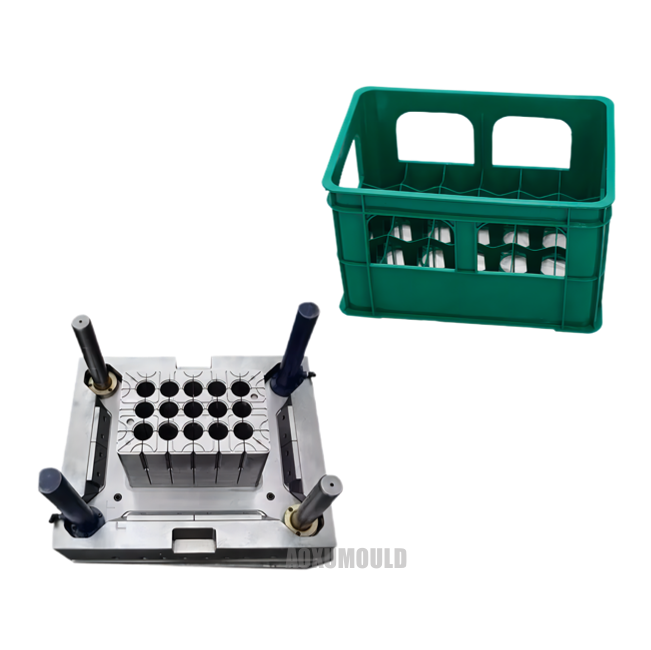
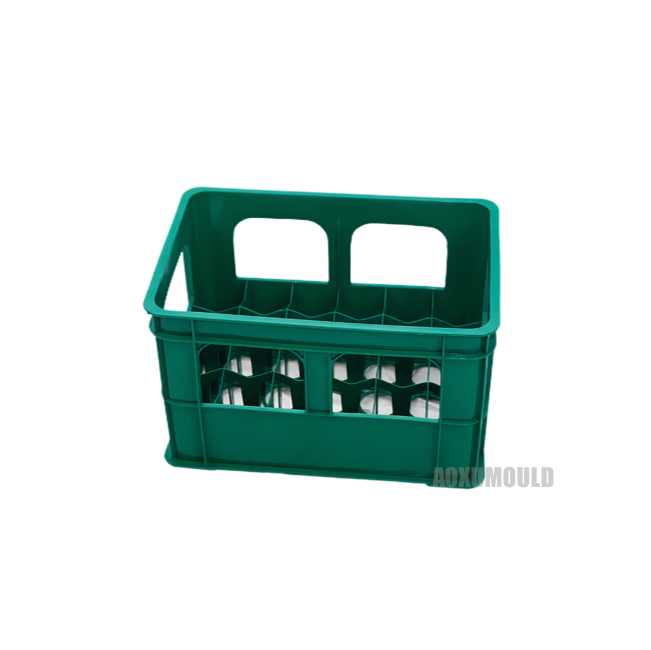
Mould Specifications
|
Mould name |
Plastic Bottle Crate Injection Mould |
|
Product material |
HDPE |
|
Product Size |
348X260X315mm |
|
Mould material for cavity &. Core |
P20/718H/H13/2738 |
|
NOs of cavity |
1 cavity |
|
Injection system |
Hot runner open gates |
|
Suitable injection machine |
450T |
|
Mould size |
580x520x560mm |
|
Mould lifetime |
more than 500,000pcs |
|
Delivery Time |
50 days |
The Design Details From Aoxu Mould

1.Overall reinforcement,
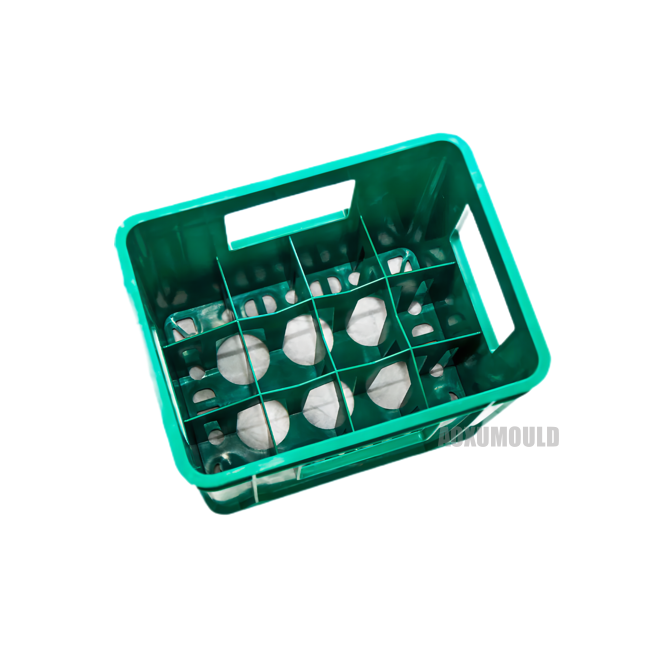
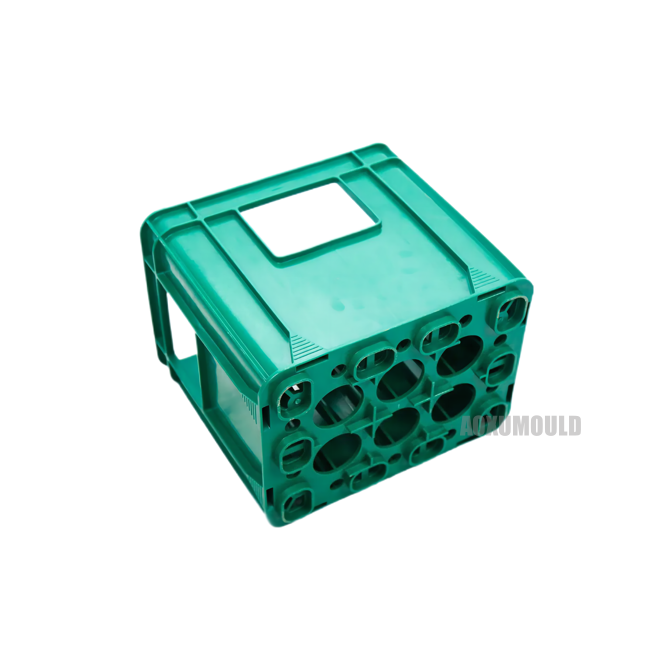
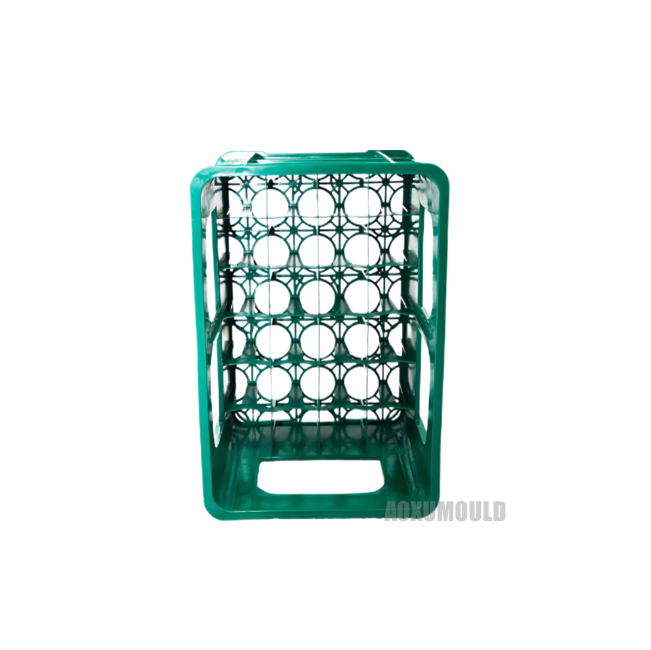
As is well known, plastic bottle crate need to carry a weight of 20-30 kilograms, so there must be sufficient reinforcement ribs on the box to make the overall structure stronger and have a huge load-bearing capacity.
2.Increase the wall thickness of the crate body
We believe that plastic bottle crate need to withstand a certain amount of force during the loading and unloading process. If the wall thickness is too thin, the box may break. Therefore, increasing the wall thickness of the box appropriately is beneficial to ensuring the quality of the plastic bottle crate .
3.Smooth edges
Thickened edge design, designed ergonomically to make workers more effortless during the loading and unloading process. Convenient without cutting hands.
Design For Product &. Mould

The Injection Mould For Bottle Crate Adopts Four Slide Core Pulling Mechanism
Bottle crate injection mould is a commonly used mould for producing plastic products such as bottle crate. The use of four slide core pulling mechanism is to better meet the needs of the product and improve production efficiency. Let's analyze in detail why the bottle crate injection mould adopts four slide core pulling mechanism.
Firstly, the four slider core pulling mechanism can achieve the molding of complex products. Bottle crate injection moulds usually require complex product shapes to be produced, requiring multiple core pulling actions to fully form. The use of a four slider core pulling mechanism can make the mould more flexible during the molding process, enabling multiple directions of core pulling actions to ensure the integrity and accuracy of product molding.
Secondly, the four slider core pulling mechanism can improve production efficiency. Injection moulds for bottle boxes generally require large-scale production, and the production cycle is relatively short, requiring fast and efficient completion of production tasks. The use of a four slider core pulling mechanism can reduce the number of mould changes, improve the production efficiency of moulds, reduce production costs, and thereby increase the competitiveness of enterprises.
Furthermore, the four slider core pulling mechanism can improve the quality and stability of the product. The bottle crate injection mould can better control the internal structure and size of the product through a four slide core pulling mechanism, ensuring the quality and stability of the product. Meanwhile, the four slider core pulling mechanism can reduce deformation or damage of the product during the molding process, improving product consistency and reliability.
Finally, the four slider core pulling mechanism can also increase the service life of the mould. Bottle box injection moulds usually require long-term continuous use. If the mould design is unreasonable or used improperly, it is easy to be damaged, which affects the production and quality of the product. The use of four slider core pulling mechanism can effectively reduce the wear and damage of the mould, extend the service life of the mould, and reduce maintenance and replacement costs.
How To Solve The Problem of Shrinkage Caused By Excessive Reinforcement Ribs In Bottle Crate Mould?
1.The injection mould for bottle crate is one of the important tools for manufacturing bottle crate, but there may be a problem of shrinkage caused by excessive reinforcement ribs during the production process. This kind of problem will bring difficulties to production, affecting efficiency and quality. To address this issue, we can take the following measures:
Optimize the design. When designing injection moulds for bottle boxes, it is necessary to design the number and position of reinforcement ribs reasonably to avoid excessive reinforcement ribs causing shrinkage problems. By optimizing the structure and materials of the mould, the stability and durability of the mould can be improved, and the occurrence rate of shrinkage problems can be reduced.
2. Adjust the injection molding process parameters. During the production process, the issue of mould shrinkage in bottle crate injection moulds can be reduced by adjusting parameters such as temperature, pressure, and speed of the injection molding machine. Ensure that the material is evenly filled during the injection molding process to avoid premature cooling and the occurrence of shrinkage problems.
3. Add cooling devices. Adding appropriate cooling devices in mould design can effectively control the temperature of the mould, reduce the impact of thermal stress on the mould, and thus reduce the occurrence of shrinkage problems.
The Entire Process of Quality Inspection For Bottle Crate Injection Mould

The manufacturing of bottle crate injection mould is a complex and precise process, and in order to ensure that the quality and performance of the moulds meet customer requirements, the quality inspection process is crucial. The following will introduce the entire quality inspection process in the manufacturing process of bottle crate injection moulds from several aspects:
Firstly, the quality inspection of raw material selection. Choosing high-quality raw materials is crucial in the process of mould manufacturing. The quality and lifespan of moulds often depend on the quality of raw materials. Therefore, quality inspectors need to conduct strict testing and inspection on raw materials to ensure that they comply with relevant standards and specifications.
Next is the quality inspection of the processing process. In the process of mould processing, quality inspectors need to monitor and inspect each processing step to ensure that the processing accuracy and quality meet the requirements. This includes quality inspections of machining, electrical discharge machining, wire cutting, and other processes.
The third is the quality inspection of assembly and combination. In the final stage of mould manufacturing, it is necessary to conduct quality inspection on the assembly and combination of the entire mould to ensure that the connection and fixation of each component meet the requirements, and to ensure the overall performance and quality of the mould.
The fourth is the quality inspection of trial molding and debugging. After completing the manufacturing of the mold, it is necessary to conduct trial molding and debugging to ensure that the mold can work properly and meet customer requirements. During the trial molding and debugging process, quality inspectors need to conduct a comprehensive inspection and testing of the performance, operability, and processing accuracy of the mould.
Finally, there is the quality inspection for final acceptance. After completing the trial mould and debugging, the mould needs to undergo final acceptance to ensure that its performance and quality meet the customer's requirements. Only after final acceptance and quality inspection can the mold be officially delivered to the customer for use.
Try-out of Bottle Crate Injection Mould
Mould Components
Mould Steel

Hot Runner System

Standard Parts

Package &. Delivery

FAQ
>1. What is bottle crate injection mould?
It is a tool used to produce plastic parts by injecting plastic into the mould cavity.
>2. What materials are used to make bottle crate mould?
The most common materials used to make injection moulds are high-quality steel, such as P20, 718, 2738, etc.
>3. What is the process of making a bottle crate mould ?
The process of making a mould includes design engineering, machine programming, tooling fabrication, mould testing and validation.
>4. Can moulds be customized to specific product requirements?
Yes, moulds can be customized to specific product requirements depending on the design and specifications of the project.
>5. What are some factors to consider when making our plastic moulds?
Some factors to consider when making plastic moulds include product design, plastic material selection, mould material selection, injection moulding machine capacity, cooling time, and mould maintenance requirements.
>6. How long does it take to make one set of mould?
The time it takes to make mould can vary depending on the complexity and size of the mould.
However, it usually takes between 6 and 8 weeks.
>7. What can be done to ensure the mould quality?
To ensure mould quality, proper design and engineering, high-quality materials, and strict quality control procedures should be employed during the entire process of making the mould.
>8. How long can a mould last?
The lifespan of a mould can vary depending on the quality of the mould, maintenance practices, and operating conditions. A well-maintained mould can last for hundreds of thousands of cycles.
>9. What are the benefits of making plastic injection moulds?
Some benefits of making plastic moulds include faster production times, lower costs per unit, high accuracy, and the ability to produce complex shapes and designs.
>10. Can our bottle crate mould be repaired and maintained?
Yes, it can be repaired and maintained to extend their lifespan. Regular maintenance can prevent breakdowns and ensure consistent quality.
Customers' Feedback


