

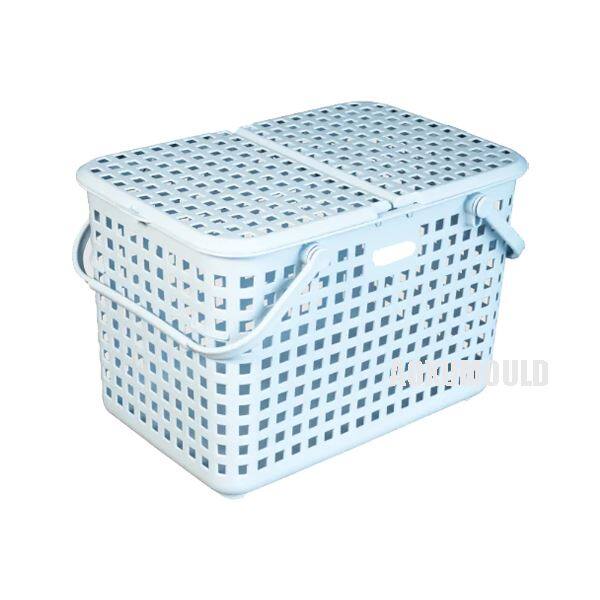
Mould Specifications
|
Mould name |
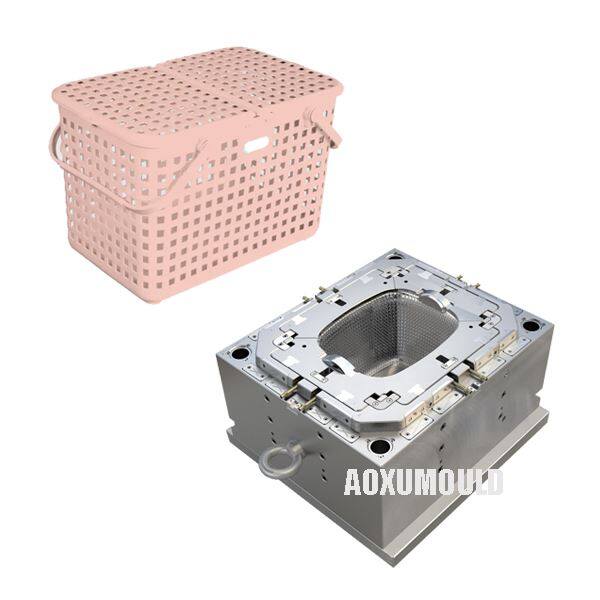
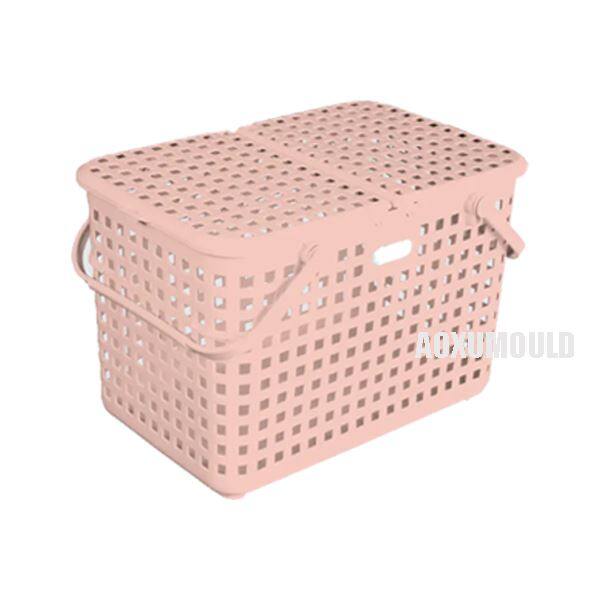
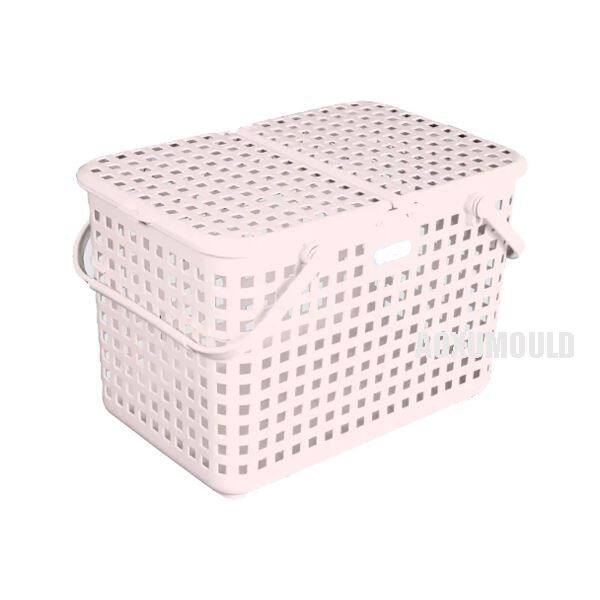
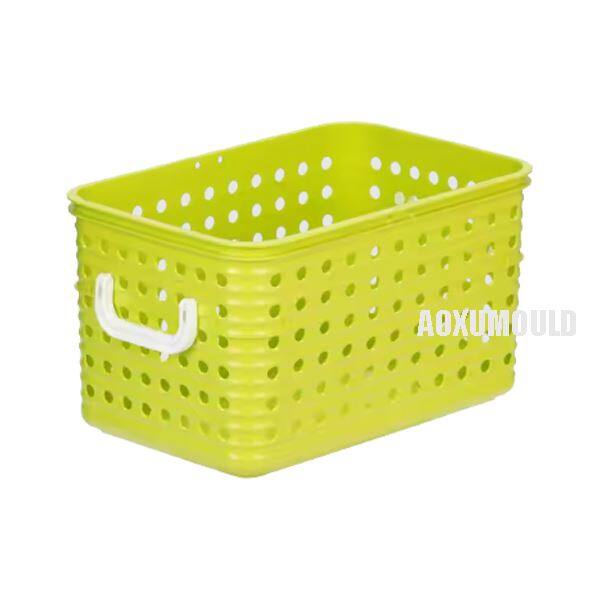
Plastic Storage Basket Mould |
|
Product material |
PP, plastic |
|
Product Size |
450X400X420mm |
| Product Weight | 1.5KG |
|
Mould material for cavity &. Core |
P20, 718, 2738 |
|
NOs of cavity |
1 cavity |
|
Injection system |
Hot runner 4 point gates |
|
Suitable injection machine |
650T |
|
Mould size |
850X800X860mm |
|
Mould lifetime |
more than 500,000pcs |
How Storage Baskets Are Molded?

1. Material Preparation
>Plastic Pellets Selection: Common materials include PP (Polypropylene), HDPE (High-Density Polyethylene), or ABS based on strength, flexibility, and cost requirements.
>Drying (if needed): Some plastics (like ABS) must be dried to remove moisture before molding.
>Color Mixing (optional): Masterbatch or liquid dyes can be added for colored baskets.
2. Injection Molding Machine Setup
>Clamping Unit: Holds the mold securely under high pressure.
>Injection Unit: Melts and injects plastic into the mould.
>Mould Installation: The storage basket mold (made of steel) is mounted onto the machine.
3. The Injection Molding Process Step-by-Step
Step 1: Mould Closing
The two halves of the mould (core & cavity) are clamped together under high pressure (typically 50–500 tons, depending on basket size).
Step 2: Plastic Melting & Injection
Plastic pellets are fed into a heated barrel (180–280°C, depending on material).
A reciprocating screw pushes molten plastic into the mold cavity at high pressure (500–1,500 bar).
Step 3: Cooling & Solidification
The plastic cools inside the mould (cooling time varies from 10–60 seconds).
Cooling channels in the mould help speed up the process.
Step 4: Mould Opening & Ejection
The mould opens, and ejector pins push the basket out.
For complex designs (like stackable baskets), stripper plates may assist ejection.
Step 5: Post-Processing (if needed)
Trimming: Excess plastic (flash) is removed.
Surface Treatment: Texturing, printing, or assembly (if the basket has a separate lid).
Does Storage Basket Moulds Require Hot Runner Molding?
Whether a storage basket mould requires a hot runner system depends on several key factors. Here's a concise professional analysis:
Recommendation:
For most storage basket production, cold runner systems are typically sufficient and more cost-effective. Hot runners are generally only justified for:
1. Very high-volume production (100,000+ units)
2. Premium-quality baskets requiring perfect gate aesthetics
3. Multi-cavity molds (4+ cavities) where material savings become significant
Technical Considerations:
1. Material Savings: Hot runners eliminate runner waste, but storage baskets often use inexpensive plastics (PP/HDPE) where material savings may not justify the added cost.
2. Part Quality: While hot runners provide better gate quality, storage baskets are functional products where minor gate marks are usually acceptable.
3. Mold Complexity: Storage basket molds are often large but relatively simple - cold runners are easier to maintain and repair.
4. Production Scale: The break-even point for hot runners typically occurs around 500,000 cycles - evaluate your production volume carefully.
For most manufacturers, a well-designed cold runner system with proper gating (preferably submarine gates or tunnel gates) offers the best balance of cost and performance for storage basket production. Hot runners should only be considered when the production volume clearly justifies the additional 30-50% mold cost increase.
Designs For Product &. Mould

How To Design The Structure Of The Storage Basket Mould?
1. Define Basket & Lid Requirements
>Before designing the mould, finalize the product specifications:
>Dimensions (length × width × height, including lid)
>Wall thickness (typically 2–3mm for strength and weight balance)
>Material (PP, HDPE, or ABS for flexibility and impact resistance)
>Load capacity (determines rib reinforcement needs)
>Lid attachment method (hinged, snap-fit, or separate)
2. Structural Design Considerations
A. Basket Body Design
>Base & Sidewalls:
Add ribs for reinforcement (if heavy loads are expected).
Include draft angles (1–2°) for easy ejection from the mould.
Ventilation holes (if needed for airflow) should be evenly spaced.
>Stackability Feature: Design interlocking rims at the top/bottom for stable stacking.
>Handles: Integrated handles (moulded as part of the basket) or cut-out grips.
B. Lid Design
>Hinged Lid vs. Snap-On Lid: Hinged (living hinge): Requires a thin, flexible section (usually PP).
>Snap-fit lid: Needs precise undercuts and tolerances for a secure fit.
>Lid Reinforcement:
Add ribs to prevent warping.
Ensure flat sealing surface if airtight storage is needed.
>Handle or Grips: A moulded handle or finger grooves for easy opening.
3. Mould Design Considerations
A. Parting Line & Core/Cavity
The parting line should minimize visible seams (usually along the basket's top edge).
Core & cavity inserts must align precisely to avoid flash (excess plastic).
B. Ejection System
Ejector pins should push the basket out without marks on visible surfaces.
For deep baskets, stripper plates may be needed for smooth ejection.
C. Undercuts (for Snap-Fit Lids)
Side actions (sliders) or collapsible cores may be required for snap-fit features.
If using a living hinge, ensure proper cooling to avoid weak spots.
D. Cooling System
Conformal cooling channels help reduce cycle time and warping.
Critical for uniform cooling, especially around thick sections (handles, ribs).
E. Venting
Proper venting prevents air traps (burn marks) in deep sections
Mould Components
Mould Steel

Hot Runner System

Standard Parts

How To Select The Mould Steel Type Of Storage Basket Mould?

1.For most manufacturers: 718H (1.2738) offers the best balance of cost and performance for typical storage basket production.
When cost is primary concern: P20 provides adequate performance for smaller production runs.
2.For maximum durability: H13 is recommended when producing over 500,000 units or using glass-filled materials.
Special considerations:
3.For corrosion resistance (food-grade applications): Consider stainless steel options
4.For textured surfaces: 718H provides excellent results
5.For high-gloss finishes: Higher hardness steels like H13 or S136
Package &. Delivery

FAQ
>1. Can you customize the size and shape of the storage basket mould according to our requirements?
Yes, we can customize the size, shape, and design of the storage basket mould to meet your specific requirements.
>2. What materials do you use to manufacture the storage basket mould?
Mould Base: Hardened steel (P20, 718, H13)
Plastic Material Options: PP, HDPE, ABS, or PS (depending on basket requirements).
>3. How long does it take to manufacture a storage basket mould?
The manufacturing time for a storage basket mould can vary depending on the complexity and size of the mould. Typically it will take 45-55days. However, we strive to deliver the mould in a timely manner.
>4. Do you provide sample baskets before mass production?
Yes, we offer T1 samples (first trial samples) for approval before full production.
Q: Do you offer after-sales support for the storage basket mould?
>5. What are the payment terms?
TT, 40% deposit, 30% to be paid before sending sample, 30% balance before mould delivery.
>6. Do you offer after-sales support for the storage basket mould?
Yes, we provide after-sales support to address any issues or concerns you may have with the storage basket mould.
>7. Can you assist with the installation and maintenance of the storage basket mould?
A: Yes, we can provide assistance with the installation and maintenance of the storage basket mould to ensure optimal performance.
>8. How do you ensure mould quality?
Precision machining (CNC, EDM, grinding)
Mould flow analysis (to prevent defects like warping/sink marks)
Quality inspections (dimensional checks, trial runs)
Customers' Feedback


