

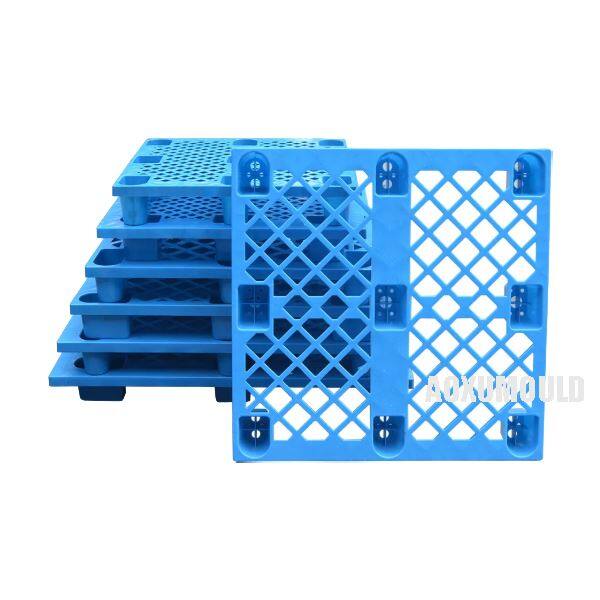
Mould Specifications
|
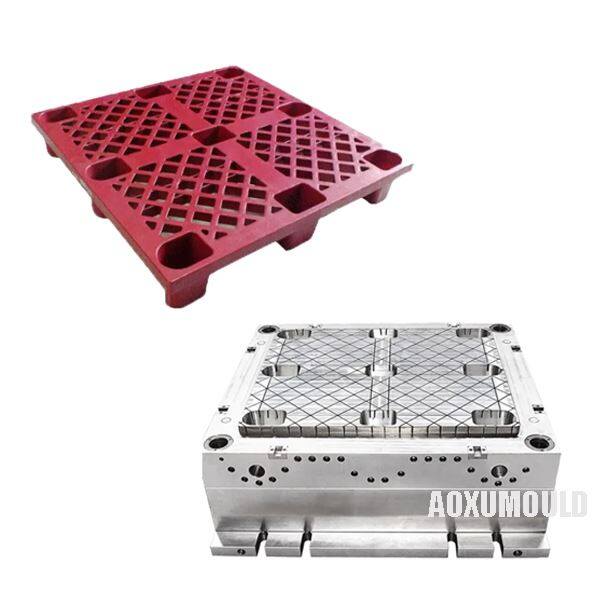
Mould name |
Nestable Pallet Mould |
|
Product material |
HDPE, plastic |
|
Product Size |
1200X1200X140mm |
| Product weight |
7 kgs |
|
Mould material for cavity &. Core |
P20 |
|
Mould base |
C45 |
|
Injection system |
Hot runner |
|
Suitable injection machine |
2800T |
|
Mould size |
2000X2000X880mm |
|
Mould lifetime |
more than 300,000pcs |
Pallet Display

1. Top Deck (Load Surface)
>Material: High-Density Polyethylene (HDPE) or Polypropylene (PP).
>Design Features:
Anti-slip texture (ribbed, diamond, or grit pattern) to prevent shifting.
Reinforced ribs underneath for added strength.
Smooth edges to prevent product damage.
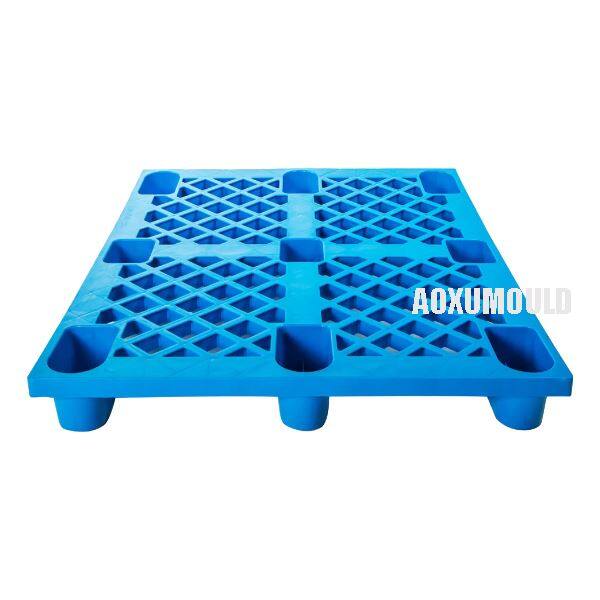
2. Nine Support Legs
>Function: Distributes weight evenly and allows forklift access from 4 sides.
>Leg Design:
Hollow or reinforced (for strength-to-weight optimization).
Tapered or straight (depending on stacking/nesting needs).
Feet may have anti-slip pads for stability on conveyors.
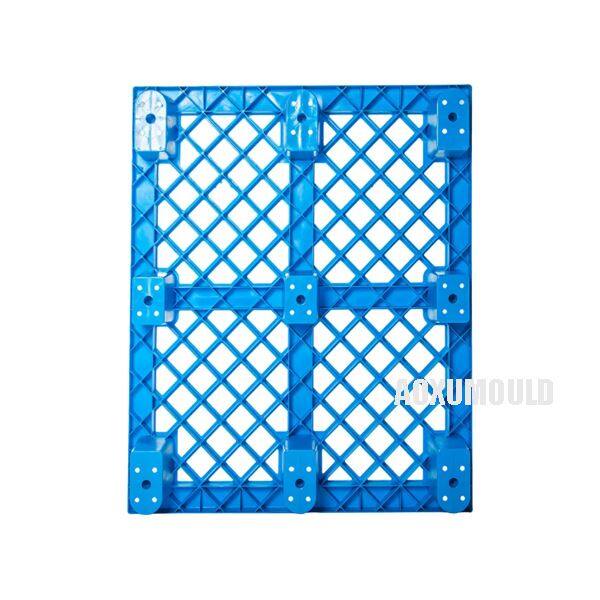
3. Bottom Deck (Support Grid)
>Purpose: Connects legs and adds rigidity.
>Design Variations:
Open grid (lighter, better for drainage).
Solid base (higher durability, but heavier).
4. Forklift Entry Points
>4-way entry (accessible from all sides).
>Height clearance optimized for standard forklifts.
Why Use Plastic Pallets Instead of Steel Pallets?

1. Weight & Handling Efficiency
>Plastic Pallets:
50-70% lighter than steel pallets (e.g., 15-25 kg vs. 50-100 kg).
Easier for manual handling, forklifts, and automated systems (AGVs/robots).
Reduces shipping costs (lower fuel consumption).
>Steel Pallets:
Heavy, requiring heavy-duty forklifts.
Higher freight costs due to weight.
2. Corrosion & Hygiene
>Plastic Pallets:
Rust-proof – Ideal for food, pharma, and chemical industries.
Easy to clean & sanitize (smooth surfaces, no cracks).
FDA/USDA compliant (no contamination risk).
>Steel Pallets:
Prone to rust (requires galvanizing or coatings).
Hard to clean (traps dirt in joints).
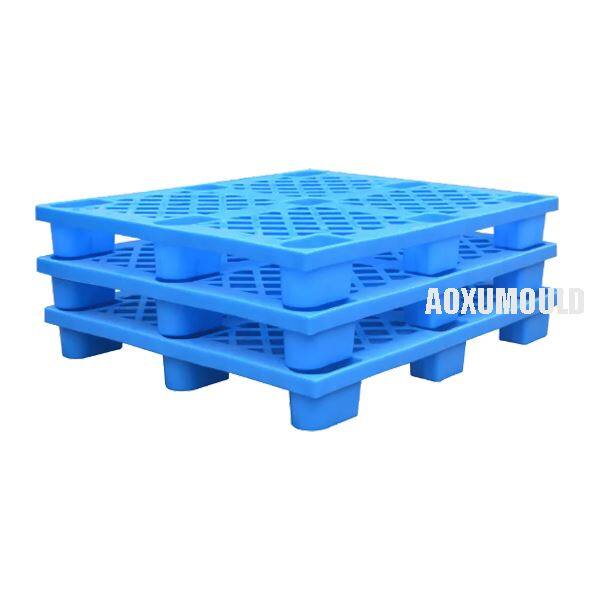
3. Nestability & Space Savings
>Plastic Pallets (Nestable):
Stack up to 70-80% smaller when empty.
Saves warehouse & return logistics costs.
>Steel Pallets:
Cannot nest, taking up full space even when empty.
4. Cost Efficiency
>Plastic Pallets:
Lower upfront cost than steel (unless ultra-heavy-duty).
Long lifespan (5-10 years with proper use).
No maintenance (steel pallets need repainting/rust treatment).
>Steel Pallets:
Higher initial cost (especially stainless steel).
Maintenance expenses (rust prevention, welding repairs).
5. Sustainability
>Plastic Pallets:
Recyclable (HDPE/PP) – Can be ground and reused.
Lightweight = lower carbon footprint in transport.
>Steel Pallets:
Recyclable but energy-intensive to produce.
Heavy = higher transport emissions.
Process of Nestable Pallet Mould Manufacturing
1. Design & Engineering
3D CAD Modeling–Engineers create a detailed design using CAD software, optimizing the pallet's nesting ratio, load capacity, and structural integrity.
Structural Analysis–Finite Element Analysis (FEA) tests stress points to ensure the pallet can handle intended loads.
Mould Flow Simulation–Software predicts plastic flow, cooling rates, and potential defects before manufacturing begins.
2. Material Selection for the Mould
Mould Base: Typically made from pre-hardened steel (P20, 718) or hardened steel (H13, S136) for durability.
Cavity & Core Inserts: High-grade steel or beryllium copper for heat dissipation.
Surface Treatment: Optional coatings (e.g., nitriding, chrome plating) to enhance wear resistance.
3. CNC Machining & EDM
CNC Milling–High-precision machines carve the mould components from steel blocks.
Electrical Discharge Machining (EDM) – Used for intricate details and fine finishes.
Grinding & Polishing–Ensures smooth surfaces to prevent plastic sticking and improve ejection.
4. Mould Assembly & Fitting
Core & Cavity Alignment–Components are assembled with tight tolerances (±0.02mm).
Ejection System Setup–Ejector pins, sliders, and lifters are installed for smooth demolding.
Cooling Channels Integration–Ensures uniform cooling to prevent warping.
5. Trial Testing (T1 Sample)
Injection Molding Test–A prototype pallet is produced to check:
Dimensional accuracy (nesting fit, thickness, weight).
Structural strength (load-bearing test).
Surface finish & defects (sink marks, flash, warpage).
Adjustments–If needed, the mould is fine-tuned (e.g., gate size, cooling rate).
After sample confirming, we will paint and packing the moulds to delivery.
Try-out Of Nestable Pallet Mould
Designs For Product &. Mould

Package &. Delivery

Mould Components
Mould Steel

Hot Runner System

Standard Parts

What Hot Runner Brand will you use?
1. HASCO (Germany) – Best for Standardization & Reliability Widely used in Europe, known for durability. Standardized components (easy maintenance & replacement). Good for medium-to-large pallets (balanced cost-performance). 2. YUDO (Korea) – Cost-Effective & High Performance Popular in Asia, competitive pricing. Excellent thermal control (reduces drooling & stringing). Suitable for HDPE/PP (common pallet materials). 3. Husky (Canada/USA) – Premium for High-Volume Production Top-tier for large pallet moulds (handles high shot weights). Ultra-durable nozzles & manifolds (long lifespan). Best for automated production lines. INCOE (USA) – Heavy-Duty & Custom Solutions Specializes in large-part molding (ideal for pallets). Robust thermal management (prevents material degradation). Customizable for complex pallet designs. Muld Masters (Canada) – Precision & Energy Efficiency Advanced temperature control (reduces cycle time). Good for multi-cavity pallet moulds. Low energy consumption (cost-saving for mass production). Chinese Hot Runner Reliable for HDPE/PP molding (common pallet materials) Competitive pricing |
FAQ
>1. What is a nestable pallet?
A nestable pallet is a space-saving plastic pallet designed to stack inside another when empty, reducing storage and transport costs by up to 70-80% compared to traditional pallets.
2. What materials are used for nestable pallets?
Most nestable pallets are made from:
HDPE (High-Density Polyethylene)–Durable, chemical-resistant, and lightweight.
PP (Polypropylene)–Good impact resistance, ideal for heavy loads.
Reinforced plastics–For added strength in high-load applications.
>3. Can you customize the design and size of nestable plastic products?
Yes, we offer custom design and size options for our nestable plastic products to meet the specific needs and requirements of our customers.
>4. What is the lead time for ordering plastic nestable products?
The lead time for ordering plastic nestable products may vary depending on the quantity and complexity of the order. Typically 55-65days.
>5. How do I maintain the pallet mould?
Regular cleaning and lubrication.
Avoid overheating during production.
Periodic inspection by our engineers.
>6. Do you offer international shipping for your plastic nestable products?
Yes, we offer international shipping for our plastic nestable products to customers around the world. Please contact us for more information on shipping options and costs.
>7. How do I request a quote?
Please contact us with:
Pallet dimensions & load requirements.
Material preference (HDPE, PP, etc.).
Mould Steel type (P20, 718, S136, etc.).
Customers' Feedback


