

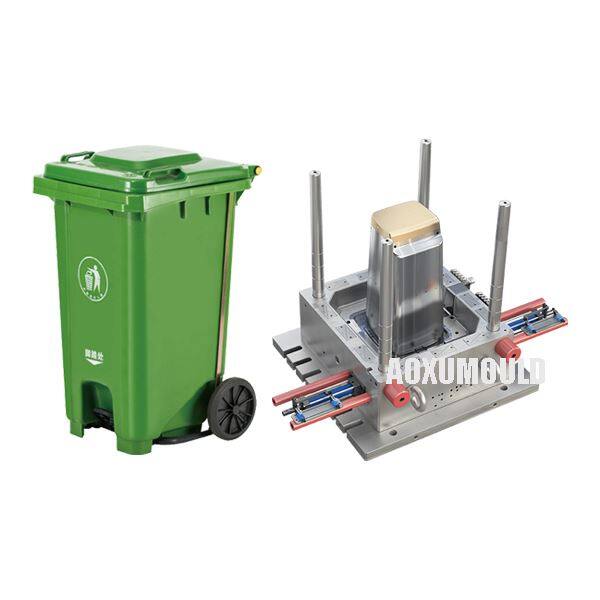
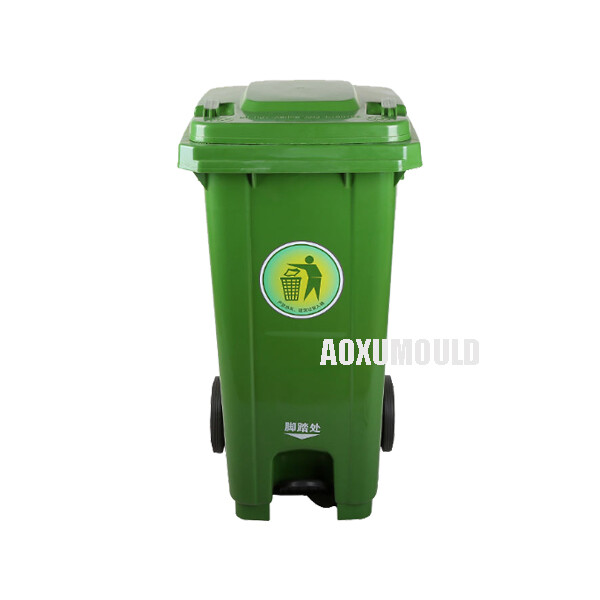
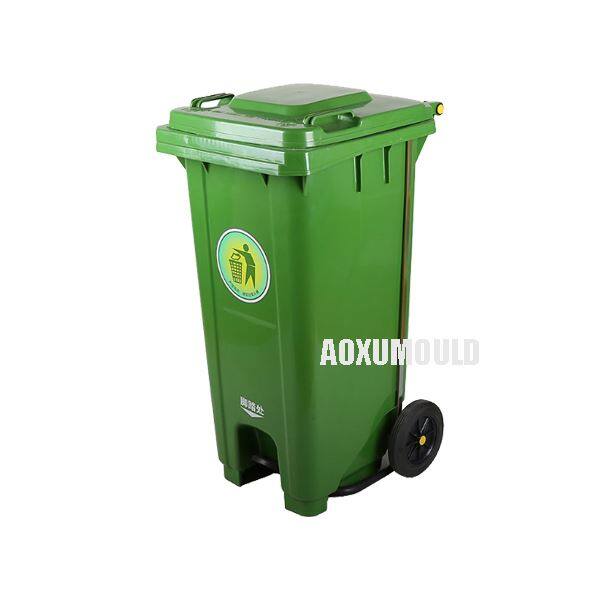
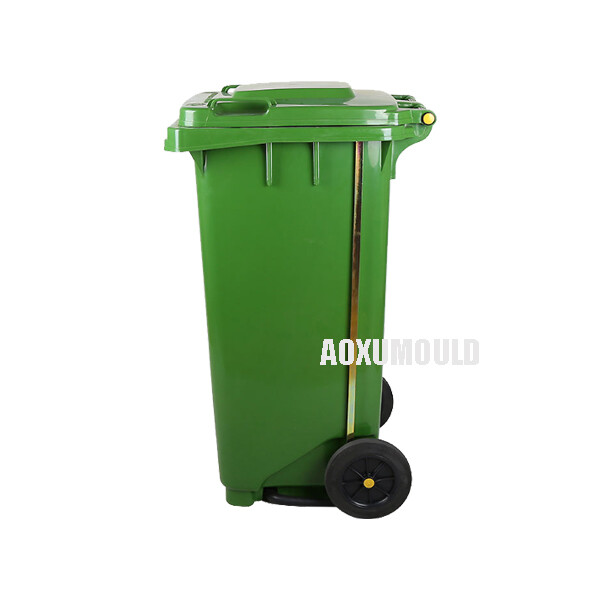
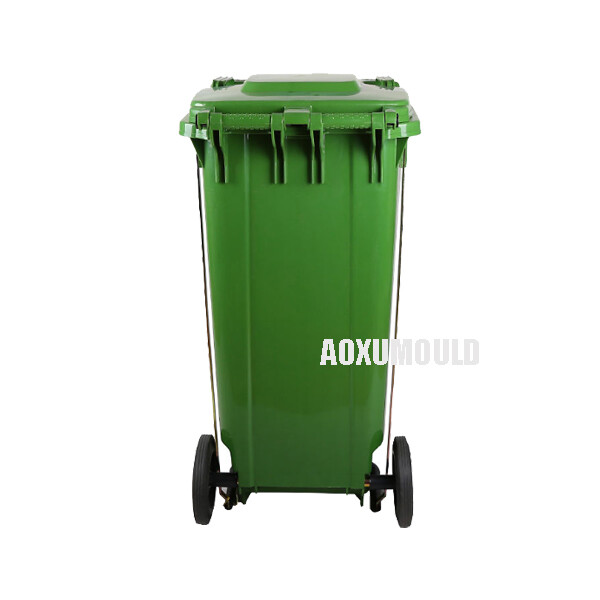
Mould Specifications
|
Mould name |
120L Wheelie Bin Mold |
|
Product material |
HDPE, plastic |
|
Product Size |
555X476X957mm |
| Product weight | 11kg |
|
Mould material for cavity &. Core |
P20, 718, 2738 |
|
NOs of cavity |
1 cavity |
|
Injection system |
Cold runner/HOT RUNNER |
|
Suitable injection machine |
1600T |
|
Mould size |
800X750X1200mm |
|
Mould lifetime |
more than 500,000pcs |
|
T1 Time |
After design is finalized, 55 days |
Product Features of A 120L Wheelie Bin

1. Robust Construction & Material
Material: Made from high-density polyethylene (HDPE) or polypropylene (PP) for impact resistance, UV stability, and weatherproofing.
Reinforced Walls: Ribbed or corrugated design for extra strength.
Thick Base: Heavy-duty bottom to withstand rough handling and heavy loads.
2. Functional Design
Capacity: 120 liters (ideal for households, small businesses, or public spaces).
Ergonomic Handle: Comfortable grip for easy tilting and maneuvering.
Lid Options:
-Hinged lid (self-closing to prevent spills and odors).
-Snap-on lid (removable for easy cleaning).
-Optional lockable lids for security.
Wheels & Axle System:
-Two heavy-duty wheels (often 200-300mm diameter) for smooth rolling.
-Rust-proof metal or reinforced plastic axle for longevity.
3. User-Friendly Features
Tipping Mechanism: Balanced design for easy emptying into garbage trucks.
Smooth Rolling: Sturdy wheels work on pavements, gravel, and uneven surfaces.
Stackable Design (for storage and transport when empty).
4. Safety & Hygiene
Animal-Resistant: Secure lids prevent pests and stray animals from accessing waste.
Leak-Proof: Prevents liquid waste from seeping out.
Easy to Clean: Smooth inner surfaces resist dirt buildup.
5. Durability & Longevity
UV-Stabilized: Resists fading and brittleness from sun exposure.
Chemical-Resistant: Handles household and mild industrial waste safely.
Temperature Tolerance: Performs in -30°C to +60°C conditions.
Designs For Product &. Mold

Why Moldflow Analysis is Necessary for 120L Wheelie Bin Injection Molds?
Moldflow simulation is a critical step in designing and manufacturing high-quality 120L wheelie bin injection molds. Here's why it's indispensable:
1. Predicts & Prevents Defects Before Production
Moldflow identifies potential flaws in the mold design, such as:
-Warping – Due to uneven cooling or material shrinkage.
-Sink Marks – Caused by insufficient packing in thick sections (e.g., handles, base).
-Air Traps & Burn Marks – Reveals where air gets trapped, leading to incomplete filling.
-Short Shots – Ensures plastic fills the entire mold cavity.
→ Saves costly mold modifications later!
2. Optimizes Plastic Flow & Gate Positioning
-Simulates how molten plastic fills the mold, helping determine:
Best gate locations (to avoid weak spots).
Number of gates needed (single vs. multi-gate systems).
Flow balance (preventing uneven filling).
-Ensures consistent wall thickness, reducing material waste.
→ Improves bin structural integrity & surface finish.
3. Enhances Cooling Efficiency
-Models cooling channel performance to:
Reduce cycle time (faster production = lower costs).
Prevent hot spots that cause warping.
-Helps design conformal cooling (follows bin shape for uniform cooling).
→ Increases mold lifespan & productivity.
4. Validates Material Selection
-Tests how different plastics (HDPE, PP, recycled content) behave under molding conditions.
-Predicts shrinkage rates (critical for tight-tolerance parts like axle mounts).
→ Ensures the final bin meets durability & dimensional requirements.
5. Saves Time & Money
-Reduces trial-and-error in mold testing (fewer T1 revisions).
-Avoids costly mold rework (steel changes are expensive!).
-Shortens time-to-market by catching issues early.
→ A one-time simulation investment pays off in long-term efficiency.
How to Make A Quality 120L Wheelie Bin Injection Mold?

1. Design & Engineering
(1) Customer Requirements Analysis
Confirm bin dimensions, capacity (120L), material (HDPE/PP), lid type (hinged/snap-on), and special features (handles, wheels, branding).
Review samples, drawings, or CAD files to avoid miscommunication.
(2) 3D Modeling & Simulation
Use CAD software (SolidWorks, UG NX, or Pro/E) to design the mold structure.
Conduct Moldflow analysis to predict:
Plastic flow & cooling efficiency
Potential defects (warping, sink marks)
Optimal gate locations
(3) Finalize Mold Design
Choose two-plate or three-plate mold structure (based on complexity).
Design ejector system, cooling channels, and venting slots.
2. Material Selection
(1) Mold Steel Selection
|
Component |
Recommended Steel |
Hardness (HRC) |
Purpose |
|
Core & Cavity |
P20, 718H, NAK80 |
30-36 HRC |
Balance cost & durability |
|
High-Wear Areas |
H13, S136 |
48-52 HRC |
Long lifespan (>1M shots) |
|
Ejector Pins |
SKD61 |
50-54 HRC |
Resist wear |
(2) Plastic Material
HDPE (High-Density Polyethylene) – Most common (durable, UV-resistant).
PP (Polypropylene) – Good for recycling bins.
Regrind Compatibility – Up to 30% recycled content possible.
3. CNC Machining & Mold Fabrication
(1) Rough Machining
Use CNC milling to shape the mold blocks.
Leave 0.2-0.5mm allowance for finishing.
(2) Heat Treatment (If Required)
Hardening & Tempering (for H13/S136 steel) to increase wear resistance.
(3) Precision Machining
EDM (Electrical Discharge Machining) – For intricate details (logos, ribs).
CNC Grinding/Polishing – Achieve smooth surface finish (Ra ≤ 0.8μm).
(4) Cooling System Installation
Drill conformal cooling channels for uniform temperature control.
Add baffles & bubblers in thick sections.
4. Assembly & Testing
(1) Mold Assembly
Fit core, cavity, ejector pins, sliders, and cooling system.
Ensure smooth movement of all components.
(2) Trial Production (T1 Test)
Inject plastic into the mold to check:
Dimensional accuracy (measure bin with calipers).
Surface finish (no flow marks or defects).
Ejection & cooling performance.
(3) Adjustments (If Needed)
Modify gate size, cooling rate, or ejection system if issues arise.
5. Mass Production & Quality Control
(1) Injection Molding Process
Machine Requirements:
Clamping force: 800–1500 tons
Cycle time: 60–120 seconds
Process Parameters:
Melt temperature: 200–260°C (HDPE/PP)
Injection pressure: 80–120 MPa
(2) Quality Checks
Weight & Wall Thickness – Ensure consistency.
Load Testing – Verify durability (simulate heavy waste loads).
Wheel & Lid Function Test – Smooth rolling and secure closure.
6. Packaging & Delivery
Wooden crate packaging for safe shipping.
Provide mold maintenance manual (cleaning, lubrication, storage tips).
Mould Components
Mould Steel

Hot Runner System

Standard Parts

Package &. Delivery

Customers' Feedback

Why We Ask Customers to Provide Samples or Drawings for 120L Wheelie Bin?
When manufacturing a 120L wheelie bin injection mold, we typically request customers to provide existing samples, technical drawings, or CAD designs before production begins. Here's why this step is crucial:
1. Ensures Accurate Design & Functionality
Avoids Misinterpretation – A physical sample or detailed drawing helps us understand:
Exact dimensions (height, width, thickness).
Structural features (ribs, handles, wheel mounts).
Lid mechanism (hinged, snap-on, or lockable).
Prevents Costly Errors – Guessing specifications risks producing a mold that doesn't fit your needs.
2. Confirms Material & Wall Thickness
Plastic Behavior – Different materials (HDPE, PP, recycled plastic) shrink at varying rates; samples help adjust mold tolerances.
Wall Thickness Consistency – Ensures durability without sink marks or warping.
3. Customization & Branding Requirements
Logos/Text Embossing – If you need branding, samples/drawings show exact placement and depth.
Color Matching – A sample helps replicate the exact shade if needed.
4. Compliance with Industry Standards
Waste Management Regulations – Some regions (EU, US, etc.) have specific bin design rules (e.g., EN 840, ANSI Z245).
Ergonomics & Safety – Handles, wheels, and tipping mechanisms must meet usability standards.
5. Faster & More Cost-Effective Mold Development
Reduces Back-and-Forth – Modifying a mold mid-production is expensive; clear references streamline the process.
Optimizes Production – Knowing exact specs helps us recommend the best steel grade and cooling system.
-What If You Don't Have a Sample or Drawing?
No problem! We can:
Provide Standard Designs – Use our existing 120L bin molds (customizable).
Reverse Engineer – If you have a similar bin, we can measure and replicate it.
Collaborate on New Designs – Our engineers can create CAD models based on your requirements.
FAQ
>1. What materials are used to make the 120L wheelie bin mold?
The mold is typically made from high-grade steel such as:
-P20, 718, NAK80 (for standard production)
-H13, S136, Stainless Steel (for high-wear resistance and long lifespan)
Hardened & polished surfaces to prevent corrosion and extend durability.
>2. What plastic materials can be used with this mold?
The mold is designed for:
-HDPE (High-Density Polyethylene)–Most common (durable, UV-resistant).
-PP (Polypropylene)–Good for recycling bins.
-Recycled plastics (up to 30% regrind possible).
>3. Can the mold produce different bin colors?
Yes, the mold can switch between colors (HDPE/PP accepts pigments well).
No color change needed if using pre-colored plastic pellets.
>4. Can I add my company logo or custom text?
Yes, logos/text can be engraved or embossed into the mold.
>5. Can the mold be adjusted for different lid types?
Yes, options include:
-Hinged lid (self-closing).
-Snap-on lid (removable).
-Lockable lid (security feature).
>6. Do you offer mold trial services?
Yes, most manufacturers provide T1 sample testing before mass production.
>7. How do I maintain the mold for long life?
Regular cleaning (remove plastic residues).
Lubrication of moving parts (ejector pins, slides).
Storage in dry conditions to prevent rust.


