

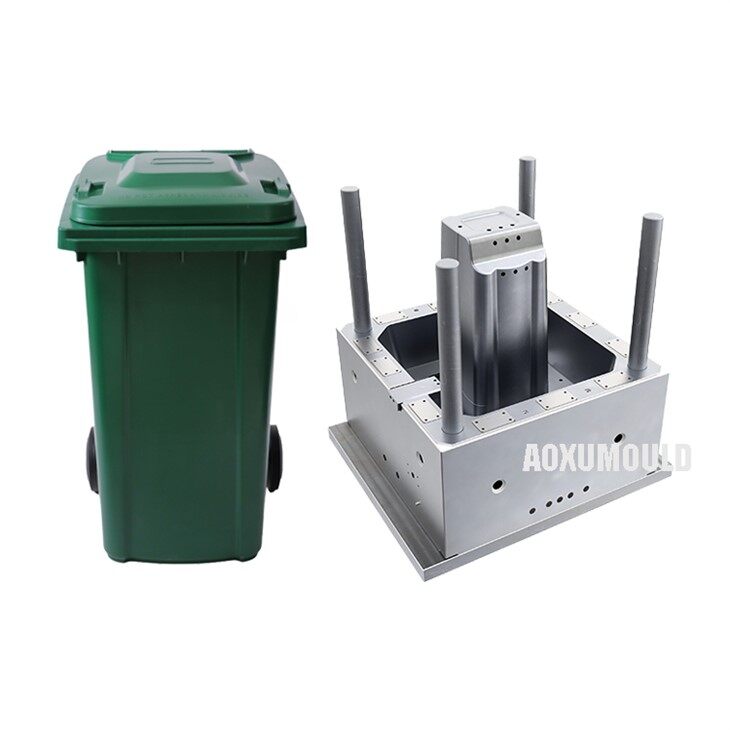
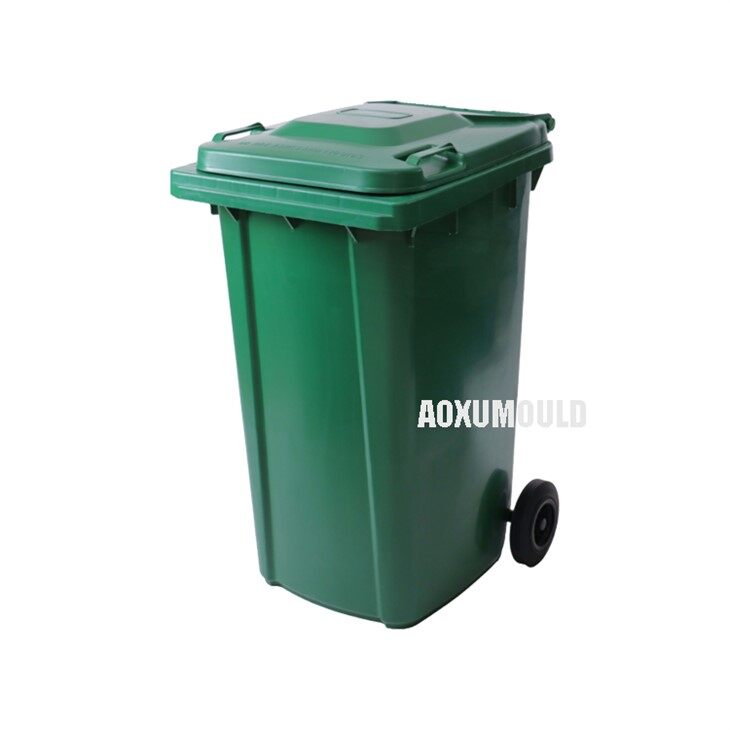
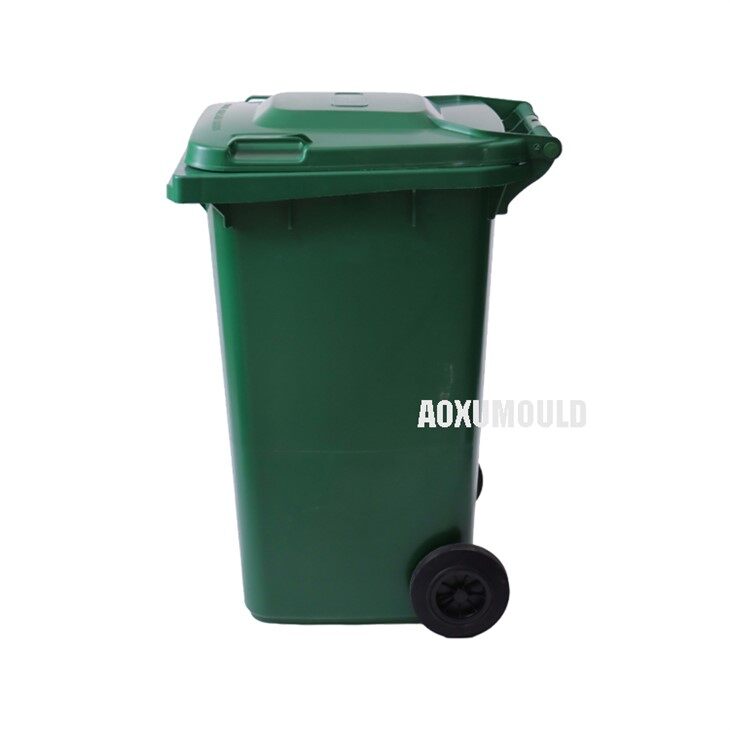
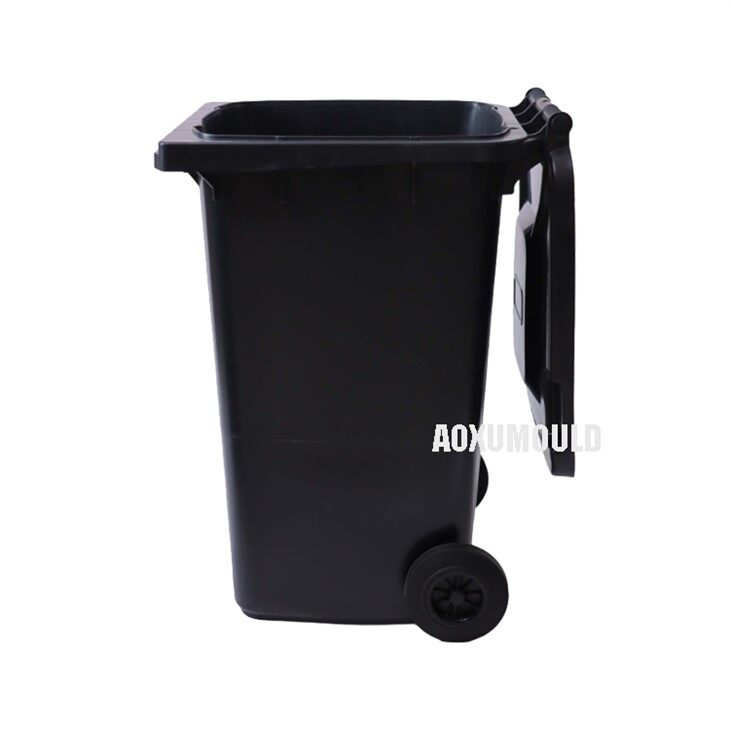
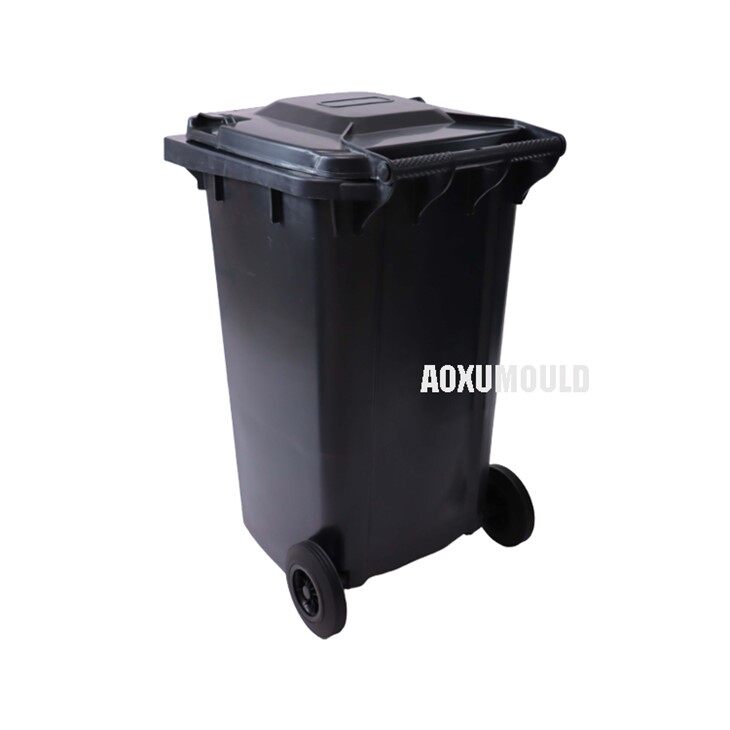
Mould Specifications
|
Mould name |
Commercial Trash Can Mold |
|
Product material |
HDPE, plastic |
|
Product Size |
585X660X990mm |
| Product weight | 13kg |
|
Mould material for cavity &. Core |
P20, 718, 2738 |
|
NOs of cavity |
1 cavity |
|
Injection system |
Cold runner |
|
Suitable injection machine |
1600T |
|
Mould size |
800X880X1250mm |
|
Mould lifetime |
more than 500,000pcs |
|
T1 Time |
After design is finalized, 55 days |
What Types of Commercial Trash Can Molds Do You Produce?

>1. By Design & Mechanism
A. Standard Open-Top Trash Cans
Molds for simple, no-lid bins (commonly used in offices, parks).
Reinforced bases for stability.
B. Pedal-Operated Trash Cans
Molds with integrated pedal mechanisms (hands-free operation).
Durable hinge systems for smooth lid movement.
C. Touchless/Sensor Lid Trash Cans
Molds compatible with IR sensor components (cutouts for electronics).
Precision-fit lids to prevent misalignment.
D. Swing Lid Trash Cans
Self-closing hinge molds (for kitchens, medical facilities).
E. Wheeled Trash Cans (Roll Carts)
Heavy-duty molds with wheel mounts (for 30–360L bins).
Ergonomic handles for municipal/industrial use.
>2. By Capacity & Size
Small (10–30L): Desk-side bins, hotel rooms.
Medium (30–240L): Office/restaurant bins.
Large (240–1100L): Industrial roll carts, curbside trash bins.
>3. By Industry-Specific Needs
A. Healthcare & Medical Waste Bins
Sharps containers (puncture-resistant molds).
Biohazard bins (red/yellow plastic, leak-proof designs).
B. Food Service & Hospitality
Grease-resistant molds (for kitchen waste).
Compost bins (vented lids, often green/brown).
C. Municipal & Public Space Bins
Vandal-proof molds (thick walls, tamper-proof lids).
Solar-powered compacting bins (for high-capacity needs).
D. Industrial/Manufacturing
Chemical-resistant molds (for hazardous waste).
Stackable/nesting designs (to save space).
>4. By Material & Finish
HDPE/PP Molds: For lightweight, impact-resistant bins.
ABS Molds: For glossy, UV-resistant outdoor bins.
Anti-bacterial surfaces: For hospitals/labs.
Custom textures: Matte, granulated, or branded finishes.
Common Steel Type for Trash Can Molds
1. P20 Steel (1.2311/1.2738)
Hardness: 28-32 HRC (pre-hardened)
-Best For:
Medium-volume production (100,000–300,000 cycles)
Cost-effective molds for standard HDPE/PP trash cans
-Pros:
Easy to machine (no post-hardening needed)
Good polishability for smooth bin surfaces
-Cons: Less wear-resistant than high-grade steels
2. 718H Steel (1.2738H Modified)
Hardness: 32-36 HRC (pre-hardened)
-Best For:
Large trash can molds (better toughness than P20)
Multi-cavity molds requiring dimensional stability
-Pros:
Uniform hardness (minimal distortion during machining)
Good weldability for repairs
-Cons: Slightly more expensive than P20
3. H13 Steel (1.2344)
Hardness: 48-52 HRC (after heat treatment)
-Best For:
High-volume production (500,000+ cycles)
Large trash cans with thick walls or complex geometries
-Pros:
Excellent thermal fatigue resistance (handles repeated heating/cooling)
Retains hardness at high temps (ideal for fast cycling)
-Cons: Requires heat treatment (higher cost)
S136/420 Stainless Steel (1.2083/1.4021)
Hardness: 48-52 HRC
-Best For:
Corrosion-resistant molds (e.g., for PVC or flame-retardant plastics)
Medical/food-grade bins requiring ultra-smooth surfaces
-Pros:
Mirror polish capability (SPI-A1 finish)
Resists acid/plastic additives
-Cons: Higher cost than P20/H13
How to Manufacture A Commercial Trash Can Mold?

>Step 1: Design & Engineering
Define Requirements
Trash can size (e.g., 30L, 50L, 100L), wall thickness (typically 3–5mm), and material (HDPE/PP/ABS).
Functional features (pedal lid, wheels, sensors, handles).
Surface finish (smooth, textured, anti-slip).
3D Modeling & DFM (Design for Manufacturing) Analysis
Use CAD software (SolidWorks, AutoCAD) to create mold designs.
Optimize for draft angles (1–3° for easy ejection), uniform wall thickness, and rib reinforcement.
Simulate mold flow analysis (using Moldflow) to prevent defects like warping or sink marks.
>Step 2: Mold Material Selection
Choose based on production volume:
High-Volume (100,000+ units): Hardened steel (P20, H13, 718).
Prototyping/Low-Volume: Aluminum (faster, cheaper).
Critical Components: Beryllium copper (for heat dissipation).
>Step 3: CNC Machining & Mold Fabrication
Core & Cavity Machining
Use CNC milling, EDM (Electrical Discharge Machining), or wire cutting to carve mold components.
Polish surfaces to SPI-A1 (mirror finish) or textured finishes (e.g., VDI 3400 for grit patterns).
Ejection System
Add ejector pins, sliders, or lifters for part release.
Design cooling channels (to reduce cycle time).
Assembly & Fitting
Assemble core/cavity plates, guide pillars, and ejector boxes.
Test for alignment tolerance (±0.05mm).
>Step 4: Trial (T1) & Testing
First-Shot Samples
Inject plastic (e.g., HDPE) to check for:
Dimensional accuracy (measure with CMM).
Surface defects (sink marks, flash, warping).
Functionality (lid fit, wheel movement).
Adjustments
Modify mold (e.g., adjust gate size, cooling rate) if needed.
>Step 5: Mass Production
Injection Molding Process
Machine Setup: Use 150–2000T clamping force machines (for large bins).
Cycle Time: 30–90 seconds (depends on size/material).
Quality Checks: Weight, wall thickness, drop tests.
Post-Processing
Deburring, drilling holes (for wheels/handles).
Printing/Embossing (logos, labels).
Try-out Video of Injection Trash Can Mold
How to Request a Quote for a Commercial Trash Can Mold?

Kimdly Provide Essential Details, to get an accurate quote, include:
- Product Specifications
Trash can dimensions (height, diameter, capacity in liters/gallons).
Wall thickness (typically 3–5mm for durability).
Design files (CAD/3D drawings in STEP, IGES, or PDF formats).
Images/sketches (if no CAD file is available).
- Mold Requirements
Material (steel P20/H13 or aluminum).
Cavity number (single or multi-cavity mold).
Surface finish (smooth, textured, logo engraving).
Special features (e.g., built-in wheels, pedal mechanism, RFID lid).
- Production Details
Plastic material (HDPE, PP, ABS, etc.).
Estimated order quantity (e.g., 5,000 units/month).
Color requirements (Pantone codes if needed).
- Logistics & Timeline
Delivery deadline (e.g., "Need samples in 30 days").
Shipping destination (for freight cost calculation).
FAQ
>1. What materials are used for the molds?
Our molds are typically made from:
Hardened steel (e.g., P20, H13, 718) – For long lifespan (500,000+ shots).
Beryllium copper – For high-heat dissipation in critical areas.
>2. What plastics can be used with your trash cans?
Common materials include:
HDPE (High-Density Polyethylene) – Durable, chemical-resistant.
PP (Polypropylene) – Lightweight, impact-resistant.
ABS (Acrylonitrile Butadiene Styrene) – Rigid, glossy finish.
>3. Can you customize molds for specific designs?
Yes! We offer:
3D design & engineering support (provide CAD files or sketches).
Custom sizes, shapes, and features (e.g., handles, lids, wheels).
Texture/finish options (smooth, matte, anti-slip patterns).
>4. Do you provide trial samples before mass production?
Yes! We offer:
T1 samples (first-shot samples for approval).
Material/color testing upon request.
>5. How do you ensure mold quality?
CNC machining & EDM for precision.
Mold flow analysis to prevent defects.
Strict QC checks (dimensional accuracy, surface finish).
>6. How long does it take to produce a plastic injection commercial trash can mold?
The production time for a mold can vary depending on the complexity and size of the design. Typically it will take 55-65days. However, we strive to complete each mold in a timely manner to meet our customers' needs.


