

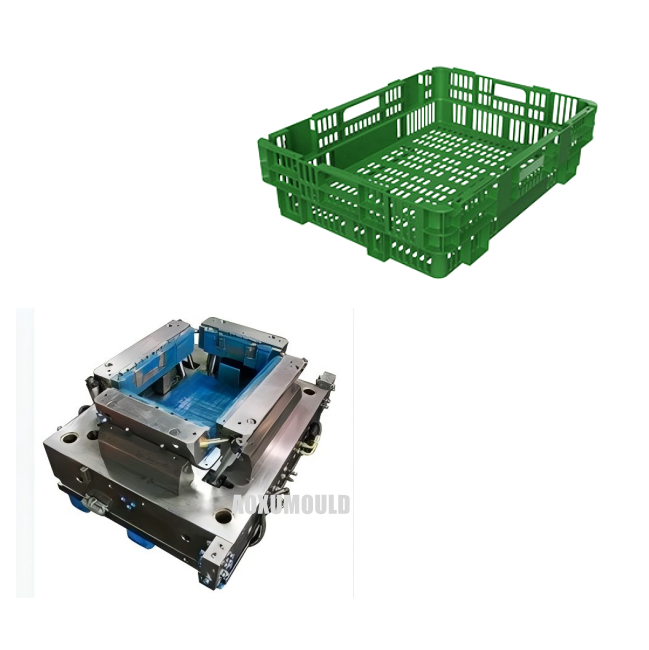
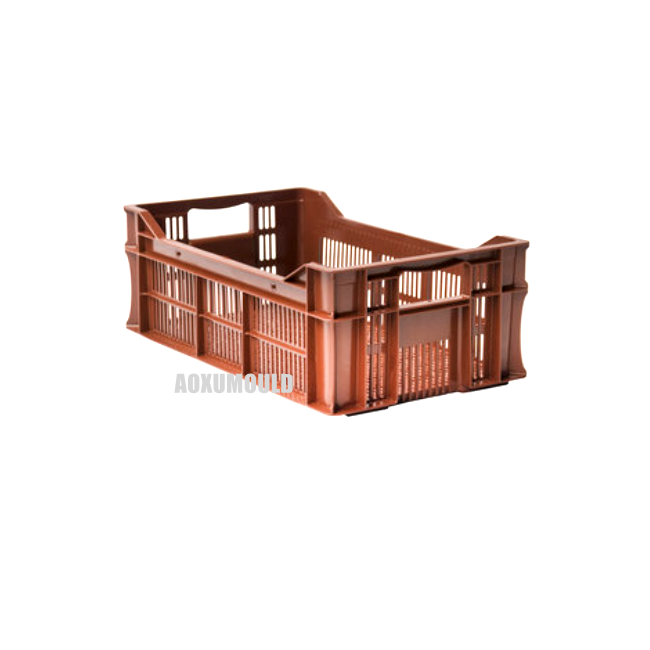
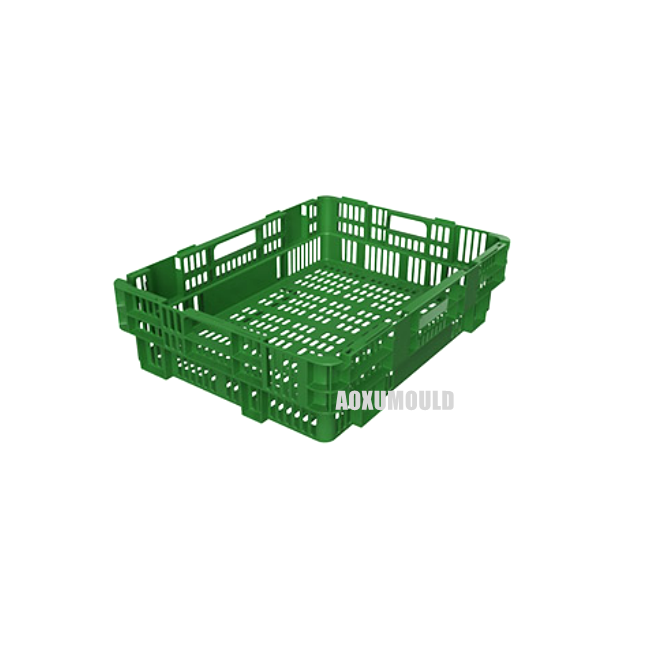
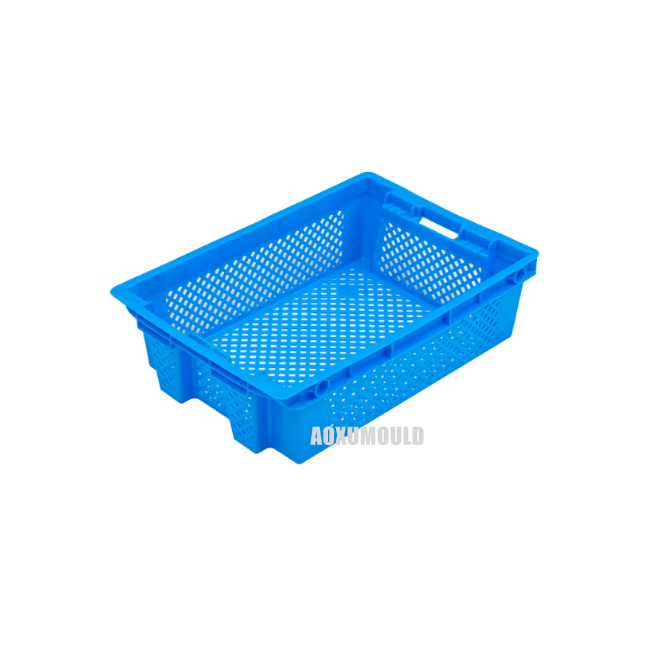
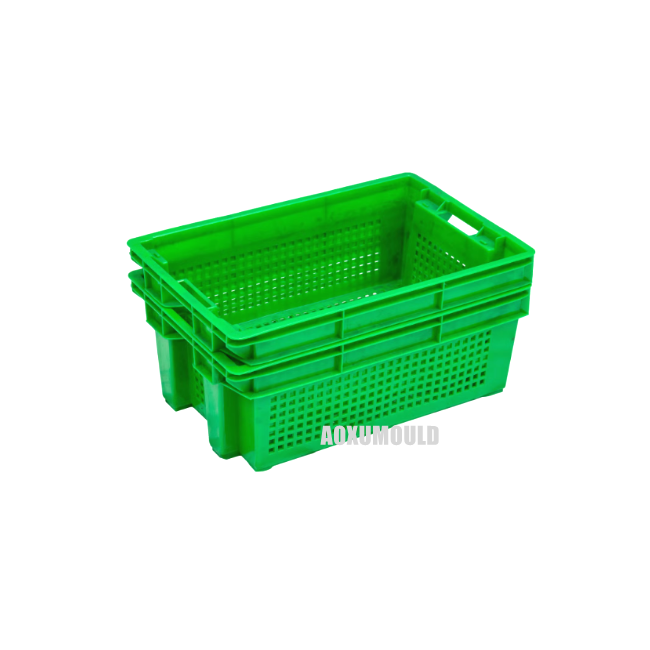
Mould Specifications
|
Mould name |
Plastic Fruit crate mould |
|
Product material |
HDPE/PP |
|
Product Size |
600 x 400 x 310 mm |
|
Product weight |
2.2KG |
|
Mould material for cavity &. Core |
P20/718H/H13 |
|
NOs of cavity |
1 cavity |
|
Injection system |
Hot runner |
|
Suitable injection machine |
650T |
|
Mould size |
850x580x900mm |
|
Mould weight |
3500KG |
|
Mould lifetime |
more than 500,000pcs |
|
Delivery Time |
55 days |
Why Do We Need Mould For Plastic Fruit Crates?

Moulds are needed for plastic fruit crates for several reasons.
Firstly, moulds give the plastic fruit crates their specific shape. They ensure that each crate is of a consistent and precise design. For example, a well - designed mold can create a crate with the right dimensions to stack neatly and hold a particular quantity of fruit.
Secondly, moulds allow for mass - production. Once a mold is made, it can be used to produce a large number of identical plastic crates in an efficient and cost - effective way. This is much quicker and more reliable than trying to shape each crate by hand.
Finally, the use of moulds can also affect the strength and durability of the crates. The way the plastic is molded can influence its structural integrity, making the crates more suitable for heavy - duty use such as transporting and storing fruits.
What Is Injection Mould?

An injection mould (or injection mold in American English) is a tool used in the manufacturing process called injection moulding.
Injection moulding is a method to produce parts by injecting molten material (usually plastic, but can also be metal or other materials) into a mould cavity. The injection mould has two main parts: the cavity (which gives the outer shape of the product) and the core (which forms the inner part of the product). When the material is injected under high pressure into the space between the cavity and the core, it takes the shape of the mould as it cools and solidifies. This way, a large number of identical products with complex shapes can be produced efficiently and with high precision.
How To Ensure The High - Quality Production of Plastic Fruit Crate Moulds?
1.Design
• Accurate Specifications: The mould design should precisely match the dimensions and structural requirements of the fruit crate. Consider factors like the size, shape, wall thickness, and any special features such as handles or ventilation holes of the crate.
• Flow Analysis: Use mould - flow analysis software to simulate the plastic injection process. This helps to optimize the runner system and gate locations to ensure even filling of the mould cavity, reducing the risk of defects like short shots or warping.
2.Material Selection
• Mould Base Material: Choose high - quality steel, such as P20 or H13 steel. These materials have good hardness, wear resistance, and heat - treating properties to withstand the high pressures and temperatures during injection moulding.
• Surface Treatment: Apply appropriate surface treatments to the mould cavity, such as polishing to a specific roughness value (for better part ejection and appearance) or hard - coating to increase wear resistance.
Machining Precision
• CNC Machining: Utilize advanced CNC (Computer Numerical Control) machining equipment to ensure high - precision manufacturing of the mould components. The accuracy of the cavity shape and dimensions directly affects the quality of the final plastic crate.
• Tolerance Control: Strictly control the machining tolerances. For example, the tolerance of the cavity dimensions might be within ±0.05mm to ensure a proper fit and consistent wall thickness of the plastic crate.
3.Cooling System
• Efficient Cooling Channels: Design an effective cooling system with well - placed cooling channels. This helps to control the cooling rate of the plastic during injection, reducing cycle times and minimizing part distortion.
• Balanced Cooling: Ensure that the cooling is evenly distributed across the mould to avoid differential shrinkage and warping of the plastic crate.
4.Quality Testing
• Dimensional Inspection: Use precision measuring tools like coordinate - measuring machines (CMM) to check the dimensions of the mould against the design specifications.
• Trial Runs: Conduct trial injection moulding runs and carefully inspect the produced plastic crates for any defects such as flash, sink marks, or ejector marks. Make adjustments to the mould based on the results of these trials until the desired quality is achieved.
Crate injection mould using hot runner system has many advantages and need to pay attention to the main points.
Why Does Crate Mould Use Hot Runner Injection System?
1.Improve production efficiency: the hot runner system does not have the limitation of the cooling time of the runner system, and the parts can be ejection in time after forming and curing, which can significantly shorten the molding cycle, and effectively improve the production efficiency for the production of larger plastic products such as plastic crates.

2.Save material costs: there is no cold runner in the pure hot runner mould, so there is no production waste, which can save a lot of plastic raw materials and reduce material costs for fruit crate production.
3. Improve product quality: In the process of hot runner mold molding, the plastic melt temperature is accurately controlled in the runner system, and the plastic can flow into each mould cavity in a more uniform state, the result is a consistent quality of parts, the hot runner molding crate gate quality is good, the residual stress is low after mold release, and the part deformation is small.
4. Conducive to production automation: the parts are finished after the hot runner mould molding, without trimming the gate and recycling cold runner and other processes, which is conducive to cooperate with automation equipment to achieve production automation, further improve production efficiency and product quality stability.
Design For Product &. Mould

Matters Needing Attention
A.Mould design: According to the specific size, shape and structural characteristics of the crate, the layout of the hot runner system should be reasonably designed, including the shape of the shunt plate, the position and number of the nozzle, etc., to ensure that the plastic melt flows in the flow channel and evenly fills each cavity. When designing the hot runner system, the layout of the cooling system of the mould should be fully considered to avoid mutual interference between the hot runner system and the cooling system, affecting the overall performance of the mould.
B. Mould manufacturing: The hot runner fruit crate mould needs precision machining machinery to ensure that the precision of mould manufacturing is high, and it is necessary to ensure the integration and cooperation of the hot runner system and the mold is extremely strict, otherwise there will be many serious problems in the production process of the mould.
C. Operation and maintenance: the hot runner mould operation and maintenance is complicated, and the technical level and experience of the operator are required to be high, so that the operator should be professionally trained before use, so that it is familiar with the operation process and precautions of the hot runner system. In the production process, it is necessary to regularly maintain the hot runner system, including checking the working status of the heater, thermocouple and other components, and cleaning the impurities and accumulated materials in the runner.
Package &. Delivery

Mould Components
Mould Steel

Hot Runner System

Standard Parts

How To Maintain Plastic Fruit Crate Mould?
Here are some ways to maintain plastic fruit crate moulds:
1.Cleaning
• After each use, clean the mould thoroughly to remove any remaining plastic materials, debris, or contaminants. Use appropriate cleaning agents that don't corrode the mould material, such as mild detergents.
• High - pressure air can be used to blow out any small particles that are stuck in the cavities or crevices of the mould.
2.Lubrication
• Apply a suitable lubricant to the moving parts of the mould, like the ejector pins and sliders. This helps to reduce friction and wear during the mould - opening and - closing process. Make sure to use a lubricant that is compatible with the mould material and won't affect the quality of the next plastic - moulding cycle.
3.Storage
• When the mould is not in use, store it in a clean, dry place. Protect it from dust, humidity, and direct sunlight. You can cover it with a plastic film or place it in a storage box.
• Place the mould on a flat and stable surface to avoid any deformation due to uneven support.
4.Regular Inspection
• Regularly check for any signs of wear, cracks, or damage on the mould surface. Early detection of such issues allows for timely repair and prevents more serious damage during production.
• Check the functionality of the cooling channels to ensure proper heat dissipation during the moulding process. If there are blockages or leaks in the cooling channels, they should be fixed promptly.
Customers' Feedback


