

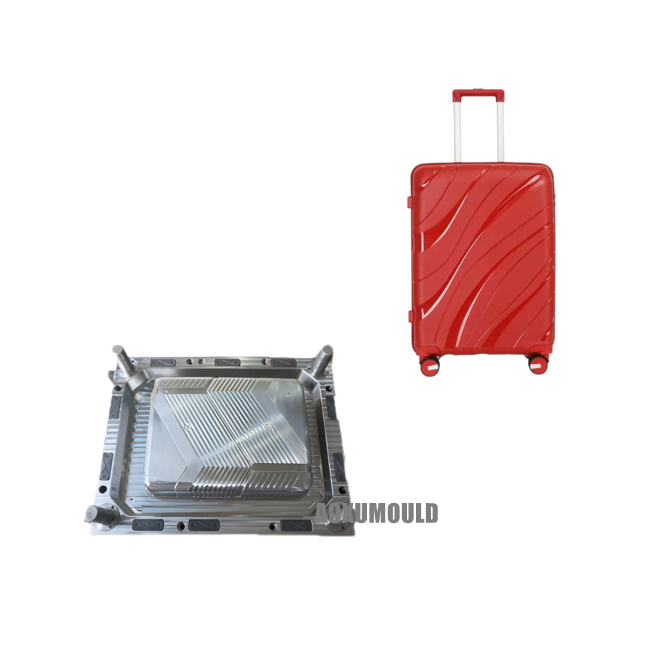
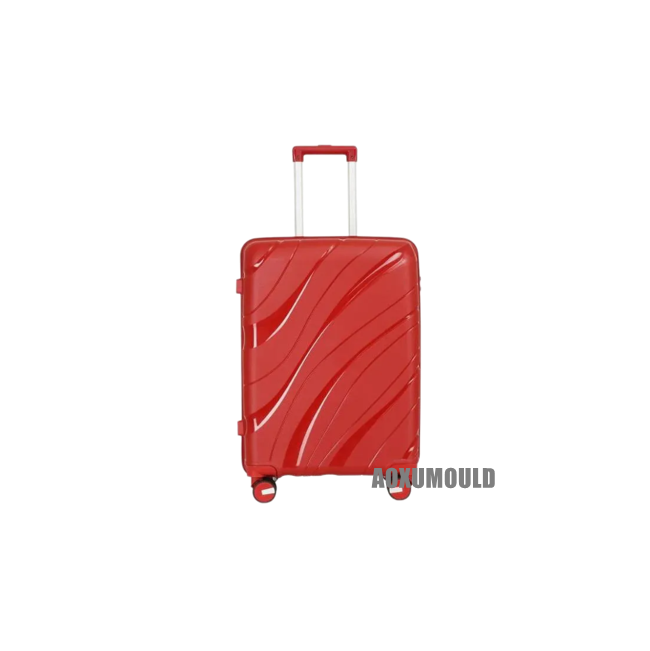
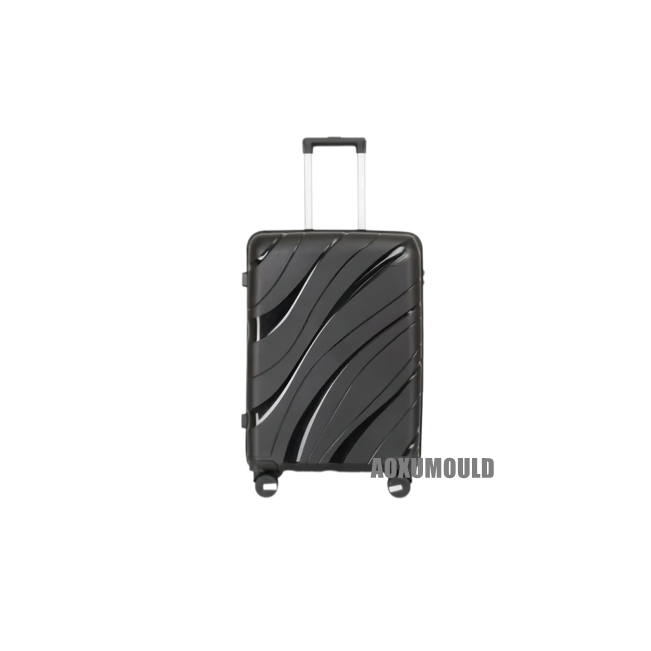
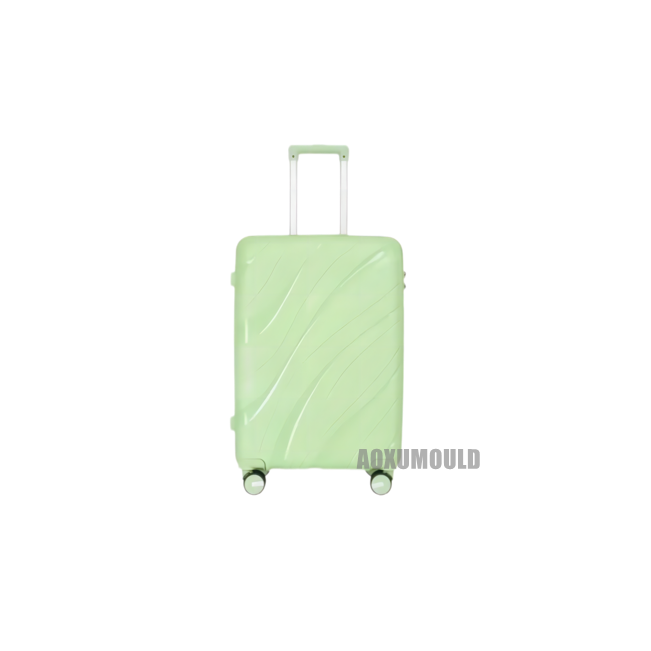
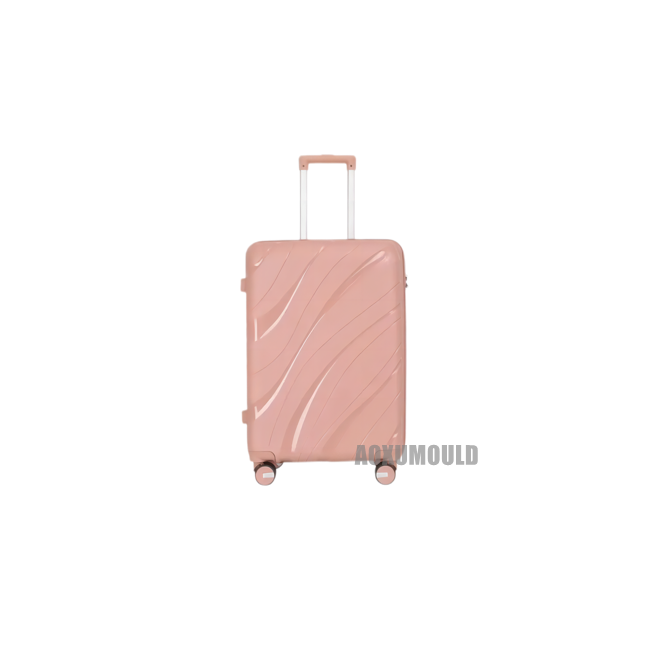
Mould Specifications
|
Mould name |
Plastic Baggage Injection Mould |
|
Crate material |
ABS |
|
Crate size |
348X260X315mm |
| Crate weight |
1kg |
|
Mould material for cavity &. Core |
P20, 718, 2738 |
|
NOs of cavity |
1 cavity |
|
Injection system |
Hot runner open gates or valve gates |
|
Suitable injection machine |
450T |
|
Mould size |
580x520x560mm |
|
Mould lifetime |
more than 500,000pcs |
How To Determine The Shrinkage Rate of The ABS Plastic Baggage Mould?
ABS plastic is a commonly used engineering plastic, featuring high strength, wear resistance, and impact resistance, etc. Therefore, it is widely used in the production of plastic baggage shells. During the production of ABS plastic baggage shells, the mould shrinkage rate is a very important parameter that directly affects the dimensional accuracy and quality of the final product. So, how to determine the shrinkage rate of the ABS plastic baggage mould?
First of all, we need to understand what mould shrinkage rate is. Mould shrinkage rate refers to the extent to which the final product size is smaller than the mould size due to the cooling and shrinking of the plastic during the injection molding process. Since ABS plastic undergoes shrinkage during injection molding, when designing the mould, this factor needs to be taken into consideration. Reasonable setting of the mould shrinkage rate is necessary to ensure that the size of the final product meets the requirements.
In order to determine the shrinkage rate of the ABS plastic baggage mould, it is necessary to conduct experimental verification. First, select a representative type of ABS plastic and measure its shrinkage rate through experiments. This can be done by comparing the molded sample with the original size, or by using professional instruments for shrinkage rate measurement. After determining the shrinkage rate of the ABS plastic, appropriate corrections can be made based on factors such as mould material and mold structure, and the final mould shrinkage rate can be obtained.
In addition, the cooling shrinkage rate and thermal shrinkage rate of ABS plastic need to be taken into account. The cooling shrinkage rate refers to the shrinkage phenomenon that occurs during the cooling process of the plastic, while the thermal shrinkage rate refers to the shrinkage phenomenon that occurs during the heating process. In the mould design, both of these shrinkage rates need to be comprehensively considered to meet the requirements of product dimensional accuracy and quality.
Determining the shrinkage rate of the ABS plastic baggage mould is a complex process that requires comprehensive consideration of multiple factors such as material properties, mould structure, and test verification. By reasonably designing the mould shrinkage rate, the production quality and accuracy of the ABS plastic baggage can be ensured, thereby enhancing the competitiveness of the product.
Designs For Product &. Mould

What Are The Criteria For Judging The Quality of Plastic Mould?
1.Processing thickness: Although the mould does not require excessive force or other harsh conditions during use, it often encounters mould inversion and ejection, which can lead to problems such as mould wear and deformation. Therefore, when choosing a mould, the quality of the mould can be analyzed based on its thickness.
2. Specification standard: A good mould can control the size of the extruded plastic products within a deviation of only a few tenths of a millimeter, while a poor mould usually causes deviations of several millimeters or even several centimeters.
3. Materials and Processes: Inspect the materials and processes of the entire mould. A good mold should be extremely smooth both inside and outside. The plastic shell is injection molded, and the plastic shell is painted to look shiny with a slightly moist touch. Poor-quality molds may have burrs or uneven surfaces, which are clearly distinguishable in comparison.
4. The appearance, size, coalescence peak, foaming, whitening (or cracking, breaking) of the formed product should be 5mm. For special-shaped perforations, the size should be 15mm. The strength of the fusion marks and the ability to pass the functional safety test should be achieved. The geometric shape and size accuracy of the product should comply with the requirements of the formal and valid mold design drawings (or 3D files). The tolerance of the product should follow the tolerance principles. The tolerance for shaft dimensions is negative tolerance, and the tolerance for hole dimensions is positive tolerance. If the customer has specific requirements, they should be met accordingly.
5. Mould appearance: The mould nameplate contains complete information, with clear characters and orderly arrangement. The cooling water nozzles should be plastic block water nozzles. If the customer has other requirements, they should be followed. The cooling water nozzles should not protrude beyond the mold frame surface. The cooling water nozzles should have inlet and outlet markings.
6. Mould material and hardness: The mould frame should be made of standard mould frames that meet the standards. The materials for the core, moving and fixed mould inserts, movable inserts, cones, push rods, and gate sleeves should be made of materials with high mechanical properties such as 40Cr or above. Alternatively, the forming surfaces should be treated with anti-corrosion measures or undergo surface hardening treatment with a hardness of 600HV.
7. Ejection, repositioning, core extraction, removal: During ejection, it should be smooth, without any sticking or unusual sounds. All ejector rods should have stop rotation positioning, and each rod should be numbered. The ejection distance should be limited by limit blocks. The reset spring should be a standard part, and both ends of the spring should not be ground or cut off. During installation, wave screws can be used; for the cylinder core extraction, a travel switch is necessary.
8. Cooling and heating system: The cooling or heating system should be fully unobstructed. There should be no leakage under pressure and it should be easy to maintain.
9. Pouring system: The gate placement should not affect the appearance of the product and should meet the requirements for product assembly. The process should be shortened, the cross-sectional area should be reduced to shorten the filling and cooling time, and at the same time, the plastic loss in the pouring system should be minimized.
10. Hot runner system: The wiring layout of the hot runner should be reasonable, facilitating maintenance. The wiring numbers should be in one-to-one correspondence. The temperature control cabinet, hot nozzles, and hot runner should be supported by standard components. The main flow port is connected to the hot runner using threads, and is fixed by a flat surface contact seal. The exterior fits well.
Forming defects, parting surfaces, and exhaust grooves: The insert piece and the mould frame should work together, and there should be a gap of less than 1mm around the rounded corners. Depression. Depth of the exhaust groove.
Selection And Layout of Injection Gates For Plastic Baggage Mould

In the selection and layout of injection gates for plastic baggage mould, it is a crucial aspect. The correct selection and layout of injection gates can enhance the injection molding production efficiency, reduce production costs, increase the lifespan of the mould, and also ensure that the products have the desired appearance and quality.
The first thing to consider is the selection of the injection gate. In plastic baggage mould, the commonly used gate forms include planar gates, blind hole gates, and notch gates, etc. Among them, the planar gate is suitable for smaller products, the blind hole gate is suitable for products with a certain height, and the notch gate is suitable for large-sized products. According to the specific design and requirements of the plastic baggage mould, choosing the appropriate injection gate form can effectively avoid quality problems such as bubbles and marks.
The next aspect is the layout of the injection gates. In the injection gate layout of the plastic baggage mould, it is necessary to consider the structure and shape of the product, and try to make the gate layout reasonable to reduce the surface marks and defects of the product. At the same time, it is also necessary to avoid setting the gates at the joint parts or critical strength parts of the mould, so as not to affect the strength and integrity of the product.
When arranging the injection gate layout, it is also necessary to consider the filling and venting conditions of the product. By reasonably setting the position and number of the gates, it can help the plastic material fill the mould cavity evenly, avoiding problems such as short shots and warping. Additionally, it is important to incorporate an exhaust system in the mould design to help quickly remove gases and prevent the formation of bubbles inside the product, ensuring the quality of the product.
The correct selection of injection gates and the proper layout are of vital importance in the design of plastic luggage box molds. Only by taking these factors into account during the mould design stage and optimizing them according to specific requirements can high-quality and aesthetically perfect plastic baggage products be produced.
What Are The Tests For The Load-Bearing Capacity of Plastic Baggage?
The load-bearing capacity tests for plastic baggages are conducted to ensure the quality and durability of the products and to guarantee the safety of consumers' use. In these tests, several aspects are typically covered:
Static load test:
This is the most basic test item, used to measure the maximum weight that the plastic baggage can bear when stationary. During the test, certain weights of items will be placed on the plastic baggage, and it will be observed whether the plastic baggage can stably bear the weight without significant deformation or rupture.
Dynamic Load Testing:
This testing item is conducted when the luggage is being transported or moved, simulating the actual usage environment. The test subjects may undergo various transportation methods such as pushing, pulling, and throwing, to test their load-bearing capacity during transportation.
Drop Impact Test:
In this test, the luggage box will be dropped from a certain height freely, and it will be observed whether the plastic baggage can withstand such impact without breaking or deforming. This test mainly examines the durability of the plastic baggage when it accidentally drops or is subjected to impact during daily use.
Rolling Load Test:
This test item simulates the pressure that a suitcase would bear when being moved. It mainly assesses the load-bearing capacity of the suitcase by simulating its rolling behavior on different surfaces. This test focuses on the quality and durability of the suitcase's wheels.
Try-out of Plastic Baggage Injection Mould
Customers' Feedback


