

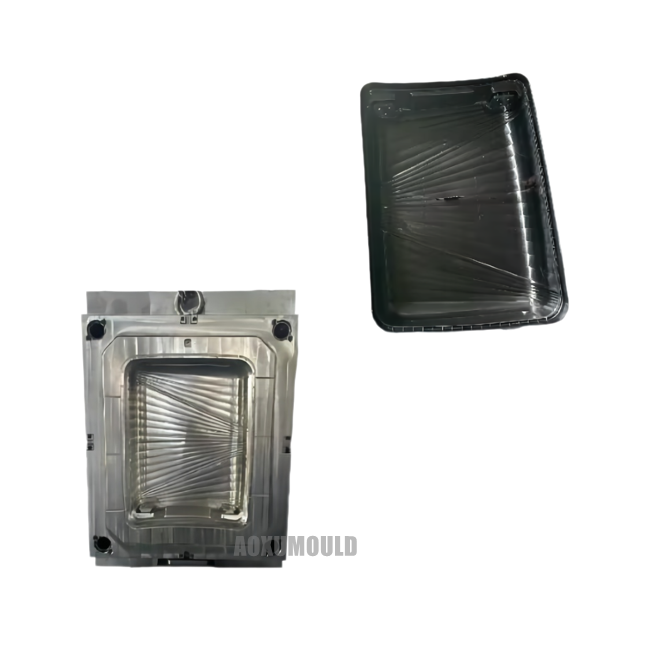
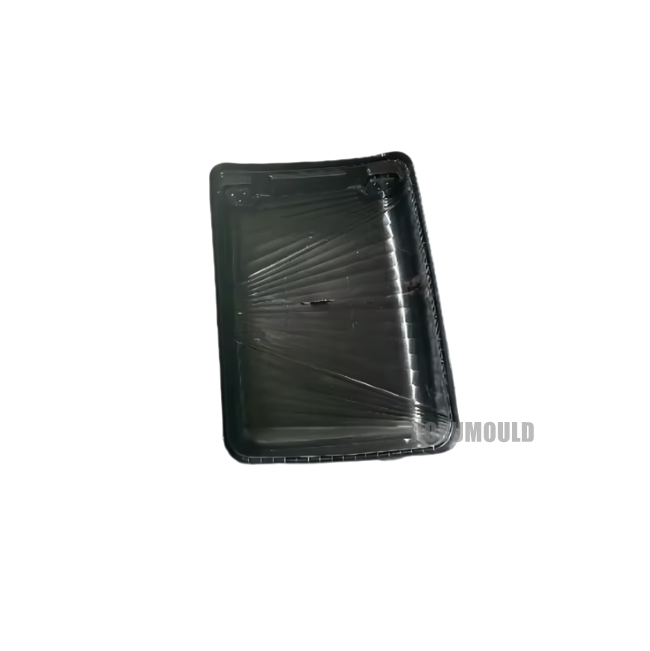
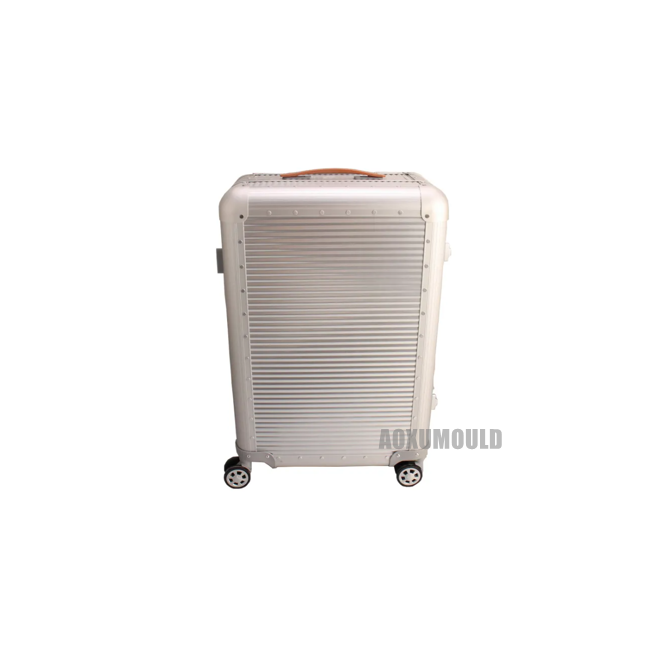
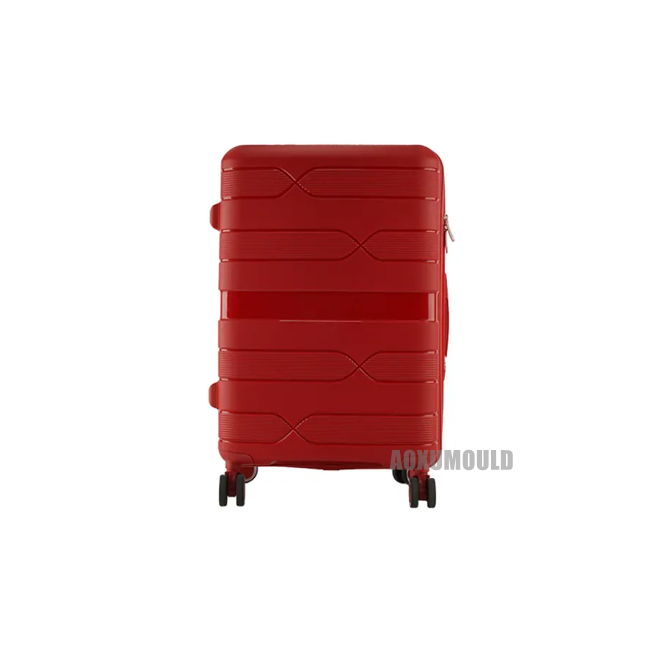
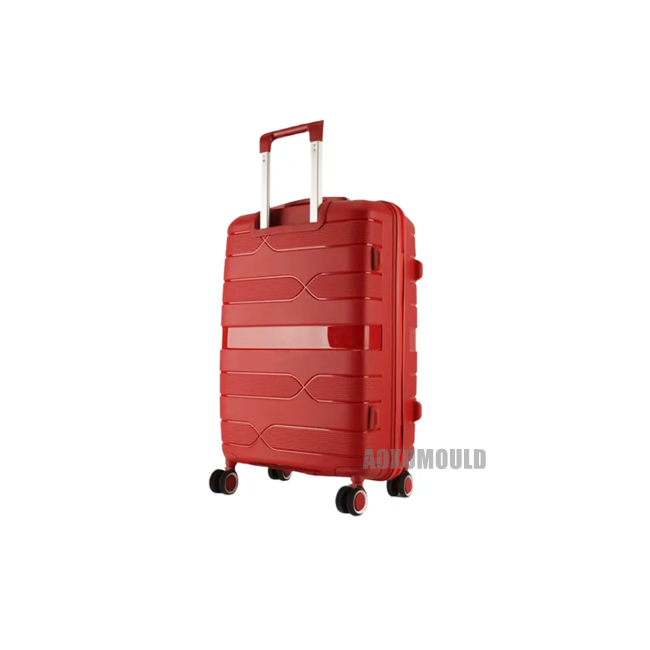
Mould Specifications
|
Mould name |
Plastic luggage case mould |
|
Crate material |
PC, plastic |
|
Crate size |
420X280X560mm |
| Crate weight |
550grams |
|
Mould material for cavity &. Core |
P20, 718, 2738 |
|
NOs of cavity |
1 cavity |
|
Injection system |
Hot runner |
|
Suitable injection machine |
450T |
|
Mould size |
760x480x840mm |
|
Mould lifetime |
more than 500,000pcs |
Why Choose PC Material For Making Luggage Case?

1. Lightweight
Luggage made of PC material is usually lighter than other materials (such as fabric, leather or metal). For the same size, the weight of PC material luggage is comparable to that of fabric or leather luggage, but much lighter than metal luggage.
2. Sturdy
The PC material has excellent impact resistance. Even in low-temperature environments, it remains tough and break. This enables the PC luggage to withstand significant external impacts and protect the contents inside from damage.
3. Durability
The luggage case made of PC material has a longer service life. It is less prone to damage from bumps and scratches compared to pure magnesium-aluminum alloy, making it more suitable for people who travel frequently.
4. Safety
PC aluminum frame suitcases are usually equipped with password locks, which are more secure and reliable compared to zippers. Moreover, high-quality suitcases also come with customs-approved safety locks. They can be opened with professional universal keys to ensure the safety of the luggage.
5. Appearance and texture
The transparent PC luggage case has a high degree of transparency, allowing for the creation of various bright colors and patterns. At the same time, it has a high glossiness, resulting in excellent appearance and texture.
Designs For Product &. Mould

How To Comprehensively Evaluate The Quality of Luggage Case?
For consumers, the quality of plastic luggage case is of great importance, as it will affect their travel experience. Therefore, here are some methods for evaluating the quality of luggage case.
Drop hammer impact test
The drop hammer impact test is a common method for testing the quality of luggage case. This test usually applies a certain impact force to the surface of the luggage case to simulate the possible impacts the luggage case may encounter during actual use. By observing whether there are obvious damages or ruptures on the surface of the luggage case, the impact resistance performance of the luggage case can be evaluated.
Oscillation impact performance test
The oscillation impact performance test mainly examines the firmness of the handle, handlebars, and side handlebars of the luggage. These components directly affect the usability. The experimental results show that after one oscillation of 41 times, two oscillations of 28 times, and three oscillations of 21 times, the handlebars broke or were damaged. This is far from the requirement of the national standard that at least 300 or more impacts should be endured, and it is a serious quality failure.
Drop performance test
The drop performance test simulates the situation where a suitcase is subjected to compression during transportation or storage. This test usually involves dropping the suitcase freely from a certain height to check if the case is damaged or deformed. By comparing the changes in the case before and after the test, the durability and compressive strength of the suitcase can be evaluated.
Load-bearing performance test
The load-bearing performance test is an important indicator for evaluating the carrying capacity of a luggage case. This test usually involves placing certain weights inside the luggage, and then checking whether the case body, straps, handles, side handles, side draw straps, and side trolley straps, etc., can withstand the load without being damaged. Through this method, it can be ensured that the luggage case can safely carry items in actual use.
Test of wear resistance and shock resistance of wheels and pull rods
The test of wear resistance and shock resistance of wheels and pull rods is a key factor in evaluating the walking performance of luggage cases. This test is usually conducted by loading a specified load on the sample, and using the rollers or conveyor belts of the roller-type or conveyor-type walking test machine to rotate and rub against the sample's wheels, causing impact oscillation and wear on the sample to simulate the usage state of the luggage when walking. It examines the quality of the sample's wheels, axle, frame, pull rods, and the case body, and calculates the wear amount of the wheels.
Static pressure and impact resistance test
The static pressure and impact resistance test is used to evaluate the resistance capabilities of a luggage case when subjected to static pressure and impact forces. This test typically involves applying a certain amount of pressure or impact force to the surface of the luggage case to check if the box can remain stable and prevent damage to the contents inside. Through this method, it is ensured that the luggage case can effectively protect the contents inside during actual use.
Strength and Durability Characteristic Test
The strength and durability characteristic test includes zipper flat pull strength, zipper reciprocating test, corrosion resistance of hardware accessories, and friction color fastness, etc. These tests are designed to evaluate whether the various components of the luggage case have sufficient strength and durability. For example, the zipper flat pull strength test can check whether the zipper can withstand a large pulling force without derailing or being damaged; the corrosion resistance test of hardware accessories can assess whether the metal accessories of the luggage case can maintain good performance in a humid environment.
Is It Necessary To Conduct MoldFlow Analysis For Plastic Luggage Case Mould?

Plastic luggage cases are essential travel items with high demand and diverse types. The appearance and quality of luggage cases are largely determined by the design and manufacturing of the injection mould. Therefore, conducting mold flow analysis when producing injection mould for luggage case is of crucial importance.
Firstly, mold flow analysis can help us better understand the internal flow conditions of the mould, including factors such as the flow speed and temperature distribution of the molten plastic during the injection process. Through mold flow analysis, we can promptly identify and rectify design flaws within the mould, thereby avoiding the occurrence of some injection defects, such as bubbles, short shots, and thermal cracking.
Secondly, mold flow analysis can also help us optimize the design of injection mould, thereby enhancing production efficiency and product quality. By analyzing the flow of molten plastic within the mold cavity, we can reasonably adjust the structure of the mould, thereby avoiding or reducing the waste of plastic materials, lowering production costs, and improving production efficiency.
Furthermore, mold flow analysis can also assist us in predicting and optimizing the appearance and performance of luggage case. By simulating the effects of different injection molding process parameters on the product, we can determine the optimal injection molding parameters to ensure a perfect product appearance and stable quality.
What Are The Advantages of Polishing The Injection Mould For Plastic Luggage Case?

Polishing the injection mould for plastic luggage case is a very important process. It can make the injection products smoother and more delicate, and enhance the appearance and texture of the products.
Polishing can enhance the glossiness and transparency of the product. Through polishing, the burrs and uneven parts on the mold surface can be removed, making the surface of the injection molded product smoother and more delicate, thereby increasing the glossiness and transparency of the product and improving its visual appeal.
Polishing can enhance the texture and quality of the product. The surface of the injection-molded products after polishing is smooth and flat, with a comfortable touch and is not prone to scratches. This significantly improves the texture and quality of the product, increases its added value, and attracts more consumers.
Polishing can extend the service life of the mould. Polishing can effectively reduce the wear and corrosion on the surface of the mould, decrease the possibility of scratches and damage to the mould, prolong the service life of the mould, save production costs, and improve production efficiency.
Polishing can also enhance production efficiency and reduce costs. Through polishing treatment, it can shorten the time and cost for subsequent processing of the products, increase production efficiency, and shorten the production cycle; at the same time, polishing can also reduce the frequency of mould maintenance and replacement, lower maintenance costs and replacement costs, and thereby reduce production costs.
Try-out of Luggage Case Mould
Mould Components
Mould Steel

Hot Runner System

Standard Parts

Package &. Delivery

Customers' Feedback


