

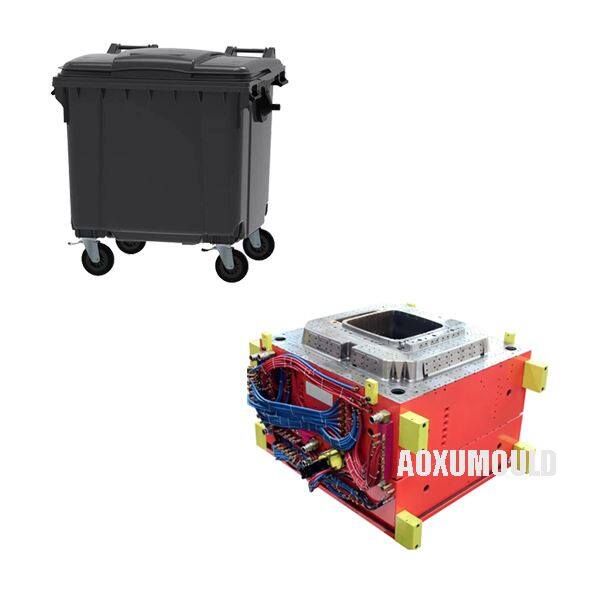
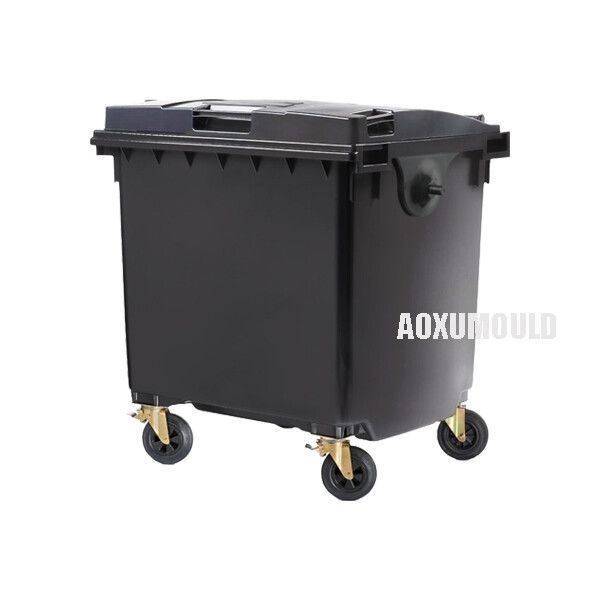
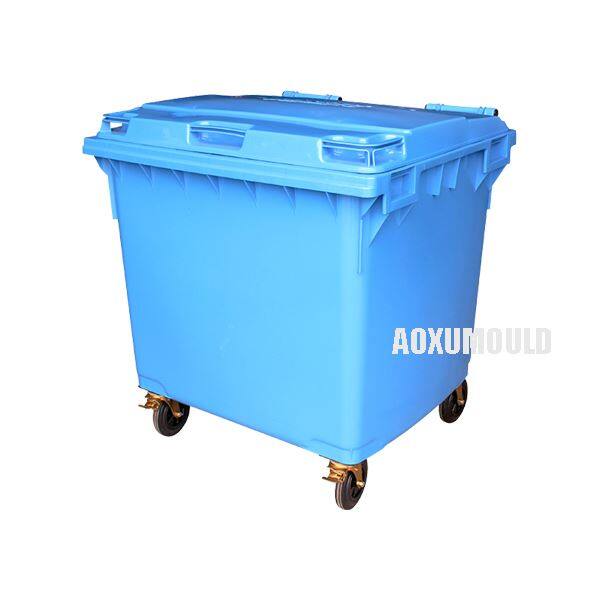
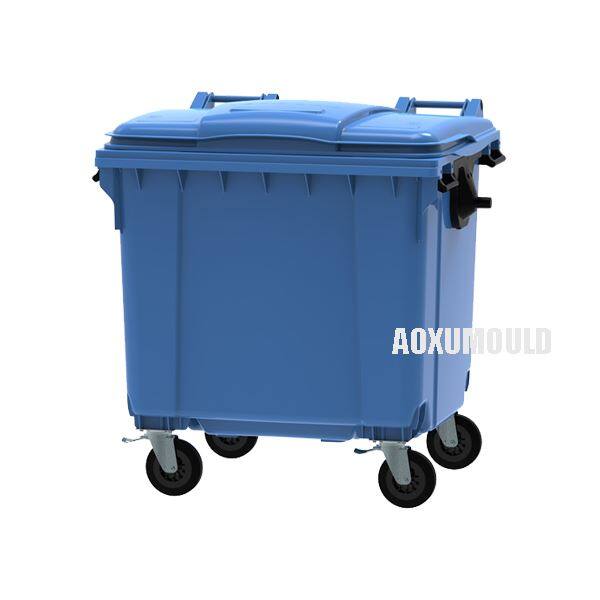
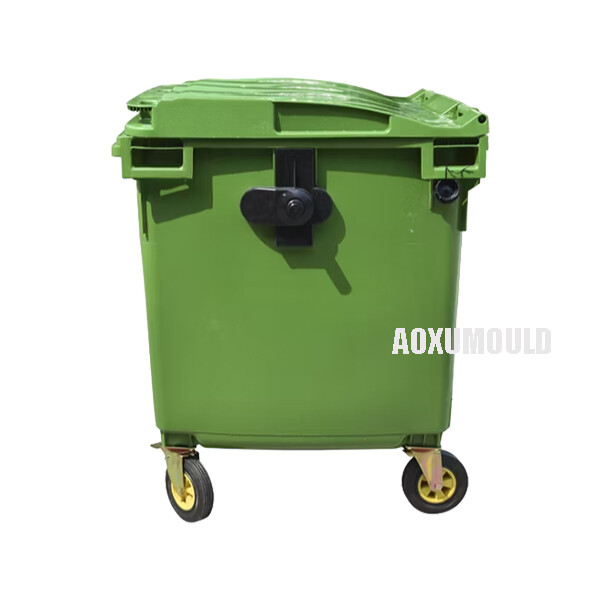
Mould Specifications
|
Mould name |
1100L Bin Mould |
|
Bin material |
HDPE, PP, plastic |
|
Bin Size |
1370X1075X1450mm |
| Bin weight | 55kg |
|
Bin Volume |
1100L |
|
Mould material for cavity &. Core |
P20 |
|
Mould base |
C45 |
|
Injection system |
Hot runner open gate or valave gate |
|
Suitable injection machine |
4000T |
|
Mould size |
1800x1600x1850mm |
|
Mould lifetime |
more than 500,000pcs |
Why Choose HDPE Material To Produce 1100L Bins?

1. Superior Durability & Impact Resistance
Toughness: HDPE can withstand heavy loads, drops, and rough handling without cracking, making it ideal for industrial and waste management use.
Weather Resistance: Performs well in extreme temperatures (–50°C to +80°C) and resists UV degradation (if UV-stabilized additives are used).
Long Lifespan: HDPE bins last 10+ years even in harsh environments (e.g., landfills, chemical storage).
2. Chemical & Corrosion Resistance
Inert Material: Resists acids, alkalis, solvents, and most chemicals, making it safe for:
Hazardous waste storage.
Agricultural chemicals (fertilizers, pesticides).
Industrial liquids (oils, detergents).
No Rust/Rot: Unlike metal or wood, HDPE won't corrode or degrade when exposed to moisture or chemicals.
3. Lightweight Yet Strong
Weight Savings: HDPE bins are 30–50% lighter than steel or fiberglass equivalents, reducing transport and handling costs.
High Strength-to-Weight Ratio: Reinforced designs (ribs, double walls) maintain structural integrity even at 1100L capacity.
4. Cost-Effectiveness
Low Material Cost: HDPE is cheaper than alternatives like PP (Polypropylene) or fiberglass.
Easy Processing: Efficient injection molding (lower energy costs vs. metal fabrication).
Recyclability: HDPE is 100% recyclable, reducing waste and appealing to eco-conscious buyers.
6. Design Flexibility
Moldability: HDPE flows easily into complex mould shapes, enabling:
Custom logos, textures, and colors.
Integrated handles, wheels, or stacking features.
Consistency: Uniform shrinkage (1.5–3%) minimizes warping vs. other plastics.
How To Make A Quality 1100L Bin Mould?
Choose the suitable materials: The quality of the mould is largely dependent on the materials used in its construction. Opt for high-grade materials that are durable, heat-resistant, and able to withstand the rigors of production.
|
Steel Grade |
Best For |
Hardness (HRC) |
|
P20 |
Low-cost, general use |
28–32 |
|
718H |
High precision, long life |
32–36 |
|
H13 |
High-wear areas (ejectors, cores) |
48–52 |
|
S136 |
Corrosion-resistant (for glossy finishes) |
48–52 |
Design & Engineering
Use CAD software (SolidWorks, UG/NX) to design the mould with:
Proper wall thickness (4–6mm for HDPE/PP).
Optimized ribs and reinforcements for structural strength.
Balanced gate system (hot runner or cold runner).
Conduct mold flow analysis (Moldflow, Moldex3D) to predict:
Cooling efficiency.
Potential defects (warping, sink marks).
Use advanced manufacturing techniques: Utilize cutting-edge technology and advanced manufacturing techniques to create the mould with precision and accuracy.
CNC Milling/Turning
Machining tolerance: ±0.02mm.
Critical surfaces polished to Mirror finish (Ra ≤ 0.05μm).
EDM (Electrical Discharge Machining)
Used for intricate cores/cavities.
Ensures sharp edges and fine details.
Cooling System Optimization
Baffle & spiral cooling channels for uniform cooling.
Flow rate analysis to prevent hot spots.
Mold temperature controllers (10–60°C for HDPE/PP).
5. Conduct thorough testing: Before the mould is put into production, it should undergo thorough testing to ensure that it meets all performance standards. This may include testing for durability, accuracy, and compatibility with the intended use.
Design For Product &. Mould

What Are Common Defects In 1100L Bins Production?
1. Warping (Deformation)
Cause:
Uneven cooling (some sections cool faster than others).
Residual stress from improper mold design or material shrinkage.
Solution:
Optimize cooling channels for uniform temperature distribution.
Adjust mold temperature (typically 10–60°C for HDPE/PP).
Use low-shrinkage plastics or modify part design (add ribs for stability).
2. Sink Marks (Dents on Surface)
Cause:
Insufficient packing pressure or holding time during injection.
Thick sections cooling slower, causing shrinkage voids.
Solution:
Increase holding pressure (usually 50–80% of injection pressure).
Extend holding time (5–10 sec for large bins).
Redesign thick areas with gradual thickness transitions.
3. Flash (Excess Plastic at Edges)
Cause:
Excessive injection pressure or clamping force too low.
Worn-out mold edges or misaligned mold halves.
Solution:
Check clamping force (should be ≥1.5x projected bin area pressure).
Inspect and repair mold parting lines for damage.
Reduce injection speed/pressure in the final filling stage.
4. Burn Marks (Black/Dark Spots)
Cause:
Trapped air burning due to poor venting.
Overheating at high injection speeds.
Solution:
Improve venting (add vents near last-to-fill areas).
Reduce injection speed or lower melt temp slightly.
5. Weld Lines (Visible Seams)
Cause:
Melt flow fronts meeting around obstacles (e.g., ribs, inserts).
Low melt temperature or slow injection speed.
Solution:
Increase melt temp and injection speed to improve fusion.
Reposition gates to change flow paths.
Package &. Delivery

1.Before the bin mould is shipped, we will check whether the opening and closing of the mould is smooth, the water cooling system,the hydraulic oil system and the hot runner system.
2. The cavity and core are cleaned without iron filings and impurities.
3. Blow the waterway clean to prevent long-term sea transportation from rusting.
4. We spray anti-rust agent on the inside of the mold, spray paint on the outside of the mould, and apply anti -rust oil on the thimble.
5. We will put a nameplate on the mold, it shows the mould name, the year of production and mould information, mould weight and size.
6: Mould parts are provided free of charge (convenient for customers to replace).
Mould Components
Mould Steel

Hot Runner System

Standard Parts

Why Choose Hot Runner System?
|
1. Reduced Material Waste Cold runners (traditional systems) solidify and must be discarded, wasting 5–15% of material. Hot runners recycle 100% of plastic into the part, saving costs-especially for large bins. 2. Faster Cycle Times No need to eject and handle solidified runners. Cycle time reduction: Up to 15–30% faster vs. cold runners. 3. Improved Part Quality Consistent melt temperature prevents flow lines and short shots. Balanced pressure distribution reduces warping in large bins. No gate vestiges (cleaner appearance). 4. Lower Energy Costs Less reprocessing of wasted material = lower electricity consumption. Reduced clamping force needed (smaller runner system). 5. Automation-Friendly No manual removal of runners, making it ideal for high-volume production.
|
FAQ
|
>1. How long does it take to produce a 1100L bin injection mould? The production time for a 1100L bin injection mould can vary depending on the complexity of the design and the current workload of our factory. However, on average, it usually takes around 55-65 days to complete the moulding process. >2. What materials are used in the production of 1100L bin injection moulds? We use high-quality steel such as P20, 718, S136, H13, etc. in the production of our 1100L bin injection moulds. These materials are durable and can withstand the rigors of the injection moulding process. >3. What materials are used to produce 1100L bins? Usually HDPE (High-Density Polyethylene) or PP (Polypropylene) due to their strength and impact resistance. >4. Can you customize the design of a 1100L bin injection mould? Yes, we can customize the design of the 1100L bin injection mould according to your specific requirements. Our team of experienced designers and engineers can work closely with you to create a mould that meets your exact specifications. >5. How do you ensure the quality of your 1100L bin injection moulds? We have strict quality control measures in place to ensure that all of our 1100L bin injection moulds meet the highest standards. Our team of skilled technicians conducts thorough inspections throughout the production process to ensure that the moulds are free from any defects. >6. Can you provide samples of your 1100L bin injection moulds for evaluation? Yes, we can provide samples of our 1100L bin injection moulds for evaluation before placing a bulk order. This will allow you to assess the quality and functionality of the mould before making a final decision.
|
Customers' Feedback


