


![Y(WCI5M`T]2]86[L_GO]{ZW](https://img.v15cdn.com/uploads/202442065/kitchen-trash-can-mouldb4fc05fd-a6bc-4d3a-a686-b6f39c001de7.png)
Mould Specifications
|
Mould name |
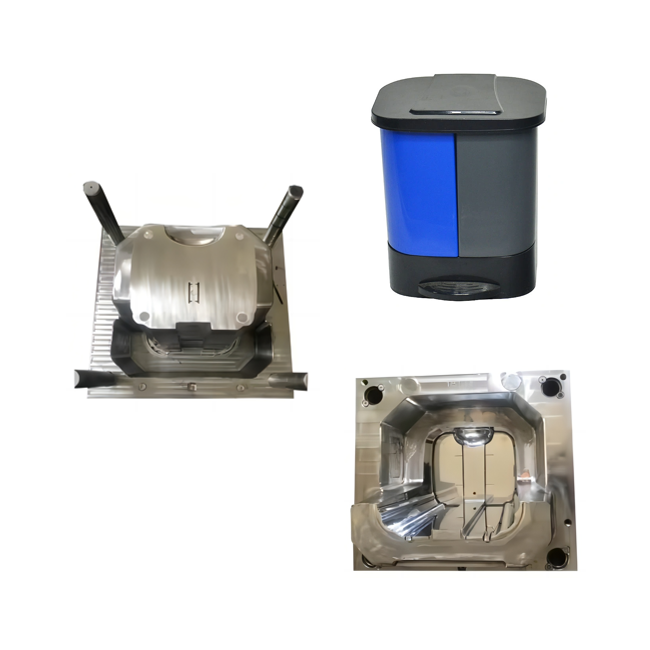
Hot selling kitchen trash can mould |
|
Product material |
PP |
|
Product Size |
270X170X280mm |
|
Product weight |
520g |
|
Mould material for cavity &. Core |
C45, P20, 718, 2738 |
|
Mould base |
C45 |
|
Injection system |
Hot runner open gates or valve gates |
|
Suitable injection machine |
3300T |
|
Mould size |
1750x1550x1550mm |
|
Mould lifetime |
More than 300,000pcs |
The Mould&Product Details of Kitchen Trash Can

Introduction
Kitchen Trash Can Mould is a special mold used to make kitchen trash cans. It uses injection molding to mold materials such as polypropylene into the shape of a trash can. It is made of precision-machined mold steel, which is wear-resistant and has a long service life.
Manufacturing process
1. Material selection and preparation
Use polypropylene (PP) material and high-quality mold steel (such as C45, P20, 718, 2738, etc.) and mold frame material (C45), etc.
2. Mold design
Before manufacturing, use computer-aided design (CAD) and computer-aided engineering (CAE) software for precise design and simulation.
3. Mold processing and manufacturing
For complex shapes and details, use EDM technology; use CNC machine tools for high-precision cutting and processing; mold materials undergo appropriate heat treatment processes such as quenching and tempering.
4. Injection molding process
After the mold design is completed, the molten polypropylene (PP) material is injected into the mold cavity through the injection molding machine, and the shape of the kitchen trash can is obtained after cooling.
5. Mold assembly
Precisely assemble the various components of the mold (such as cavity, core, gate system, etc.).
6. Quality control and testing
Use equipment such as three-dimensional coordinate measuring machines to perform precision testing to ensure that the size of the mold and the quality of the product meet the standard requirements, and conduct mold trials after the mold is initially completed.
How to maintain
1. Cleaning and decontamination
After each production, clean the residual materials (such as plastic, grease, etc.) on the mold, and regularly check the mold cavity, core, gate system and other parts.
2. Lubrication and rust prevention
Regularly lubricate the active parts of the mold (such as sliders, ejection systems, etc.).
3. Inspection and adjustment
Regularly check the wear of various parts of the mold, especially the wear of the cavity, core and cooling system. Check whether the hot runner system, gate and cooling channel are unobstructed.
4. Avoid excessive use
You can use the method of rotating different molds to avoid a single mold working continuously for a long time.
5. Storage and preservation
When not in use, the mold should be stored in a dry and clean environment to avoid rust or corrosion caused by a humid environment.

Design For Product &. Mould

Mould Try-out of Kitchen Trash Can Mould
Package &. Delivery

Mould Components
Mould Steel

Hot Runner System

Standard Parts

FAQ
Customers' Feedback


