

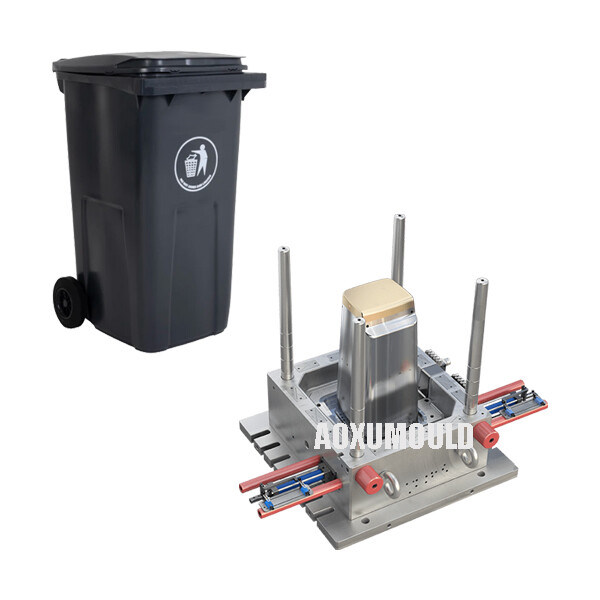
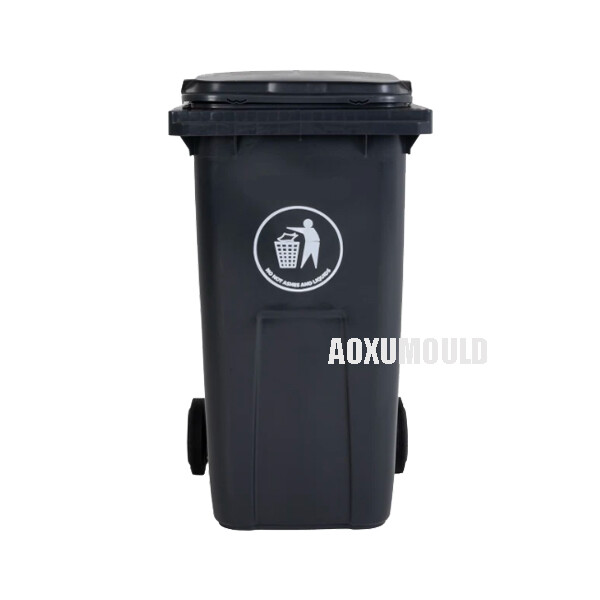
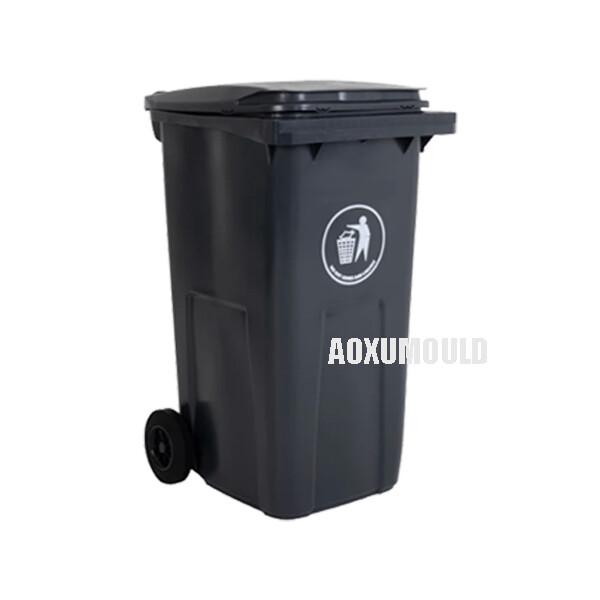
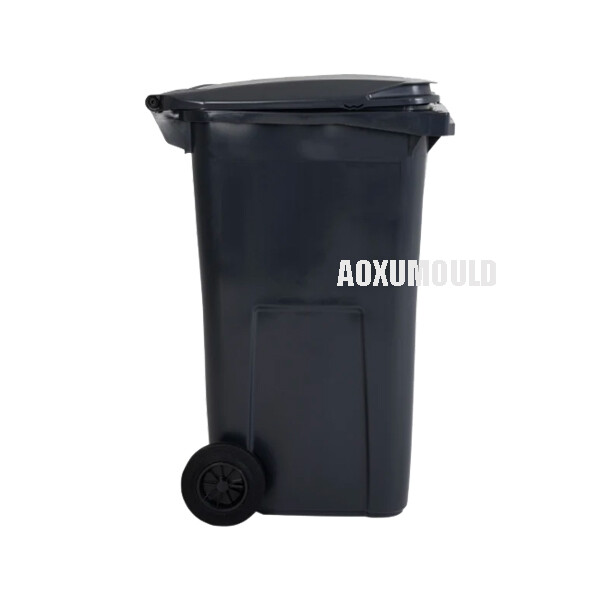
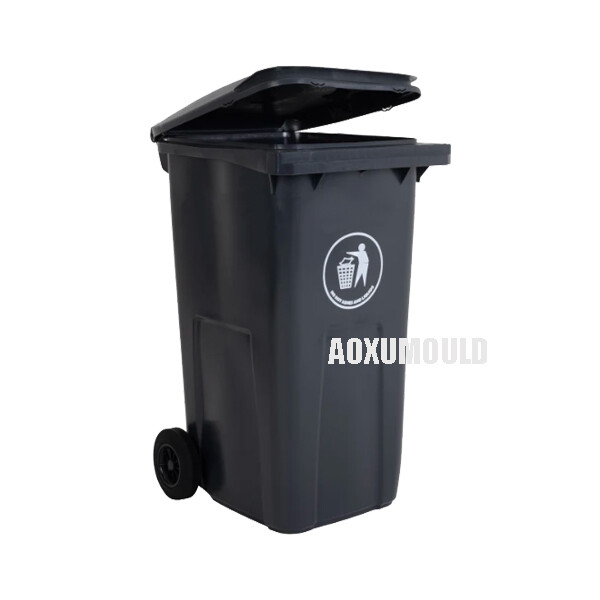
Mould Specifications
|
Mould name |
Injection Trash Can Mold |
|
Product material |
HDPE, plastic |
|
Product Size |
580X740X1070mm |
| Product weight | 13kg |
|
Mould material for cavity &. Core |
P20, 718, 2738 |
|
NOs of cavity |
1 cavity |
|
Injection system |
Cold runner/HOT RUNNER |
|
Suitable injection machine |
1850T |
|
Mould size |
780X950X1350mm |
|
Mould lifetime |
more than 500,000pcs |
|
T1 Time |
After design is finalized, 55 days |
Application of Plastic Trash Cans
Plastic trash cans are widely used across various sectors due to their durability, cost-effectiveness, and versatility. Below are the key applications categorized by industry and functionality:
1. Household Use
-Kitchen & Bathroom Bins
Small to medium-sized (5–20L) with odor-control lids (flip-top, step-on pedal).
Materials: HDPE/PP (lightweight, easy to clean).
-Recycling Bins
Color-coded (blue, green, black) for waste segregation (paper, plastic, organic).
Often stackable or with compartments.
-Outdoor Trash Cans
UV-resistant plastic (e.g., HDPE with stabilizers) for weatherproofing.
Heavy-duty (30–100L) with wheeled bases for mobility.
2. Commercial & Public Spaces
-Office & Retail Waste Bins
Sleek designs (stainless steel look or custom-branded).
Touch-free options (sensor lids) for hygiene.
-Street & Park Bins
Vandal-resistant, anchored designs.
Large capacity (50–200L) with fire-retardant additives.
-Food Service & Hospitality
Grease-resistant bins for restaurants.
Slim-profile bins for hotel corridors.
3. Industrial & Healthcare
-Industrial Waste Containers
Heavy-duty (100–500L) with reinforced ribs and wheels.
Chemical-resistant (e.g., PP bins for factories).
-Medical Waste Bins
Sharps containers (puncture-proof, red/yellow for biohazard).
Foot-operated lids to prevent contamination.
Designs For Product &. Mold

How to Design A Injection Trash Can Mold?
1. Define Product Requirements
Trash Can Specifications:
Size (height, diameter, wall thickness).
Shape (round, rectangular, tapered).
Features (lid, handles, pedal mechanism, ribs for reinforcement).
Material Selection:
Common plastics: HDPE, PP, ABS (consider strength, flexibility, and cost).
Production Volume:
High volume → Multi-cavity mold.
Low volume → Single-cavity or aluminum prototype mold.
2. Mold Type Selection
Choose between:
Two-Plate Mold (Simpler, cheaper, manual runner removal).
Three-Plate Mold (Automatic runner separation, better for multi-cavity).
Hot Runner Mold (No runners, higher cost, best for mass production).
3. 3D Modeling & Mold Design
CAD Software: Use SolidWorks, AutoCAD, or UG/NX to create:
-Part Design (trash can 3D model).
-Mold Structure:
Core & cavity (steel/aluminum).
Cooling channels (for efficient heat dissipation).
Ejection system (pins, sleeves, or stripper plates).
Runner & gate design (side gate, submarine gate, or direct sprue).
Simulation Analysis:
-Moldflow analysis checks for:
Fill balance (avoid air traps/short shots).
Cooling efficiency (minimize warpage).
Stress points (prevent cracks).
Two-plate Mold and Three-plate Mold for Trash Can
Two-Plate Mold for Trash Cans

-Structure:
Consists of two main plates (moving half & fixed half).
The runner system and part are ejected together.
-Advantages:
Simpler & cheaper – Fewer components, lower maintenance.
Faster cycle times – No extra plate movement required.
Better for large parts – Suitable for bulky trash cans (e.g., 20L+ bins).
-Disadvantages:
Manual runner removal – Requires trimming (unless using hot runners).
Limited gating options – Typically uses side gates, which may leave marks.
-Best for:
Simple, large trash cans without complex gating needs.
High-volume production where cost efficiency is critical.
Three-Plate Mold for Trash Cans

-Structure:
Has three plates: fixed plate, runner plate, and moving plate.
Automatically separates the runner from the part during ejection.
-Advantages:
Automatic runner separation – No manual trimming needed.
Flexible gating – Allows center gates (better for round bins) or sub-gates (cleaner appearance).
Better for multi-cavity molds – Balanced filling for small/medium bins.
-Disadvantages:
Higher cost – More complex mechanism.
Slower cycles – Additional plate movement increases time.
Maintenance – More wear-prone components.
-Best for:
Small/medium trash cans with aesthetic requirements (e.g., no gate marks).
Multi-cavity molds (e.g., producing 4–8 bins per shot).
Precision parts needing balanced filling.
Mold Manufacturing Process
A. Material Selection for Mold
Hardened Steel (e.g., P20, H13, S136) – For high-volume production.
Aluminum (e.g., 7075, 6061) – For prototypes/low-volume runs.
B. CNC Machining
Core & Cavity: High-precision CNC milling/EDM for complex shapes.
Sliders/Lifters: For undercuts (e.g., pedal mechanism).
Ejection System: Ejector pins/sleeves machined for smooth operation.
C. Heat Treatment & Surface Finishing
Hardening (HRC 48-52) – Extends mold life.
Polishing/Texture: Mirror finish or grained texture (e.g., for matte bins).
D. Assembly & Fitting
Fit core/cavity, sliders, and ejection system.
Test for alignment and smooth movement.
E. Mold Testing (Trial Run)
First Shot Inspection:
Check for defects (sink marks, flash, warping).
Measure dimensions (verify shrinkage allowance).
Adjustments:
Modify cooling channels/gates if needed.
Fine-tune ejection force to avoid part damage.
Try-out Video of Injection Trash Can Mold
FAQ
>1. What types of trash cans can your molds produce?
We manufacture molds for various trash cans, including:
Household bins (small to medium sizes)
Commercial/industrial bins (heavy-duty, large capacity)
Pedal-operated bins (with foot pedal mechanisms)
Recycling bins (multi-compartment designs)
Custom-shaped bins (round, square, rectangular, etc.)
>2. What materials are best for trash can molds?
We recommend:
HDPE (High-Density Polyethylene) – Durable & cost-effective.
PP (Polypropylene) – Lightweight & chemical-resistant.
Recycled Plastics – Eco-friendly options available.
>3. Can you help with mold design and optimization?
Yes, we have a team of skilled designers and engineers who can assist with mold design and optimization. We work closely with our customers to understand their specific requirements and provide design solutions that meet their needs. Our team also specializes in optimizing molds for efficiency and cost-effectiveness.
>4. What file formats do you accept for mold design?
3D CAD files (STEP, IGES, X_T, etc.).
2D drawings (PDF, DWG, DXF).
Physical samples (we can reverse-engineer).
>5. How long does it take to produce a custom injection trash can mold?
The time it takes to produce a custom injection trash can mold can vary depending on the complexity of the design and the size of the mold. Generally, it can take anywhere from 55-65days to produce a custom mold. Our team works efficiently to ensure that we meet our customers' deadlines and deliver molds in a timely manner.
>6. Do you provide mold testing and sampling?
Yes! We offer:
Trial runs to ensure quality before mass production.
Sample trash cans for approval.
>7. What are the payment terms?
TT, 40% deposit, 30% to be paid before sending sample, 30% balance before mold delivery.
>8. Do you offer maintenance services for injection trash can molds?
Yes, we offer maintenance services for injection trash can molds to ensure that they remain in optimal working condition. Our team can inspect the mold, make any necessary repairs or adjustments, and provide regular maintenance to extend the lifespan of the mold. We are dedicated to providing ongoing support to our customers to ensure the longevity of their molds.


