

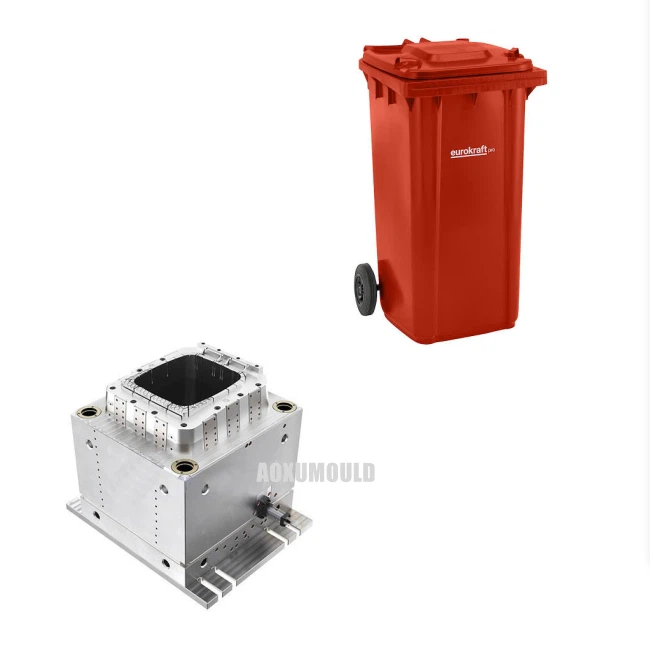
Mould Specifications
Mould name: 240L Plastic Bin Mould
Bin Dimensions: 57x72x103cm
Mould steel type: P20
Mould base: C45
Injection system: Cold runner, hot runner
Estimate mould dimensions: 1085X1000X1200mm
Suitable injection molding machine: 2400T
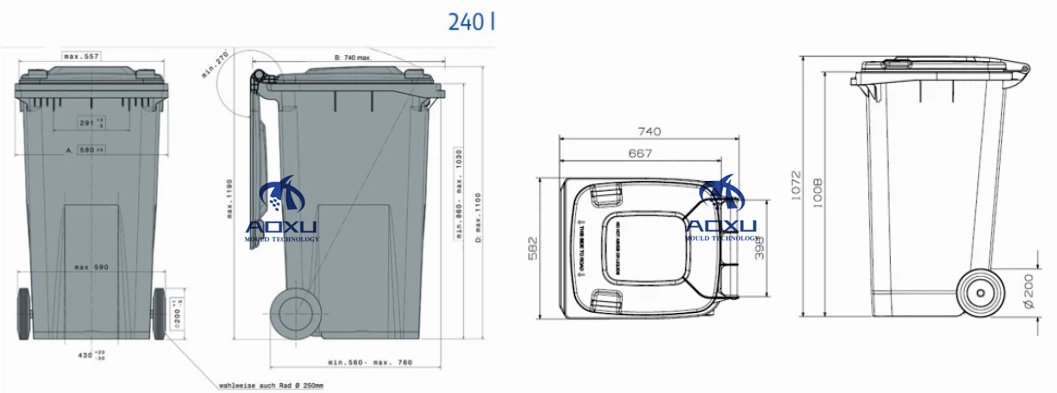
What Are The Specific Dimensions of A 240L Plastic Bin?
Generous Capacity: Holds 240 liters (63.4 US gallons) of waste, ideal for high-traffic commercial or public areas.
Robust Construction: Made from durable, impact-resistant, UV-stabilized HDPE plastic for long-lasting performance.
Practical Design: Features sturdy wheels for easy maneuverability, ergonomic handles for comfortable lifting/tilting, and a smooth inner surface for easy cleaning. Lid typically included (hinged or lift-off).
Standard Dimensions (Approx.):
Length: 59 cm (23.2 in)
Width: 49 cm (19.3 in)
Height (without wheels): 92 cm (36.2 in)
Height (with wheels): 100 cm (39.4 in)
Wide Application: Perfect for offices, restaurants, hotels, schools, hospitals, parks, apartment complexes, and industrial sites.
240L Plastic Bin Mould Customized By Using Steel P20
* Engineered for high-volume production of durable 240L bins.
* Manufactured from high-quality P20 tool steel (typically ~HRC 28-32 as supplied, machinable; can be hardened to ~HRC 38-42 for enhanced service life).
* Excellent balance of machinability, polishability, and toughness.
* Superior wear resistance for extended mold lifespan.
* Good dimensional stability during heat treatment (if required).
* Suitable for various plastic resins commonly used in trash can manufacturing (e.g., HDPE, PP).
Popular Material - Steel P20 For 240L Bin Mould

1. Clear Product Identification: 240L bin Mould instantly states the purpose and size. Adding Wheeled is common if applicable.
2. Material Highlight: P20 Tool Steel is prominently featured, which is crucial information for buyers.
3. Pre-Hardened State Mentioned:Specifying "Pre-Hardened" informs buyers about the typical delivery condition, important for machining considerations.
4. Key Benefits Listed: Focuses on the advantages of P20 steel relevant to trash can mold production: machinability, polishability (for a good finish), toughness (impact resistance), wear resistance (longevity), and stability.
5. Typical Hardness Range: Including the common as-supplied hardness (~HRC 28-32) and achievable final hardness (~HRC 38-42) provides essential technical detail expected by mold makers and buyers. You could simplify this to just Pre-Hardened (~HRC 28-32) if preferred.
6. Material Suitability: Mentions compatibility with typical plastics like HDPE or PP.
7. Conciseness: Gets the critical information across quickly for catalogs, websites, or quotes.
8. Professional Terminology: Uses standard industry terms like Tool Steel, Machinability, Wear Resistance, Dimensional Stability, Heat Treatment.
How To Developing A 240L Plastic Bin Mould?
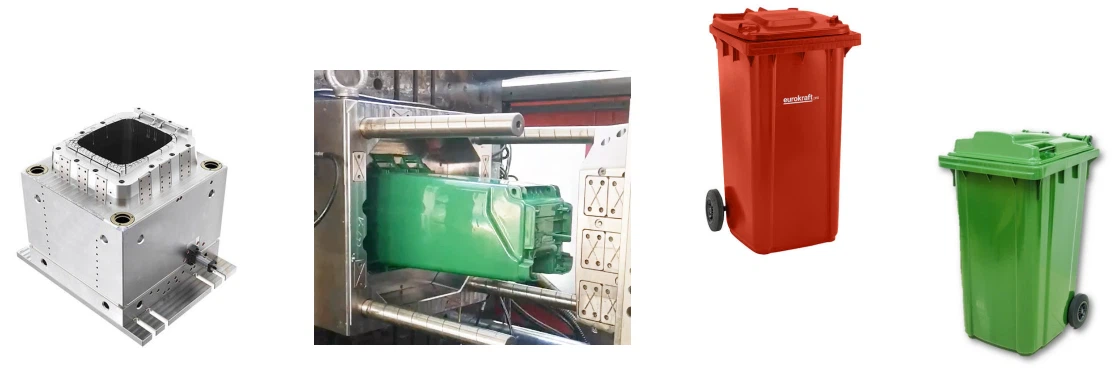
1. Product Design &. Requirements:
Capacity: Precise volumetric design to achieve true 240L (≈63.5 US Gallons) capacity, considering material thickness and internal geometry.
Material: Primarily High-Density Polyethylene (HDPE) for its excellent impact resistance, weather durability, chemical resistance, and recyclability. Consider UV stabilizers for outdoor use.
Wall Thickness: Optimized uniform thickness (typically 3.5mm - 5mm) for structural integrity, weight reduction, and efficient cooling. Avoid thick sections causing sinks or long cycles.
Structural Reinforcement: Integral ribs, corrugations, and feet designed for load-bearing (full bin weight, stacking, lifting stresses). Critical for handles and wheel mounting points.
Draft Angles: Adequate draft (min. 1°-2°, ideally 3°+ on deep draws) on all vertical surfaces for smooth ejection and preventing part damage/scraping.
Undercuts &. Features: Design solutions for handles, wheel axle slots, lifting points, and lid attachment features (often requiring side-actions/cams or lifters). Minimize complexity where possible.
Stackability & Nesting: Precise design of rim profile and base geometry to ensure stable stacking (for empty bins) and efficient nesting (for transport/storage).
Wheel Mounting: Robust design for axle insertion points or integrated wheel housings.
Lid Compatibility: Design for standard or specific lid attachment (hinge pins, clips, etc.).
2. Mould Design &. Engineering:
Mould Type:High-Cavitation Stack Mold is highly recommended. This places cavities back-to-back on a central "stack" plate, doubling output per machine cycle compared to a standard two-plate mold, significantly reducing part cost. Alternatives: Large two-plate mold (simpler, lower initial cost, lower output) or Three-Plate Mold (for specific gating needs).
Cavitation: Determined by part size, machine tonnage, and required output. Stack molds offer 2x, 4x, or even 8x cavities efficiently. (e.g., 1+1, 2+2, 4+4).
Mould Base &. Construction: Robust construction using hardened steel (e.g., P20, H13, S136) for cores, cavities, and critical components. Sufficient mold base size and support pillars to handle clamping forces and prevent deflection.
Gating System:
Direct Sprue Gate: Simple, cost-effective, good for filling large parts. Leaves a vestige on the base (often acceptable for bins).
Hot Runner System: Highly recommended for stack molds and high-volume production. Eliminates runners (saving material/regrind), improves cycle time, allows balanced filling of multiple cavities, provides flexibility in gate location (e.g., center-gated base). Requires higher initial investment.
Cooling System:Critical for cycle time and warpage control. Conformal cooling channels following complex part contours (especially deep draws and thick sections like base/rim). Baffles, bubblers, and optimized flow paths essential for uniform cooling. Consider materials like copper alloys for inserts if needed.
Ejection System: Robust system with ample, strategically placed ejector pins (Ø6mm+), sleeves, and potentially stripper plates/blocks for the deep draw. Sufficient stroke to fully clear the part. Nitrogen assist systems might be considered for very deep draws.
Venting: Extensive venting (perimeter vents, vent pins, porous inserts) at weld lines, end-of-fill areas, and deep ribs to prevent burns, short shots, and gas traps.
Side-Actions (Cams/Lifters): Required for undercuts (e.g., handles, axle slots). Design for reliability, smooth operation, and easy maintenance. Hydraulic or pneumatic actuation common.
Corrosion Protection: Consider surface treatments (e.g., nitriding, hard chrome plating) for cores/cavities, especially if using regrind or corrosive materials.
Professional Mould Development Inquiry: 240L Bin Mould
Project Specifications:
1. Product: Heavy-duty wheeled trash bin / garbage container
2. Capacity: 240 liters (Standard EU/ISO size)
3. Target Material: HDPE / PP (Rotomolding or Injection Molding)
4. Key Requirements:
- Mould Lifespan: ≥ 500,000 shots
- Wall Thickness: Uniform 4-6mm (reinforced base)
- Features:
• Integrated wheels &. axle slots
• Ergonomic lid with sealing rim
• Stackable design (nesting capability)
• Side handles &. lifting grips
5. Certification: Compliance with EN 840/ISO standards (if applicable)
Requested Services:
- Mould design &. DFM analysis
- CNC machining (hardened steel: P20/718/NAK80)
- Trial sampling &. T1 approval
- Post-production support (technical documentation)
Delivery Terms:
- T0: 45-60 days after order confirmation
- Warranty: 24 months against manufacturing defects
Quotation Should Include:
- Unit price (mould) &. payment milestones
- Mould flow analysis report
- Maintenance recommendations


