

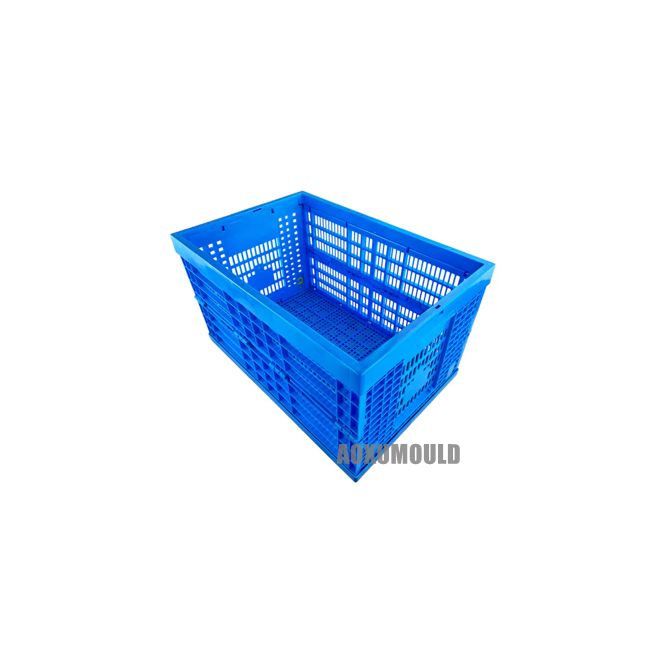
Mould Specifications
|
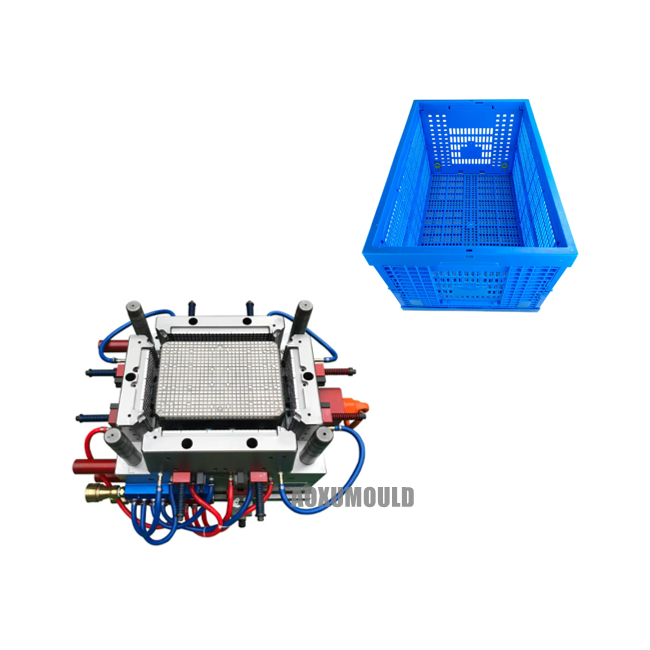
Mould name |
logistic box mould |
|
Crate material |
HDPE/PP, plastic |
|
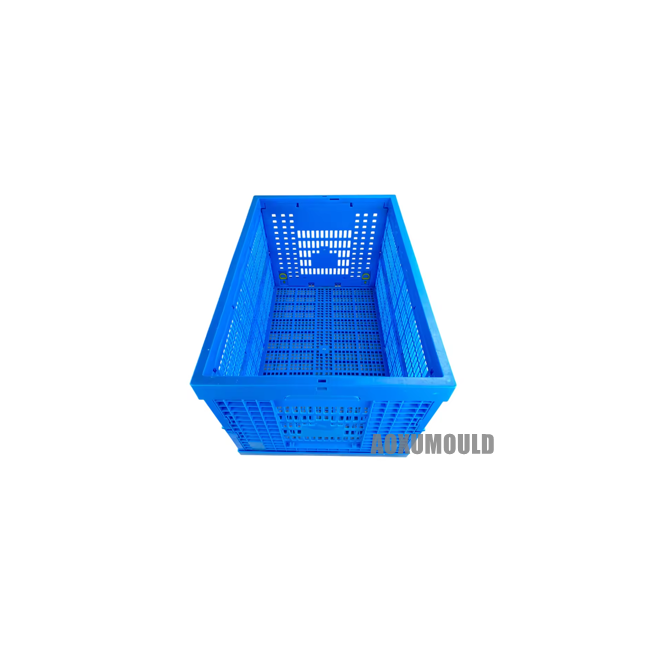
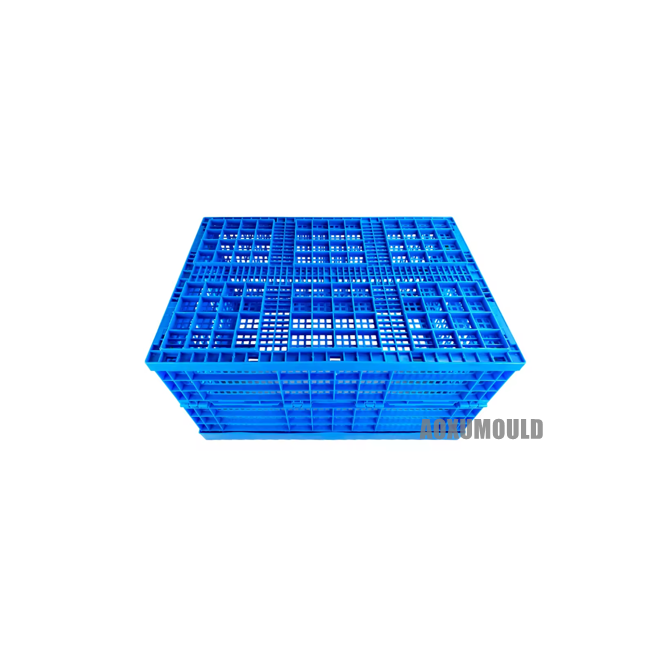
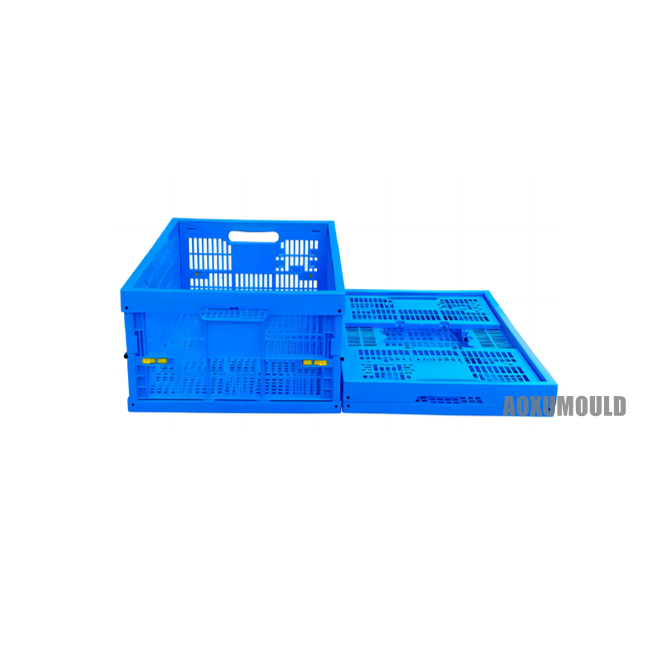
Crate size |
600X400X230mm |
| Crate weight |
2.3kg |
|
Mould material for cavity &. Core |
P20, 718, 2738 |
|
NOs of cavity |
1 cavity |
|
Injection system |
Chinese brand hot runner |
|
Suitable injection machine |
450T |
|
Mould size |
980x800x480mm |
|
Mould lifetime |
more than 500,000pcs |
What Are The Features of Plastic Logistics Box?
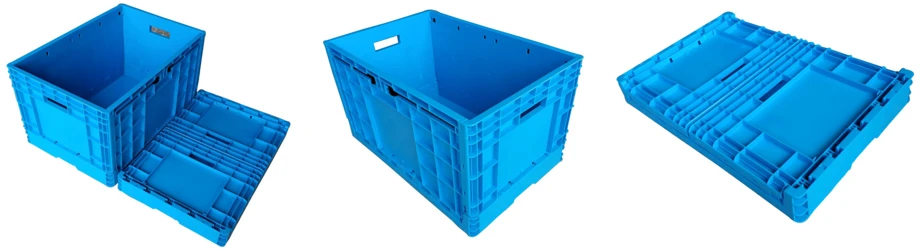
Attractive and durable: The plastic logistics box products are made by one-time injection molding of low-pressure high-density polyethylene (HDPE) (PP), with good gloss, good hand feel, and a long service life. Attractive, lightweight, anti-slip, impact-resistant, cold-resistant, heat-resistant, wear-resistant, pressure-resistant, corrosion-resistant, acid-resistant and alkali-resistant, breathable, and impermeable.
Reasonable structure design: The product has a well-designed structure with high load-bearing strength. The load capacity of the 1L capacity transfer box is within 1-100KG. When dropped freely from a height of 1.5 meters, it does not deform or crack severely.
Environmental protection and energy conservation: Plastic logistics boxes are more environmentally friendly and energy-efficient. They are made through a single injection molding process and are more sturdy and durable. Plastic logistics boxes have advantages such as anti-aging and anti-breakage, as well as high bearing strength, and the ability to stretch and compress.
Wide applicability: The plastic logistics boxes are suitable for transportation, distribution, storage, and circulation processing in factory logistics. Their reasonable design and excellent quality make them applicable to transportation, distribution, storage, and circulation processing in factory logistics.
Stackable: The plastic logistics boxes can be stacked together, which not only saves space but also reduces logistics costs.
Recyclable: The discarded logistics boxes can be processed and reused, without causing pollution to the environment or wasting resources.
Designs For Product &. Mould

What Are The Methods For Testing The Load-Bearing Capacity of Plastic Logistics Box?
Appearance inspection method: Check whether the appearance of the plastic box is intact, and whether there are any obvious damages, cracks or deformations.
Dimension measurement: Measure the length, width and height of the plastic box to ensure it meets the design requirements and usage needs.
Surface flatness inspection: Use a flatness measuring tool to check the surface flatness of the plastic box to prevent damage to the contents.
Physical performance testing method: Utilize mechanical testing equipment to assess the strength properties of plastic boxes, such as compressive strength, tensile strength, and impact resistance.
Weathering test: By exposing the plastic box to different environmental conditions, the weather resistance of the plastic can be evaluated, thereby predicting its lifespan and performance in actual use.
Load-bearing capacity test: By applying a certain load to the plastic box, its load-bearing capacity is evaluated to ensure that it can safely carry the goods.
Material composition testing method: Use chemical analysis methods or instruments to identify the type and composition of the materials used in the plastic boxes.
Soluble substance test: By immersing the sample of the plastic box, the content of soluble substances within it is detected to assess its safety and environmental friendliness.
What Are The Detailed Requirements For The Processing of Plastic Logistic Box Mould?

Mould material requirements: All mould frames are uniformly selected as Longji moulds; moulds with a size of 230 or above are uniformly equipped with four sets of needle plate guides. The core is strictly manufactured according to the material requirements listed in the company's mould quotation table. All insert parts in the front and rear molds are uniformly made of 2083 quenched material or Swedish S136 quenched material. All inserts in the front and rear moulds are made of Longji NAK80 material. All pins, inserts, bosses, and flat tops of the molds are uniformly made of SKD61 material. For injection molding with a production volume of over 500,000 pieces, pins, inserts, bosses, and flat tops are uniformly made of SKD51 material.
Mould processing requirements: All inserts, inserts and parts of the core of the front mould must be processed by slow wire cutting. The mirror surface of the front mould products shall be uniformly processed by mirror surface spark cutting to ensure the flatness of the product appearance. All moulds, flow channels and gateways shall be uniformly polished. For the rear mould core, inserts, stoppers and those with a diameter of less than 3.0, all shall be processed by slow wire cutting. Flat tops shall be processed by slow wire cutting. The diving ports shall be uniformly processed by spark cutting and polished to 1200# sandpaper or polished.
Mold structure requirements: For the rear mould of the product, all columns should be uniformly connected by rods; for the front mold, all columns should be uniformly fitted with pins. All through-holes should be uniformly in the form of inserts. All ribs and bones higher than 15mm should be in the form of inserts.
Mould appearance requirements: The surface should be mirror-like. It should be polished with 1500# and above sandpaper, and then coated with a protective film. The surface should have fine lines when polished. It should be polished with 1200# sandpaper. The surface should have coarse lines. It should be polished with 1000# sandpaper. The surface is required to be of a normal smooth finish by the customer. It should be polished with 1200# sandpaper to ensure uniform polishing effect. In the case of no requirements for the rear mould, it should be polished with 800# sandpaper.
Mould strength requirements: For moulds with a strength of 400 or above, the mould frame should be made into a block shape for the side, the bottom, and the top (the block material is P20). The edge of the mould core to the edge of the product should not be less than 35mm. For molds with a strength below 350, the edge of the mould core to the edge of the mould frame should not be less than 60mm. For molds with a strength above 350, the edge of the mould core to the edge of the mould frame should not be less than 75mm.
Mould production requirements: The mould must not be processed using any secondary processing methods with tools. Mould injection cycle: For a product weighing 200 grams, the cycle is V40S; for a product weighing 200 grams, the cycle is V50S. The mould must not require major repairs (limited to 3 maintenance days) when the injection cycle is less than 100,000 times. During mould production, the product qualification rate must be above 93%, and the double-color mould qualification rate must be above 80%.
Molded product requirements: The molded products must be one-time formed qualified products and no additional processing is allowed (except for processing required for corresponding special structures). A qualified molded product is defined as: its appearance conforms to the acceptance standards of Chuanyuan, the dimensional tolerance meets the requirements of the drawing design, the materials comply with the requirements and are in line with relevant laws and regulations, and the product strength meets the relevant tests.
Mould Try-out of Plastic Logistic Box
Why Choose Us
Quality Certification: Ensure that the suppliers possess relevant quality certifications, such as ISO13485, etc. These certifications indicate that the suppliers meet international standards and are capable of providing high-quality moulds that comply with the requirements of the medical equipment industry.
Experience and expertise: Select suppliers who possess extensive experience and professional knowledge. They have in-depth understanding of the design, manufacturing and usage of medical equipment moulds, and can provide you with professional advice and solutions.
Technical capability: Evaluate the technical capabilities of the suppliers, including their technical levels in mould design, processing, and improvement. Excellent technical capabilities can ensure the accuracy and stability of the moulds, thereby guaranteeing product quality.
Customer Service: The customer service provided by the supplier is also an important factor in the selection. They should be able to respond promptly to your needs and offer excellent after-sales services, including maintenance, repair and technical support, etc.
Cost-effectiveness: Although quality and service are of utmost importance, cost is also a factor that needs to be taken into consideration. Choose suppliers with reasonable prices and competitive offerings to ensure that your production costs are controlled.
Compliance and traceability: Ensure that the products of suppliers comply with relevant regulations and standards, and can provide complete product traceability to address potential quality issues and regulatory reviews.
Delivery time: Take into account the delivery time of the supplier. Timely delivery can ensure that your production plan is not affected and that market demand can be met promptly.
Equipment and skills of the workers: When choosing a plastic mould manufacturing factory, it is advisable to select one with relatively good equipment and skilled workers. Plastic mold manufacturing is a large-scale investment, so the quality requirements are extremely strict. If the equipment and skills of the workers in the plastic mold factory are not up to standard, the quality of the moulds and products will be greatly affected.
Scale and Delivery Time: Choose a plastic mould manufacturing factory with a relatively large scale. Some small workshops have multiple people handling various tasks, making it difficult for them to be professional. As a result, there may be issues with delivery times. Larger-scale mould factories have more reliable delivery times.
Establishment period and technological maturity: It depends on the establishment period of the plastic mould product factory. For newly established companies, due to the immature mold processing technology, it is difficult to meet the high requirements of customers in terms of mould processing accuracy.


