

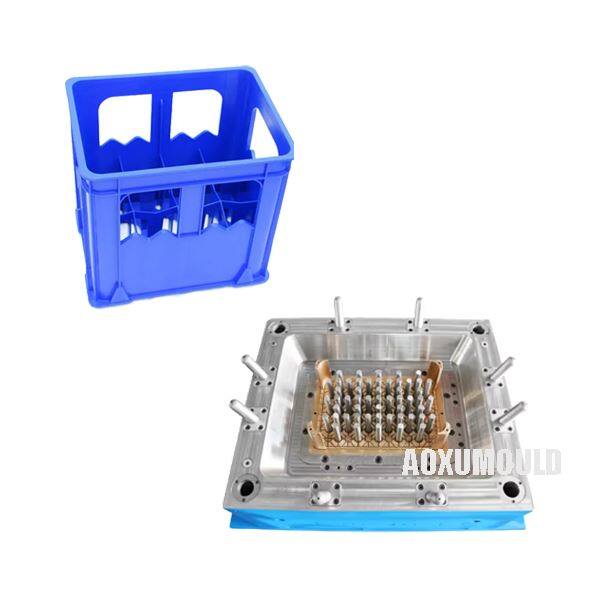
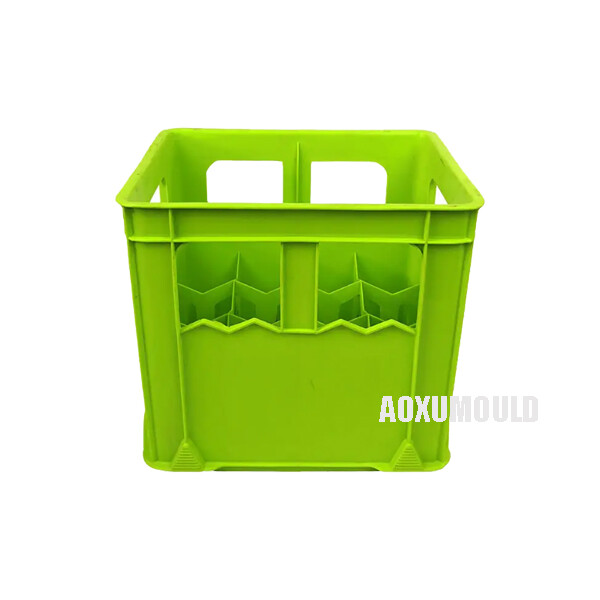
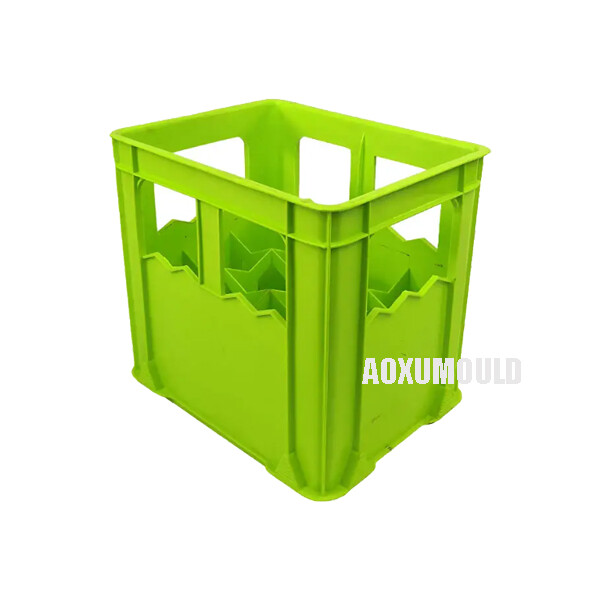
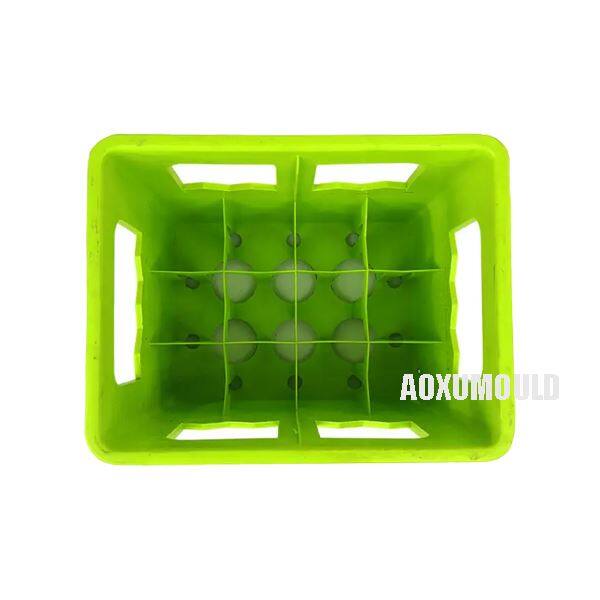
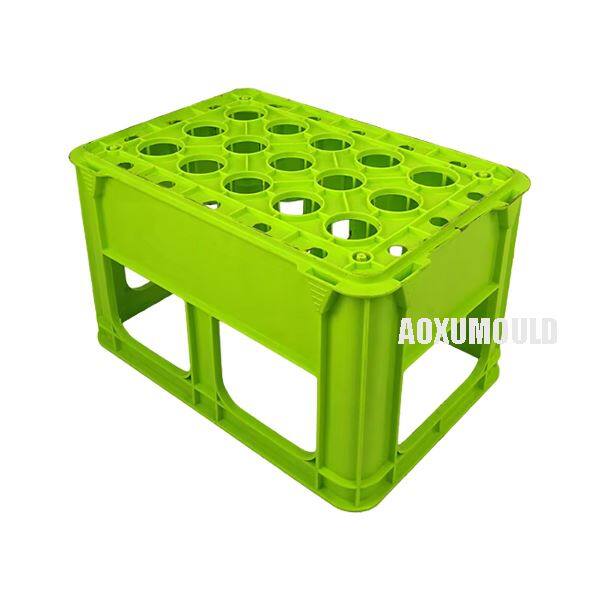
Mould Specifications
|
Mould name |
12-Bottle Crate Mould |
|
Product material |
HDPE, plastic |
|
Product Size |
366X275X245mm |
| Product Weight | 1.3KG |
|
Mould material for cavity &. Core |
P20, 718, 2738 |
|
NOs of cavity |
1 cavity |
|
Injection system |
Yudo Hot runner |
|
Suitable injection machine |
680T |
|
Mould size |
890X770X630mm |
|
Mould lifetime |
more than 500,000pcs |
Key Features of 12-Bottle Crates

1. Material & Durability
High-Density Polyethylene (HDPE) or Polypropylene (PP) – Offers excellent impact resistance, UV stability, and chemical resistance.
Reinforced Walls & Ribs – Provides structural strength to withstand stacking and rough handling.
Long Lifespan – Resistant to cracking, moisture, and temperature variations.
2. Bottle Compartment Design
Precision-Molded Divider Grids – Securely holds 12 bottles (usually standard 330ml/500ml/1L sizes) in place to prevent breakage.
Ventilation Holes – Allows drainage and airflow (useful for wet or condensation-prone environments).
3. Stackability & Nesting
Interlocking Design – Crates have stacking lips or grooves for secure, stable stacking (even when full).
Nesting Capability – Empty crates can often be nested to save storage/transport space.
4. Ergonomic Handling
Integrated Handles – Easy grip for manual lifting and carrying.
Lightweight Yet Sturdy – Balances weight for worker comfort while maintaining load capacity.
5. Logistics & Compatibility
Standardized Sizes – Fits pallets and conveyor systems for automated handling.
RFID/Barcode Tags (Optional) – Some crates include molded areas for tracking labels.
6. Customization & Branding
Embossed Logos/Text – Molded directly into the plastic for permanent branding.
Color Options – Custom colors (e.g., brewery-specific hues) using masterbatch pigments.
7. Sustainability
100% Recyclable – Made from mono-materials for easy recycling.
Reusable Design – Reduces single-use packaging waste.
Advantages Of Beryllium Bronze Inserts

1. Superior Thermal Conductivity
Faster Cooling: BeCu conducts heat 3–5× better than steel, reducing cycle times and improving production efficiency.
Uniform Cooling: Prevents warping or sink marks in large plastic crates.
2. High Strength & Wear Resistance
Hardness (HRC 36-42): Comparable to tool steel but with better heat dissipation.
Resists Abrasion: Holds up well against glass-filled or abrasive plastics (e.g., reinforced PP).
3. Corrosion & Chemical Resistance
Ideal for humid environments or corrosive plastics (e.g., PVC, acidic additives).
Resists pitting and oxidation better than standard steel.
4. Excellent Machinability & Polishability
Easier to machine into complex shapes (e.g., bottle dividers, textured surfaces).
Achieves a mirror-like polish for smooth crate interiors (reduces sticking).
5. Durable in High-Temperature Molding
Maintains strength at 300–400°C+, making it suitable for high-speed production.
6. Reduced Cycle Times & Energy Costs
Faster heat extraction = higher output & lower energy use per crate.
-Common Applications in Crate Moulds:
Core inserts (bottle compartments, ribs).
Ejector pins/sleeves (durable, heat-resistant).
Hot runner components (nozzles, gates).
Designs For Product &. Mould

Mould Try-out Of Berry Trays
Mould Components
Mould Steel

Hot Runner System

Standard Parts

Package &. Delivery

Why Choose Hot Runner System?
1. Eliminates Material Waste (No Sprues or Runners)
Cold Runner: Produces solid plastic waste (sprue & runners) that must be recycled or discarded.
Hot Runner: Keeps plastic molten in heated channels, injecting directly into cavities → 0% waste.
Cost Savings: Reduces raw material use by 5–15%, crucial for large-scale crate production.
2. Faster Cycle Times (Higher Productivity)
No need to eject and handle runners → shorter cooling & cycle times.
Ideal for multi-cavity molds (e.g., 2–4 crates per shot).
3. Improved Part Quality & Consistency
Balanced Flow: Ensures even filling of all cavities (critical for uniform crate strength).
Reduced Gate Marks: Smaller, cleaner gate vestiges vs. cold runners.
Lower Clamping Force Needed: Less pressure required vs. cold runners.
4. Better for Automated Production
No runner separation → fully automated molding (no manual degating).
Compatible with robotic crate extraction & stacking systems.
5. Energy & Cost Efficiency Over Time
Higher upfront cost than cold runners, but saves money long-term due to:
Less material waste.
Faster cycles → more crates per hour.
Lower labor costs (no runner handling).
6. Design Flexibility for Complex Crates
Allows sequential valve gating (controls flow to prevent warping).
Supports stack molds (double-layer production for ultra-high output).
FAQ
>1. What materials are used for 12-bottle crate injection moulds?
Mould Base: Hardened steel (e.g., P20, H13) for longevity.
Crate Material: Typically HDPE (High-Density Polyethylene) or PP (Polypropylene) for durability and impact resistance.
>2. How long does it take to manufacture a 12-bottle crate mould?
Lead Time: Usually 45-55 days, depending on complexity, steel type, and manufacturer workload.
>3. Can the mould be customized for different bottle sizes?
Yes, the cavity inserts can be modified for:
Bottle diameters (e.g., beer, soda, or wine bottles).
Crate dimensions (EU vs. US standards).
Branding (logos, text, or RFID tag slots).
>4. What surface finishes are available for the crates?
Textured (e.g., grit finish) – Improves grip and hides scratches.
Smooth Polish – For a premium look (less common for utility crates).
Matte or Gloss – Customizable based on branding needs.
>5. What are the maintenance requirements for the mould?
Regular cleaning, lubrication, and inspection of ejector pins, sliders, and cooling channels.
Corrosion prevention (especially for steel moulds in humid environments).
>6. Are the crates recyclable?
Yes, HDPE/PP crates are 100% recyclable and often made from recycled materials.
>7. How are the crates tested for quality?
Drop tests (from specified heights).
Stack load tests (simulating warehouse conditions).
UV resistance checks (for outdoor use).
Customers' Feedback


