

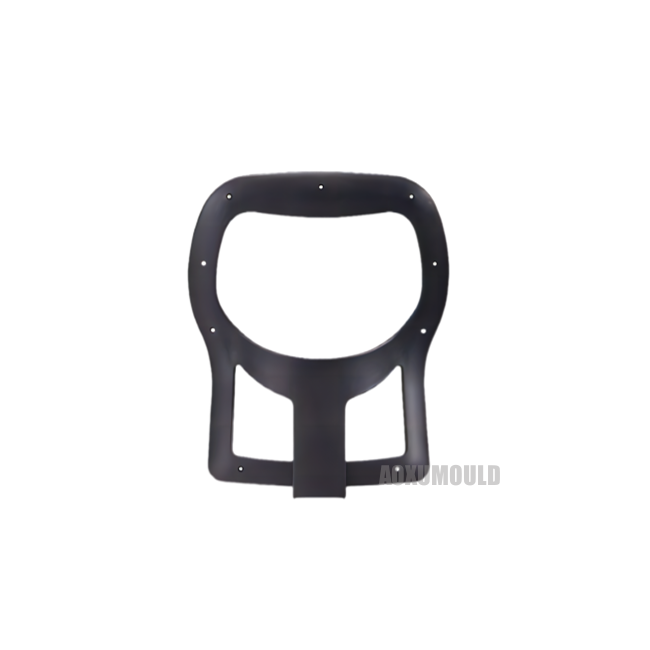
Mould Specifications
|
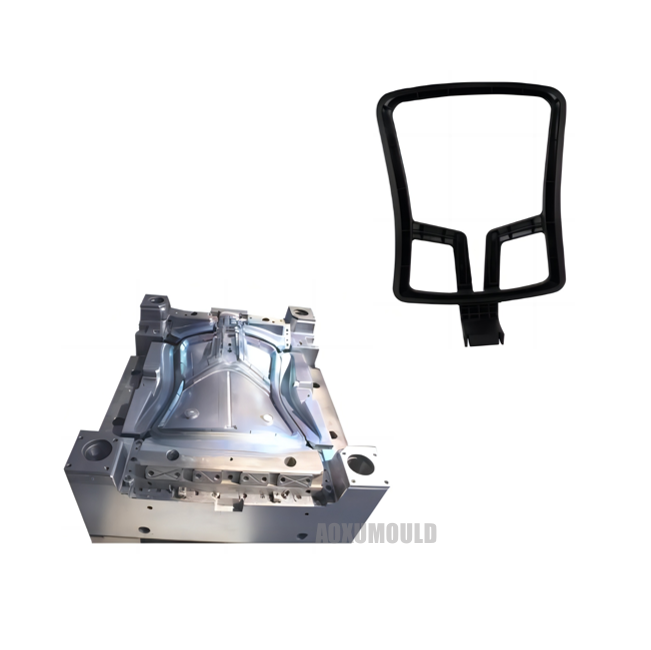
Mould name |
Office Chair Injection Mould |
|
Product material |
PA66+GF30 |
|
Product Size |
597X477X30mm |
| Product Weight |
2.7kg |
|
Mould material for cavity &. Core |
P20, 718 |
| Mould Base | C45 |
|
NOs of cavity |
1 cavity |
|
Injection system |
Cold runner |
|
Suitable injection machine |
550T |
|
Mould size |
830x730x320mm |
|
Mould lifetime |
more than 300,000pcs |
|
Delivery Time |
45 days |
The main components of an office chair

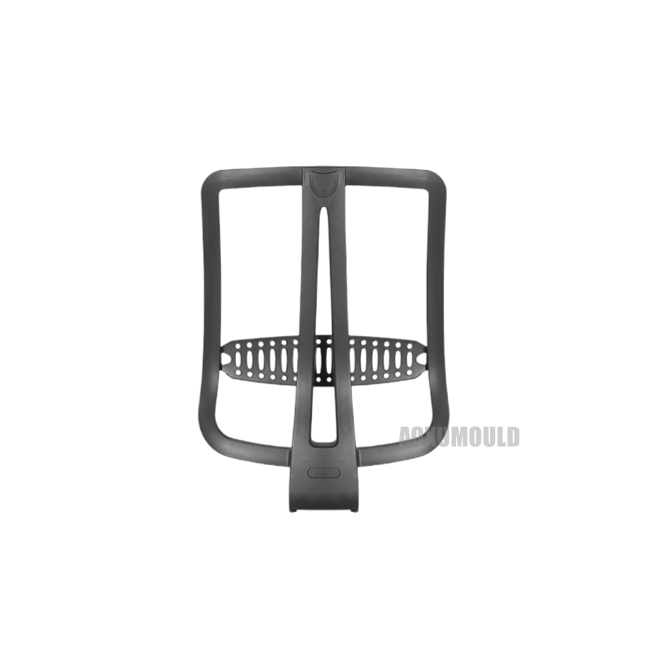
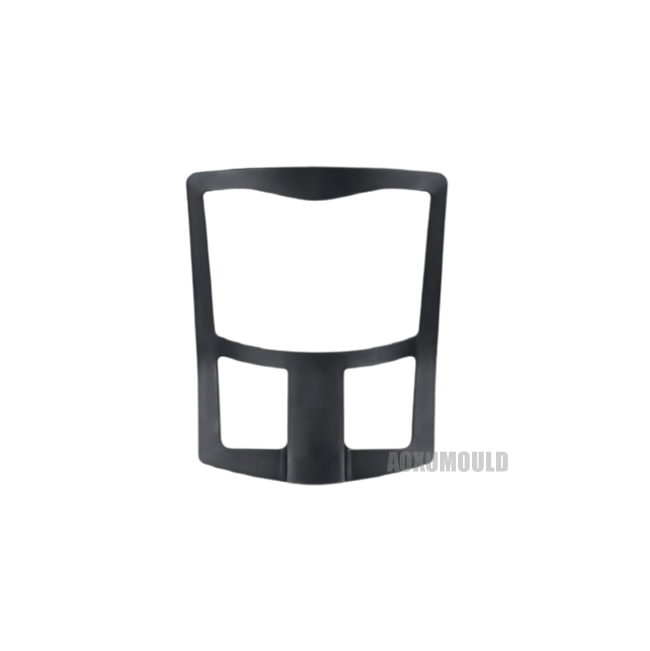
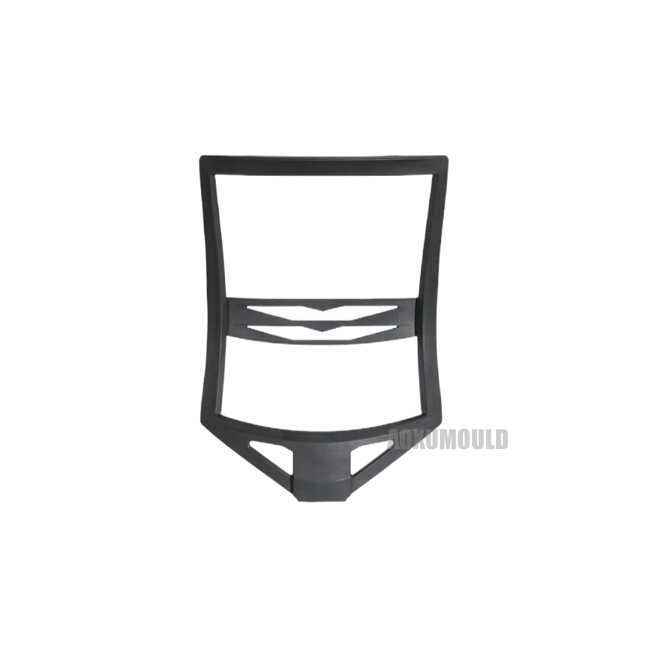
Chair backrest: support the spine, reduce back pressure, maintain the natural curve of sitting posture, and conform to the S-shaped curve of the human spine, prevent hunchback
Seat cushion: supports body weight, distributes pressure on the buttocks, and prevents fatigue from prolonged sitting.
Armrest: support the arms, reduce the pressure on the shoulders and neck, and keep the elbows naturally bent.
Five-star base: provide stable support, disperse the load-bearing pressure, nylon material is lightweight and economical, suitable for ordinary office environments.
Headrest: it supports the cervical vertebrae, relieves neck pressure and is suitable for leaning back to rest.
Why Is It Recommended To Use PA66+GF30 Material For Office Backrest?
The backrest is a very important component of an office chair, which directly affects the work efficiency and comfort of employees. Choosing the appropriate materials to make office backrests is of vital importance. Generally, we recommend using PA66+GF30 material to manufacture the backrests of office chairs.
PA66+GF30 material has excellent physical properties. PA66 is an engineering plastic with high strength, hardness and wear resistance. GF30 indicates that this material contains 30% glass fiber reinforcing agent, which makes its strength and rigidity even higher. Therefore, using PA66+GF30 material to make office backrests can ensure their structural stability, strong durability, resistance to deformation and cracking, and the ability to withstand long-term use and heavy pressure, guaranteeing that employees maintain a good posture during work.
PA66+GF30 material has excellent high-temperature resistance. In the office, there are sometimes short-term high-temperature operations, such as using hot air guns or heaters. If the backrest material cannot withstand high temperatures well, it may cause deformation or breakage, thereby affecting the work experience of employees. The PA66+GF30 material has a relatively high heat distortion temperature and thermal stability, which can maintain its shape and performance stability in high-temperature environments, ensuring the comfort and safety of employees.
PA66+GF30 material also has excellent corrosion resistance. In an office environment, some chemical substances, liquids or food may splash onto the backrest. If the backrest material cannot resist corrosion well, it may cause the surface of the material to discolor, fade or deform, affecting the overall aesthetics of the office. The PA66+GF30 material has excellent chemical resistance and can resist the erosion of common acids, alkalis and solvents, maintaining the appearance and performance of the backrest as good as new for a long time.
Design For Product &. Mould

Why Do Office Chair Injection Mould Need To Use Better Mould Steel?

PA66+GF30 material is an engineering plastic with excellent performance, featuring high strength, wear resistance, heat resistance, corrosion resistance and other advantages. When PA66+GF30 material is used in products, choosing better mould steel is a very important matter for office chair mould quality.
The quality of mould steel is directly related to the service life and processing efficiency of the mould. PA66+GF30 is a high-performance engineering plastic with high strength and hardness. The pressure and friction that the mould bears during the processing are also relatively large. If substandard mould steel is selected, it can easily lead to severe wear, deformation, cracking and other problems on the mould surface, affecting the precision and stability of the mould, and even the normal operation of the entire production line. Choosing high-quality mold steel can not only ensure the service life of the mold, but also improve the processing accuracy and stability of the mould, reduce production costs and increase production efficiency.
The quality of mould steel is directly related to the quality of the product. During the processing, the mould directly comes into contact with the surface of the product. The quality of the mould surface has a direct impact on the surface finish and dimensional accuracy of the product. If substandard mold steel is chosen, it is easy to cause problems such as defects, unevenness and color differences on the product surface, which will affect the quality and appearance of the product. Choosing high-quality mould steel can ensure the smoothness, flatness and precision of the mould surface, guarantee that the product quality meets the requirements, and enhance the competitiveness of the product.
Choosing better mould steel can also enhance the working efficiency and production efficiency of the mould. High-quality mould steel features high wear resistance and corrosion resistance, which can reduce the maintenance and replacement frequency of moulds, lower the downtime of production lines, and enhance production efficiency. Meanwhile, high-quality mould steel also has good thermal and electrical conductivity, which can accelerate the cooling speed of products, shorten the production cycle and improve production efficiency.
How To Solve The Problem of Fit Between Office Chair Accessories From The Perspective of Mould?
We know that office chairs are composed of many accessories, including backrests, cushions, armrests, bases, rollers, etc. How to solve the coordination problem among these accessories is very important, as it is related to whether the final product is qualified. Therefore, we offer some suggestions from the perspective of office chair mould.
Mould design accuracy: during the design stage, the dimensions and tolerances of the parts should be fully considered, and appropriate calculation and design methods should be adopted to ensure the accuracy of the mould. The issue of mould accuracy may be due to insufficient consideration of part dimensions and tolerances during design, resulting in the inability to meet the accuracy requirements after the mould is manufactured.
Ensure the processing accuracy of materials to reduce the dimensional error of the mould and improve the assembly accuracy of the mould.
Mould material selection: according to the working conditions and requirements of the mould, select materials with sufficient strength and toughness to ensure the durability and service life of the mould.
For moulds operating in corrosive environments, materials with good corrosion resistance should be selected.
Heat treatment process: according to the working temperature and performance requirements of the mould, select the appropriate heat treatment process to enhance the hardness and wear resistance of the material.
The hardness and wear resistance of the mould surface are enhanced through surface coating, carburizing, nitriding and other processes.
Mould structure optimization: optimize the structural design of the mould to enhance its strength and durability, reduce stress concentration and wear, and improve the stability and service life of the mould.
Adopting the modular design method, the design process is decomposed into several modules to improve the design efficiency.
Assembly process monitoring: adopt high-precision CNC machine tools, machining centers and other equipment to improve processing accuracy and efficiency. High-precision measuring equipment such as three-coordinate measuring machines and laser interferometers are adopted to precisely measure each component of the mould, ensuring assembly accuracy. Strengthen the monitoring of the assembly process. By real-time monitoring of the assembly process, problems in assembly can be discovered and solved in a timely manner to ensure the stability and reliability of assembly quality.
Mould testing and debugging: after the mold manufacturing is completed, a trial mould is conducted. Based on the results of the trial mould, the size and fit relationship of the mould are adjusted to ensure the fit accuracy of the final product. Use fit tools to simulate the motion relationship between components, such as linear coupling and restricted fit in SOLIDWORKS, to ensure that the motion relationship between components meets the design requirements
Package &. Delivery

Mould Components
Mould Steel

Hot Runner System

Standard Parts

Customers' Feedback

FAQ
>1. What is office chair injection mould?
An injection mould is a tool used to produce plastic parts by injecting plastic into the mould cavity.
>2. What materials are used to make office chair injection mould?
The most common materials used to make injection moulds are high-quality steel, such as P20, 718, 2738, etc.
>3. What is the process of making a plastic office chair mould?
The process of making a mould includes design engineering, machine programming, tooling fabrication, mould testing and validation.
>4. Can moulds be customized to specific product requirements?
Yes, moulds can be customized to specific product requirements depending on the design and specifications of the project.
>5. What are some factors to consider when making our plastic moulds?
Some factors to consider when making plastic moulds include product design, plastic material selection, mould material selection, injection moulding machine capacity, cooling time, and mould maintenance requirements.
>6. How long does it take to make one set of mould?
The time it takes to make mould can vary depending on the complexity and size of the mould.
However, it usually takes between 6 and 8 weeks.
>7. What can be done to ensure the mould quality?
To ensure mould quality, proper design and engineering, high-quality materials, and strict quality control procedures should be employed during the entire process of making the mould.
>8. How long can a mould last?
The lifespan of a mould can vary depending on the quality of the mould, maintenance practices, and operating conditions. A well-maintained mould can last for hundreds of thousands of cycles.
>9. What are the benefits of making plastic injection moulds?
Some benefits of making plastic moulds include faster production times, lower costs per unit, high accuracy, and the ability to produce complex shapes and designs.
>10. Can our office chair injection mould be repaired and maintained?
Yes, it can be repaired and maintained to extend their lifespan. Regular maintenance can prevent breakdowns and ensure consistent quality.


