

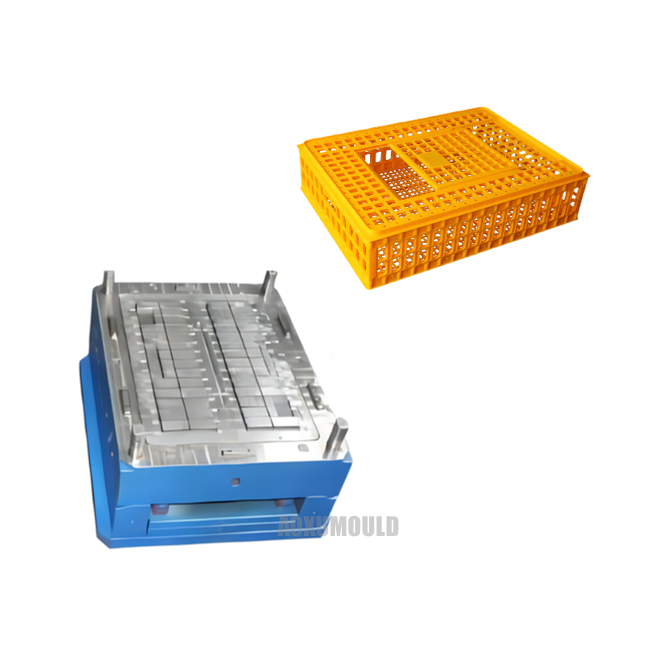
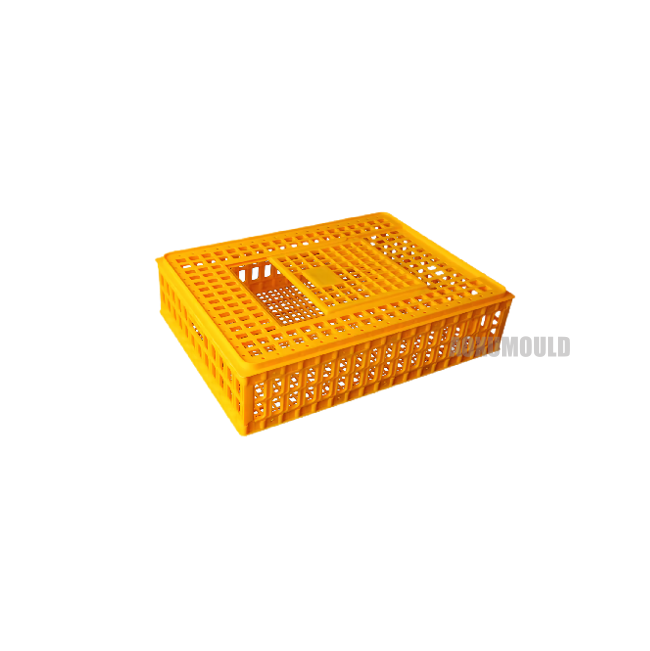
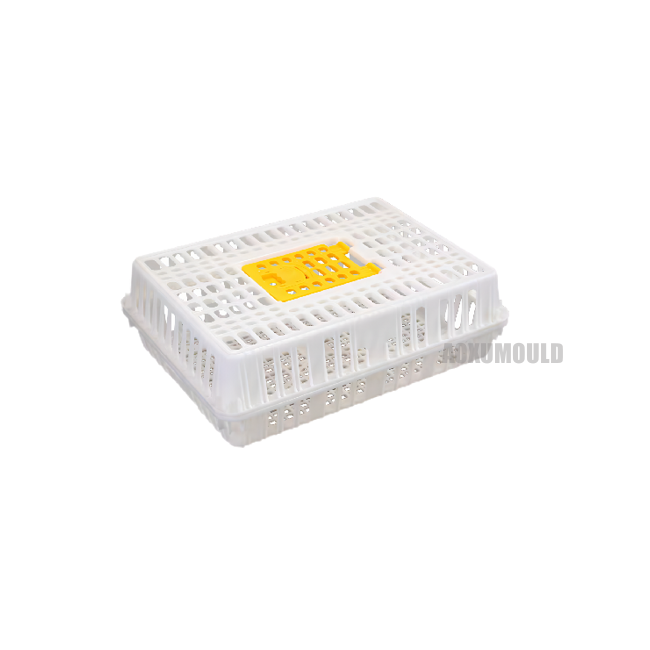
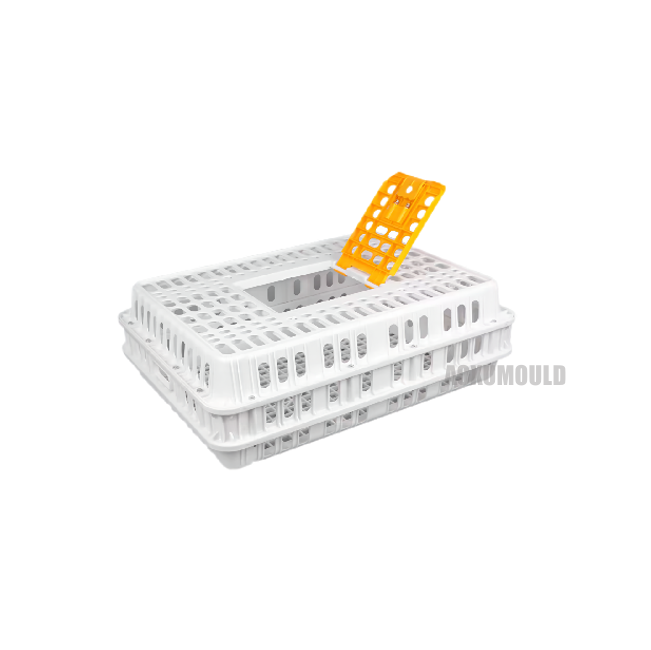
Mould Specifications
|
Mould name |
Plastic Transport Cage Mould |
|
Product material |
PP, plastic |
|
Product Size |
750X550X190mm |
|
Product weight |
4.7KG |
|
Mould material for cavity &. Core |
P20, 718 |
|
Mould base |
P20, 718H |
|
Injection system |
Cold runner |
|
Suitable injection machine |
850T |
|
Mould size |
1030x880x450mm |
|
Mould lifetime |
More than 500,000pcs |
What Are The Advantages of Transporting Cages With Plastic Compared To Iron?

1.Plastic chicken cages are lighter compared to iron chicken cages, which means they are easier to handle during transportation and handling. This can not only reduce labor intensity, but also improve work efficiency.
2.The surface of plastic chicken cages is smooth, not easy to rust, and has waterproof and moisture-proof properties, which makes cleaning and disinfection easier. Iron chicken cages are prone to rusting and may produce rust stains after prolonged use, thereby affecting the health and production efficiency of chickens.
3.Plastic chicken cages have good ventilation performance, which can maintain air circulation inside the chicken coop and reduce the risk of disease transmission. In contrast, iron chicken cages have poor ventilation performance and are prone to causing illness or death in chickens.
4.Plastic transport chicken cages also have high durability and compression resistance. Iron chicken cages are prone to damage after long-term use, while plastic chicken cages can withstand long-term use and external environmental tests, reducing the cost of replacement and maintenance.
5.Plastic chicken cages also have significant advantages in terms of hygiene and environmental protection. As a recyclable material, plastic chicken cages reduce the consumption of natural resources and contribute to sustainable development. Moreover, plastic chicken cages are easy to clean and disinfect, helping to maintain the comfort and health of chickens.
Designs For Product &. Mould

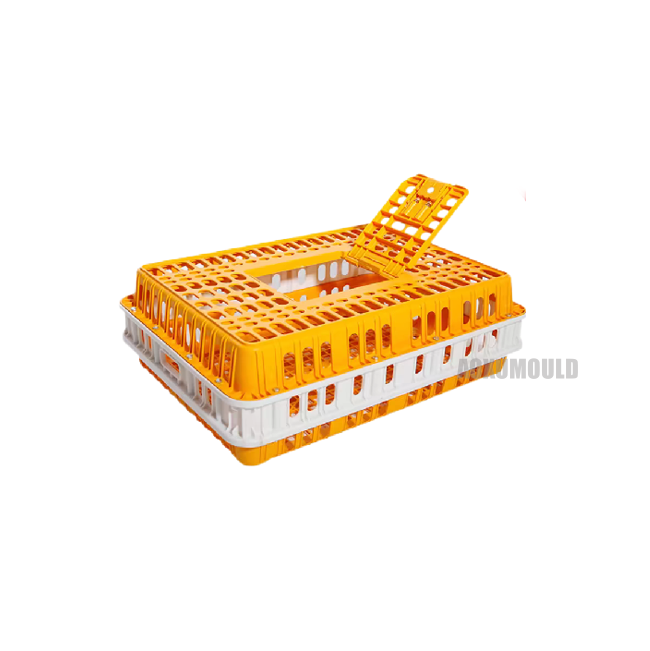
Design Details of Plastic Transportation Cage

1.Edge thickening, can be stacked ten layers without defor-mation, improve transportation efficiency.
2.Oval opening, the design is reasonable to ensure the ventilation conditions inside the basket.
3.Push-pull cage door, push-pull small door guide design, easy to close the cage door
4.Self-locking buckle, screwless fastening and easy to disassemble and use.
How To Design Reasonable Exhaust System For Plastic Transportation Cage Mould?
When designing the exhaust system for plastic transportation cage mould, the following aspects need to be considered:
1. Ensure good ventilation: The design of the exhaust system should fully consider the effect of ventilation, ensure smooth air circulation inside the chicken cage mold, and avoid the accumulation of harmful gases that may cause the chicken cage mold to deteriorate or produce odors.
2. Safety considerations: The exhaust system should be safe and reliable, avoiding situations such as air leakage. The design of the exhaust system needs to consider factors such as waterproofing and dust prevention to ensure the quality and service life of the chicken cage mould.
3. High efficiency convection: Convection can accelerate the discharge of harmful gases and reduce the temperature inside the mould, while the chicken cage mold operates within the range of thermal deformation temperature. The more favorable the convective system, the more thorough the smoking and the wider the circulation.
4. Reduce production costs: The design of the exhaust system should be able to reduce production costs and improve production efficiency. By designing the exhaust system reasonably, the scrap rate can be reduced, and the production quality and utilization rate of chicken cage molds can be improved.
5. Energy conservation and environmental protection: The design of exhaust systems should consider energy conservation and environmental protection, and reduce energy waste. Efficient technologies such as energy-saving ventilation devices can be used to reduce energy consumption and minimize environmental impact.
How To Solve The Problem of Plastic Transport Cage Deformation From The Perspective of Mould?
From the perspective of the mould, the problem of deformation in plastic transportation chicken cages is mainly due to the unreasonable design of the mould structure, such as uneven wall thickness, insufficient demolding slope, improper gate position and quantity, and design issues with the ejection system
1. Optimize the design of the cooling system
Uniform cooling layout: Adopting a conformal cooling water circuit to ensure uniform temperature in all areas of the mold (especially thick walls and reinforced ribs), avoiding uneven shrinkage caused by differences in cooling rates.
Cooling time control: Extend the cooling time or increase the density of the cooling water channel to reduce residual stress.
2. Reasonably design the pouring system
Gate position and quantity: Multiple symmetrical gates (such as fan-shaped or hidden gates) are used to balance the flow path of the melt, shorten the filling time, and reduce uneven shrinkage caused by differences in flow direction.
Flow channel balance: Ensure that the filling pressure of each mould cavity is consistent to avoid local overpressure or underinjection.
3. Control the uniformity of wall thickness
Gradient transition design: Avoid sudden changes in wall thickness (such as using circular arc transition at the connection between the reinforcing rib and the main body), and control the thickness of the rib within 50% -70% of the main wall thickness.
Simplified structure: Reduce deep cavities and complex embedded structures, and if necessary, use sliders or slanted tops for parting.
4. Enhance demolding stability
Demoulding slope: Ensure a minimum demoulding slope of 1 °~2 ° (larger in deep cavity areas) to reduce ejection resistance.
Optimization of the ejection system: The ejector pins are evenly distributed and prioritized for placement in load-bearing areas (such as the bottom edge of the cage) to avoid local stress concentration.
5. Material shrinkage compensation
Mold size scaling: Enlarge the mould cavity size based on the material shrinkage rate (such as PP shrinkage rate of 1.5% -2.5%), and adjust the local compensation amount in combination with CAE simulation.
Fiber orientation management: If using fiberglass reinforced materials, optimize the gate position to reduce anisotropic shrinkage caused by flow direction.
Mould Try-out of Plastic Transport Cage Mould
Package &. Delivery

Mould Components
Mould Steel

Hot Runner System

Standard Parts

FAQ
Customers' Feedback


