

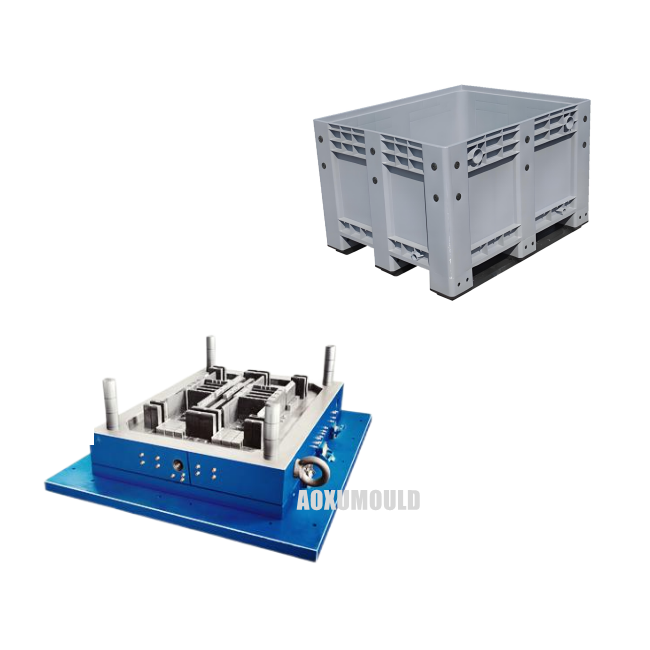
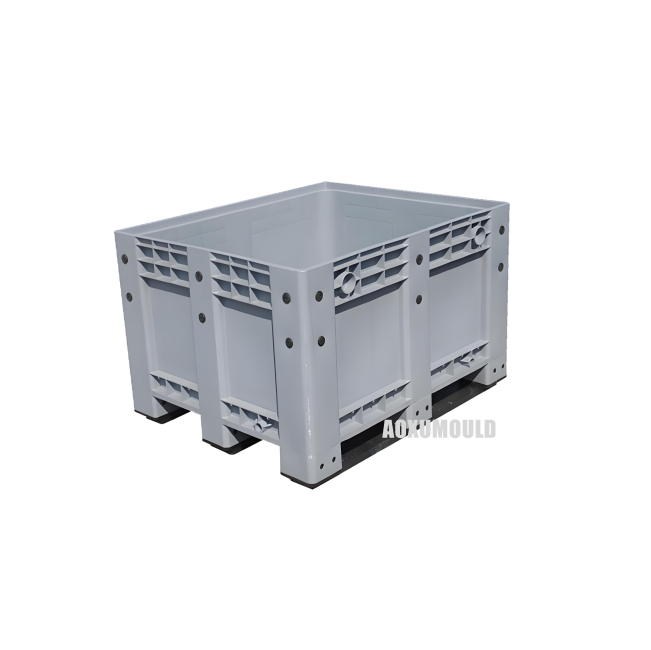
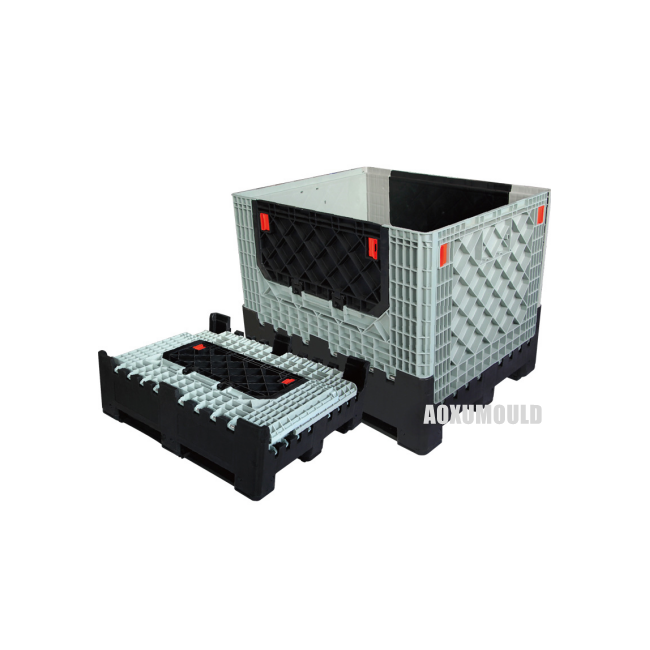
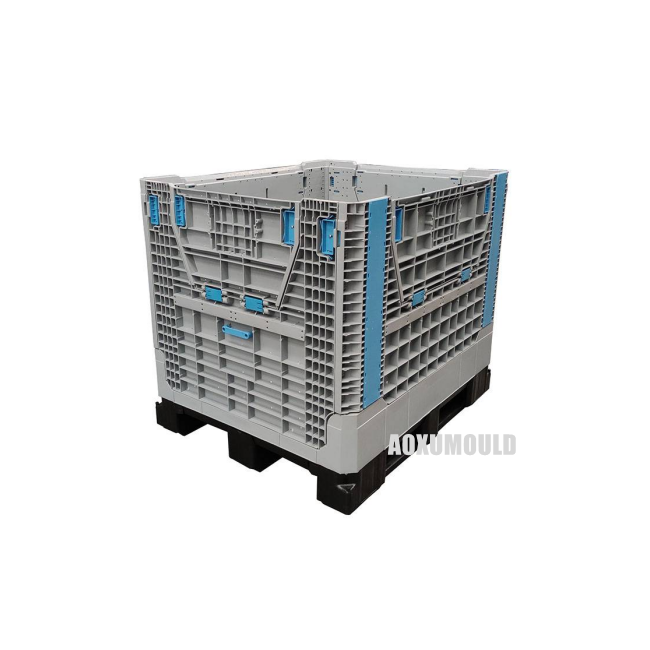
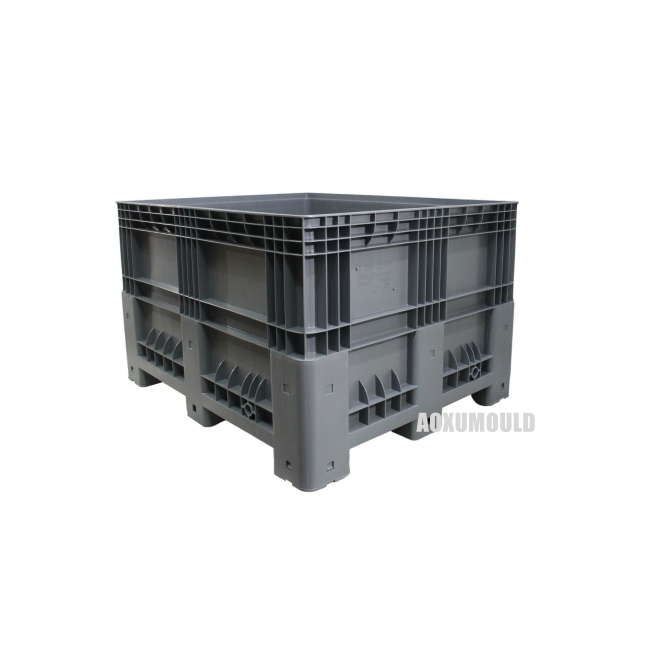
Mould Specifications
|
Mould name |
Pallet Box Mould |
|
Product material |
High-density polyethylene(HDPE)/PP |
|
Product Size |
1200mm(W) x 1000mm(L) x 760mm(H) |
|
Mould material for cavity &. Core |
2738 |
|
Mould base |
C45 |
| NO.s of cavity | 1 cavity for such big mould |
|
Injection system |
Hot runner valve gates |
|
Suitable injection machine |
4500T |
|
Mould size |
1800X1800X1350mm |
| Mould weight |
32500T |
|
Mould lifetime |
more than 500,000pcs |
| Lead time |
After design is finalized, 65 days |
Why Are Moulds Required for Plastic Pallet Boxes?

Plastic pallet boxes, widely used in logistics, warehousing, and manufacturing, require mould-based production due to the technical and economic demands of industrial-scale manufacturing. Moulds, typically made of steel, are precision-engineered tools that define the shape, structure, and functionality of the final product. Below are the key reasons for using molds in their production:
1. Precision and Consistency
Moulds enable high repeatability, ensuring uniform dimensions, wall thickness, and structural features (e.g., ribs, stacking lugs, or venting channels) across thousands of units. This consistency is critical for compatibility with automated handling systems, forklifts, and racking systems in supply chains.
2. Complex Geometry
Plastic pallet boxes often incorporate intricate designs to enhance load-bearing capacity, anti-slip surfaces, or nesting capabilities. Injection molding allows for precise replication of these features, which would be impractical or cost-prohibitive with alternative methods like thermoforming or machining.
3. Material Efficiency
Molding processes (e.g., injection, blow molding) minimize material waste by controlling resin flow and cooling rates. This efficiency reduces per-unit costs and aligns with sustainability goals by limiting scrap generation.
4. Durability and Performance
Molds facilitate the use of engineering-grade plastics (e.g., HDPE, PP) with additives for UV resistance, fire retardancy, or anti-static properties. The controlled molding process ensures optimal molecular alignment, enhancing impact resistance and longevity in harsh environments.
5. Cost-Effectiveness at Scale
While mould creation involves high upfront costs (design, prototyping, tooling), it becomes economical for large production runs. The per-unit cost drops significantly compared to low-volume methods, justifying the investment for manufacturers serving global supply chains.
6. Customization Flexibility
Moulds can be modified to produce variants (e.g., collapsible designs, integrated RFID slots) without redesigning entire tooling systems, enabling tailored solutions for specific industries like pharmaceuticals or automotive.
7. Regulatory Compliance
Standardized molding ensures compliance with international safety and load-testing standards, reducing liability risks.
Moulds are indispensable for producing plastic pallet containers that meet industrial demands for strength, precision, and cost efficiency. The technology balances upfront investment with long-term operational benefits, making it the cornerstone of modern plastic logistics solutions.
How To Design A Plastic Pallet Box Mould?

1.Design & Structure
The mold is typically constructed as a multi-cavity or single-cavity tool, depending on production volume requirements. It features a modular design with hardened steel or beryllium copper inserts to withstand high injection pressures (often exceeding 1,500 bar) and abrasive polymer flows. Critical components include:
A.Core and cavity blocks with textured surfaces to achieve anti-slip features on the pallet base
B.Integrated rib structures for reinforcing load-bearing walls (up to 2,000 kg capacity)
C.Interlocking features for stackability and compatibility with automated handling systems
2.Material Selection
Premium-grade steel alloys such as DIN 1.2344 (H13) or 1.2316 are employed for critical components, offering exceptional wear resistance and thermal stability. Surface treatments like nitriding or PVD coatings enhance durability, extending mold life beyond 1 million cycles. Guide pillars and bushings utilize hardened tool steel to maintain alignment under cyclic loading.
3.Cooling System
Conformal cooling channels are strategically machined to optimize thermal management, reducing cycle times by 20–30% compared to conventional designs. The cooling layout follows the pallet's geometry, ensuring uniform heat dissipation from thick-walled sections (typically 8–12 mm) to minimize warpage and residual stresses.
4.Ejection & Automation
A multi-stage ejection system combines hydraulic lifters, air poppets, and stripper plates to safely demold deep-drawn containers without distortion. Quick-change insert systems enable rapid format adjustments for producing pallets in standardized dimensions (e.g., 1200×800 mm or 1200×1000 mm). The mold integrates with robotic part removal systems via standardized interfaces.
Is MoldFlow Analysis Necessary for Large Pallet Box Moulds?

Yes, Mold Flow Analysis (MFA) is critical for designing and manufacturing large pallet container moulds. Key reasons include:
1. Complex Geometry and Size
Large pallets often feature thin walls, ribs, and snap-fit structures. MFA predicts polymer flow behavior to avoid defects like incomplete filling, air traps, or weak weld lines.
2. Material and Process Optimization
Pallets typically use high-flow or impact-resistant materials (e.g., PP, HDPE). MFA validates material suitability and optimizes parameters (injection pressure, temperature, cooling time), reducing trial-and-error costs.
3. Minimizing Warpage and Shrinkage
Uneven cooling in large molds can cause warpage or sink marks. MFA simulates cooling efficiency to ensure dimensional stability.
4. Cost and Risk Reduction
Large moulds involve high development costs. MFA identifies design flaws early, avoiding costly mold modifications or scrap, thereby accelerating time-to-market.
Mold Flow Analysis is a cost-effective tool to enhance quality, efficiency, and reliability in large pallet box mould production.
Package &. Delivery

Mould Components
Mould Steel

Hot Runner System

Standard Parts

FAQ
|
1. What is a pallet box mould? A pallet box mould is a specialized tool used in injection moulding to manufacture plastic pallet boxes. These containers are designed for storage, stacking, and transporting goods, often in industrial settings. The mould shapes molten plastic into the desired form, ensuring durability and consistency. 2. What materials are used for pallet box moulds? Moulds are typically made from high-grade steel for durability and heat resistance. The plastic used for the boxes is often polypropylene (PP) or high-density polyethylene (HDPE) due to their strength and impact resistance. 3. What are the key components of a pallet box mould? - Core & Cavity: Forms the box's shape. - Cooling System: Regulates temperature for efficient cycle times. - Ejection System: Releases the cooled product. - Vents: Prevent air traps and defects. 4. What is the manufacturing process for a mould? - Design: CAD-based engineering for precision. - Material Selection: Steel chosen for longevity. - Machining: CNC or EDM for accuracy. - Heat Treatment: Hardening via quenching/tempering. - Assembly & Testing: Ensures functionality before production. 5. Single vs. Multi-Cavity Moulds? - Single-Cavity: Lower cost, ideal for small batches. - Multi-Cavity: Higher output, cost-effective for large volumes. 6. Hot Runner vs. Cold Runner Systems? - Hot Runner: Reduces waste, faster cycles; higher upfront cost. - Cold Runner: Simpler, cheaper but generates more waste. 7. Design Considerations - Wall Thickness: Uniformity prevents warping. - Draft Angles: Eases ejection (1–2° typical). - Gate Location: Affects flow and aesthetics. 8. Cost Factors - Material grade, mould complexity, size, and production volume. Multi-cavity/hot runner systems increase initial cost but reduce per-unit price at scale. 9. Maintenance Tips - Regular Cleaning: Remove residues to prevent defects. - Lubrication: Ensures smooth ejection. - Inspection: Check for wear/damage post-production. 10. Customization Options - Logos/text via engraving, adjustable dimensions, and color variations (using masterbatches). 11. Troubleshooting Common Issues - Warping: Improve cooling uniformity. - Sink Marks: Increase holding pressure/time. - Short Shots: Check material flow or gate size. 12. Lead Time Factors - Complexity, manufacturer backlog, and material availability (3–12 weeks typical). 13. Choosing a Manufacturer - Evaluate experience, technology (e.g., CNC/EDM capabilities), quality certifications, and post-sale support. 14. Safety Standards - Compliance with ISO (e.g., ISO 21898 for packaging) and ASTM standards ensures load-bearing safety and material quality. Alternatives to Injection Moulding - Blow Moulding: For hollow designs. - Rotational Moulding: Low-volume, large items. 16. Environmental Impact - Use recyclable plastics (PP/HDPE), energy-efficient machines, and minimize waste through hot runner systems. 17. Future Trends - Automation for precision, biodegradable materials, and IoT-enabled moulds for real-time monitoring. 18. Advantages of Injection Moulding for Pallet Boxes - High production speed, repeatability, and ability to integrate features like reinforced walls or stackable designs.
|
Customers' Feedback


