

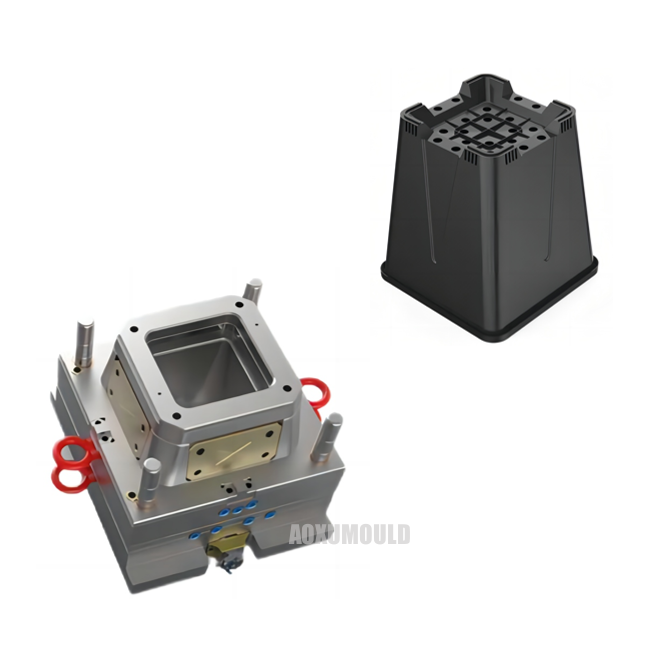
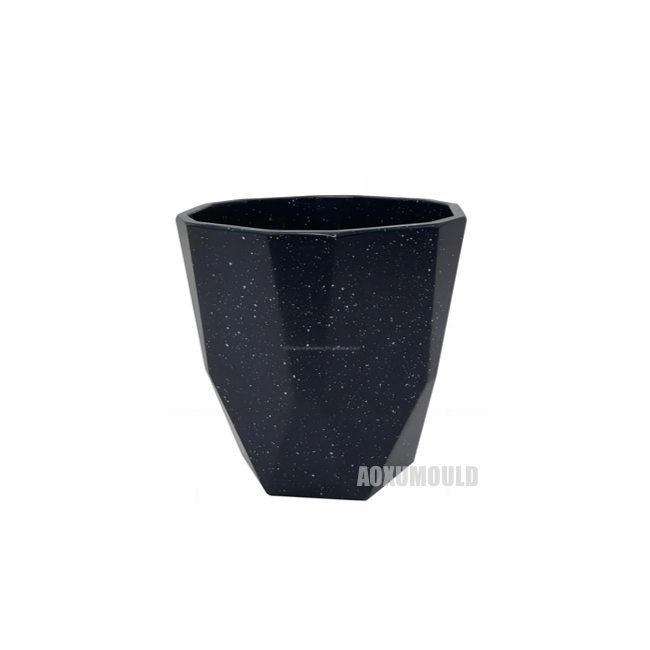
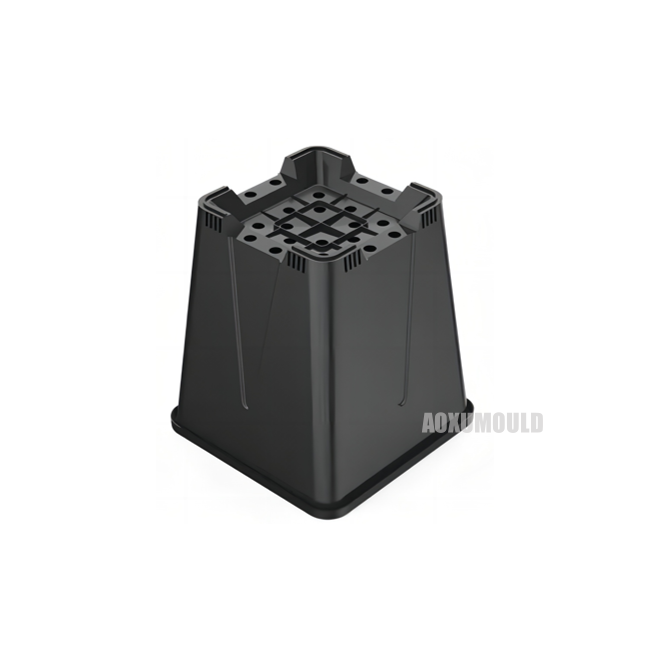
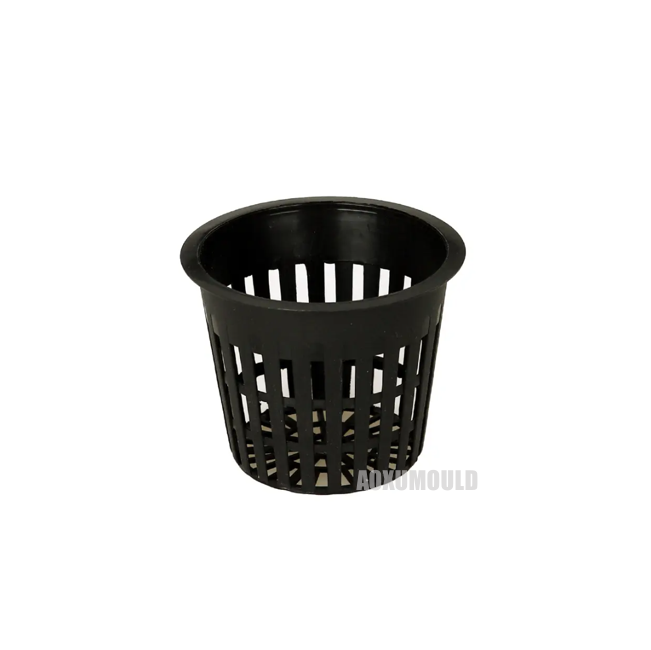
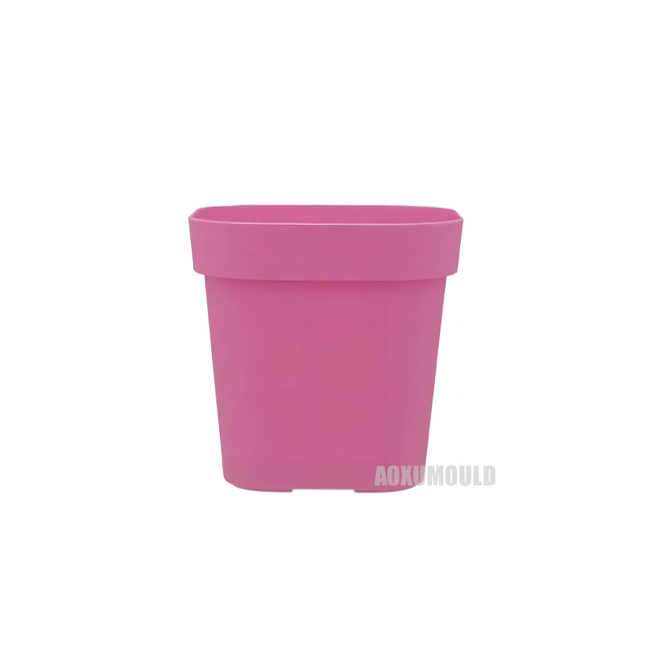
Mould Specifications
|
Mould name |
Injection Molding Plastic Thin-Walled Flowerpot Mould |
|
Product material |
HDPE, plastic |
|
Product size |
270X170X175mm(Include wheels) |
|
Product weight |
480g |
|
Mould material for cavity &. Core |
C45, P20, 718, 2738 |
|
Mould base |
C45 |
|
Injection system |
Hot runner open gates or valve gates |
|
Suitable injection machine |
450T |
|
Mould size |
350x230x255mm |
|
Mould lifetime |
more than 300,000pcs |
Why Produce 1100litres Containers By Using Material HDPE?

1.PP Material
The flowerpot is made of environmentally friendly materials with good toughness and strong anti-fall, and its service life is longer.
2. Drainage Hole Design
The bottom and side drainage hole design, to achieve water control and breathable, conducive to the respiration of plant roots, eliminate excess water.
3. Edge of Pelvic Mouth
The edge of the basin is thickened to increase the texture and feel of the flowerpot and facilitate the handling of
the flowerpot.
4. Pelvic Floor Thickening
Pelvic floor thickening and bottom drainage design, resin PP material, light and durable, wear resistant.
What Issues Should Be Noted When Processing Plastic Flowerpot Mould?
Processing plastic flowerpot molds is a common processing industry that plays a very important role in our daily lives. However, although this is a common task, we must pay attention to the following issues when processing plastic flowerpot molds.
Firstly, we need to choose appropriate materials that meet various specifications. Normally, considering production costs and product quality, we would choose ABS plastic and steel. However, if we want to produce higher quality flower pots, it is best to choose high-end materials.
Secondly, stability is very important for processing plastic flowerpot molds. During the processing, it is necessary to ensure that these molds can accurately replicate the original design dimensions. Therefore, we need to accurately measure and ensure that the mold can maintain its shape stability.
At the same time, during the processing, we also need to ensure that the processing technology is correct. This includes melting and injection molding of raw materials, as well as continuous adjustment and monitoring of molds and plastic flower pots. If we cannot master these processes correctly, it will result in flower pots that cannot meet the requirements of high quality.
Finally, we need to pay attention to safety issues. When processing plastic flowerpot molds, we must ensure the safety of the site and the physical health of the workers. We need to ensure that all machines and tools are properly and promptly maintained to reduce the occurrence of accidents caused by improper use.
Design For Product &. Mould

How To Determine The Reasonable Wall Thickness of Plastic Flower Pot?
Plastic flower pots are indispensable tools and decorations in modern homes and gardening. The use of plastic flower pots has become widespread due to their advantages such as low cost, lightweight, durability, and waterproofing. However, the quality of flower pots is closely related to their wall thickness. Flower pots with insufficient wall thickness are prone to problems such as breakage, deformation, aging, and cracking.
Determining the wall thickness of plastic flower pots is something that manufacturers and buyers must consider. The determining factors of wall thickness are:
1. The use of plastic flower pots: If used for the growth of flowers and the planting of green plants, the wall thickness should be relatively thick to ensure that the flower pot can withstand the weight of the planted plants and is not affected by sunlight and rain.
2. Size of flower pot: Large flower pots require thicker walls to withstand the weight of a large amount of soil and plants.
3. Production cost: Increasing wall thickness will increase costs, so manufacturers need to strike a balance between wall thickness and cost.
To confirm the wall thickness of the flowerpot, we can use the following methods.
1. Touch feel: If the feel is soft, the wall thickness may be too thin. When touching the flowerpot, there should be a certain sense of weight and hardness.
2. Check the shape and flatness of the side of the flowerpot: The side of the flowerpot should be straight, without obvious deformation or unevenness. If the side is uneven, the wall thickness may be lacking.
3. Check the transparency of the flowerpot: The appearance of the transparent plastic flowerpot can reveal its wall thickness. If the transparency is too high, the wall thickness may be too thin and not suitable for outdoor use.
Why Can't We Dismantle Plastic Mould At Will?
Plastic moulds are one of the main tools for manufacturing plastic products, and they have a significant impact on the accuracy, efficiency, and cost of the production process. However, many people may have the idea of dismantling plastic molds at will when using them, which is not advisable. Here are the reasons for this:
Firstly, improper disassembly may lead to a decrease in service life. The structure of plastic molds is very complex, including the assembly of many components, and the matching degree of these components is very high. If not disassembled in the prescribed manner, it is easy to cause damage to these components, affecting the accuracy and internal structure of the entire mold. This will reduce the service life of plastic molds, making them unusable.
Secondly, dismantling may affect production efficiency. If the mold needs to be replaced during the production process, incorrect disassembly methods will lead to an increase in replacement time. If such replacement times have to occur frequently, it will greatly reduce production efficiency and affect the profitability of the enterprise.
Thirdly, dismantling at will will also increase maintenance costs. Plastic molds require regular maintenance and upkeep to ensure their proper functioning. If the mold is dismantled arbitrarily, it will increase maintenance costs and cause unnecessary waste.
Mould Try-out of Injection Molding Plastic Thin-Walled Flowerpot Mould
Package &. Delivery

Mould Components
Mould Steel

Hot Runner System

Standard Parts

FAQ
Q: What is the injection molding cycle time for your plastic flowerpot mold in seconds?
A: We will design according to the customer's requirements, mainly depending on factors such as mold waterway design and mold cavity number.
Q: Does your plastic flowerpot mold steel have a testing certificate?
A: If the customer requires, we will provide a certificate of composition testing for mold steel.
Q: Do you have your own mold design engineer?
A: Yes, we have two senior mold engineers and three intermediate mold engineers.
Q: Will you send free plastic flowerpot trial samples?
A: Yes, we will send a certain quantity of samples to customers free of charge.
Q: What factors should be considered when making plastic molds?
A: Some factors to consider when making plastic molds include product design, plastic material selection, mold material selection, injection molding machine capacity, cooling time, and mold maintenance requirements.
Q: How long does it take for you to make a set of plastic flowerpot molds?
A: The mold delivery time varies depending on the complexity and size of the mold, however, this usually takes 6 to 8 weeks.
Q: Can you provide 3D modeling drawings and 2D floor plans of the mold?
A: Of course, once the mold design is completed, we will send it to the customer for confirmation.
Q: Do we need to provide injection molding machine parameters?
A: Yes, we will design the size of the plastic flowerpot mold based on your injection molding machine specifications.
Q: What are the benefits of making plastic injection molds?
A: Some benefits of manufacturing plastic molds include faster production time, lower unit cost, high precision, and the ability to produce complex shapes and designs.
Q: Can our plastic flowerpot molds be repaired and maintained?
A: Yes, plastic flowerpot molds can be repaired and maintained to extend their lifespan. Regular maintenance can prevent malfunctions and ensure consistent quality.
Customers' Feedback


