

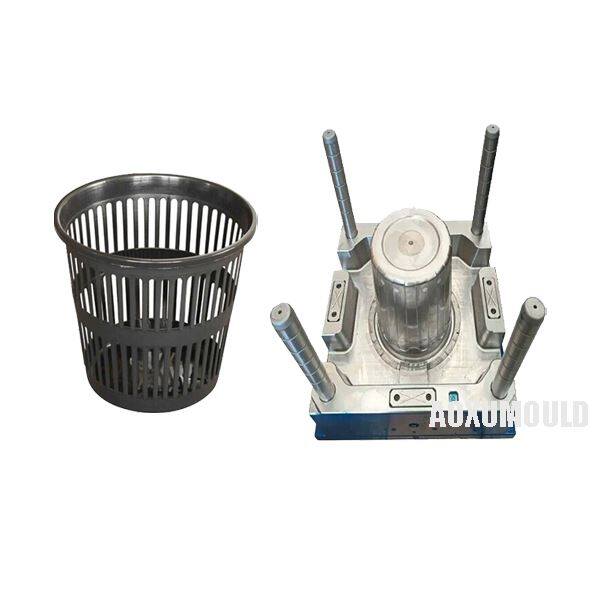
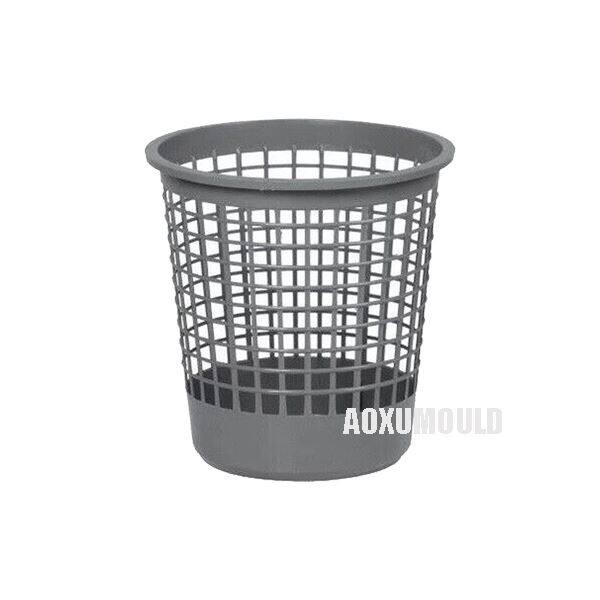
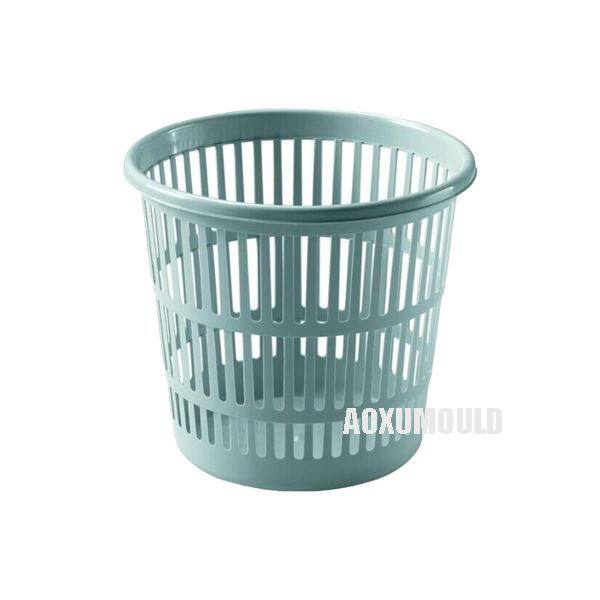
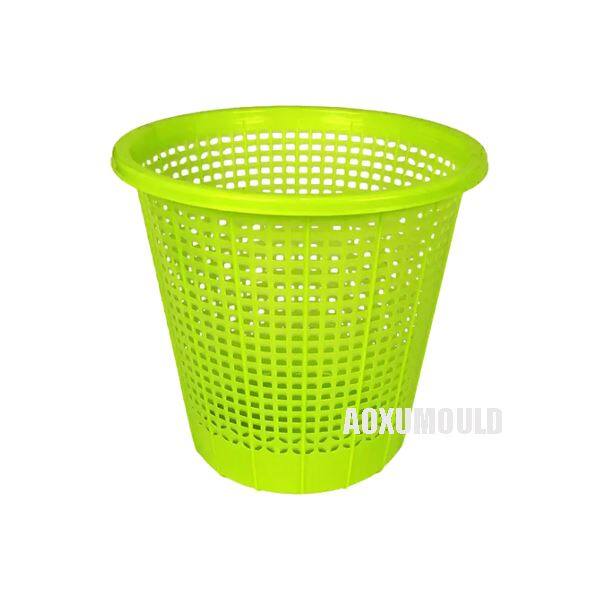
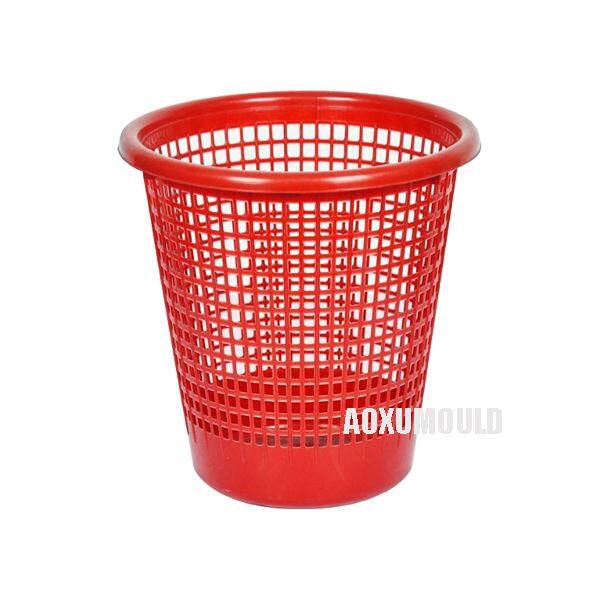
Mould Specifications
|
Mould name |
Plastic Waste Basket Mould |
|
Can material |
HDPE, plastic |
|
Can Size |
D240X255mm |
|
Can weight |
144kg |
|
Mould material for cavity &. Core |
P20, 718, 2738 |
|
Mould base |
P20 |
|
Injection system |
Cold/Hot runner |
|
Suitable injection machine |
480T |
|
Mould size |
450X450X520mm |
|
Mould lifetime |
more than 500,000pcs |
Common Plastic Materials for Waste Baskets

1. HDPE (High-Density Polyethylene)
Best for: Heavy-duty, outdoor, and industrial waste bins.
Properties: High impact resistance; Chemical & moisture resistant; Lightweight yet strong; Recyclable (Resin ID #2).
2. PP (Polypropylene)
Best for: Household, office, and healthcare waste bins.
Properties: Good stiffness & fatigue resistance; Resistant to acids, detergents, and oils; Food-safe (used in medical waste bins); Recyclable (Resin ID #5).
ABS (Acrylonitrile Butadiene Styrene)
Best for: Premium, decorative, and high-end waste bins.
Properties: Tough, glossy finish; Excellent dimensional stability; Good heat resistance; Recyclable (Resin ID #7).
4. PVC (Polyvinyl Chloride) – Less Common
Best for: Chemical waste containers (not typical for household bins).
Properties: High chemical resistance; Rigid or flexible (with plasticizers); Flame retardant.
Key Features of a Plastic Waste Basket Mould
1.Material:
Typically made from high-quality steel (P20, 718, S136) for durability and precision.
Hardened and polished to resist wear and corrosion.
2.Design Considerations:
Cavity & Core: Defines the shape of the waste basket (round, rectangular, square, etc.).
Ejection System: Ensures easy removal of the finished product.
Cooling Channels: Optimizes cycle time by cooling molten plastic quickly.
Venting: Prevents air traps and burn marks.
Surface Finish: Can be textured (e.g., matte, glossy) or smooth.
3.Production Process:
Injection Moulding: Molten plastic (PP, HDPE, ABS) is injected into the mould under high pressure.
Cooling & Ejection: The plastic solidifies, and the mould opens to release the waste basket.
Post-Processing: Trimming, labeling, or assembly (if handles/lids are included).
4.Types of Waste Basket Moulds:
Single-cavity mould: Produces one basket per cycle.
Multi-cavity mould: Produces multiple baskets simultaneously.
Family mould: Makes different parts (e.g., basket + lid) in one cycle.
Stack mould: Increases productivity by moulding in layers.
5.Customization Options:
Different capacities (5L to 50L+).
Decorative patterns, logos, or branding.
Reinforced edges or handles.
Colors (achieved by adding pigments to plastic).
How To Make A Quality Plastic Waste Basket Mould?
Step 1: Design & Engineering
3D Modeling: Use CAD software (SolidWorks, AutoCAD, or UG NX) to design the mould with precise dimensions.
Wall Thickness: Maintain uniform thickness (typically 2-4mm) to prevent warping or sink marks.
Draft Angles: Add 1-3° draft angles for easy ejection.
Ribs & Reinforcements: Include structural supports to enhance strength without adding bulk.
Venting: Design proper vents (0.02-0.04mm depth) to avoid air traps and burn marks.
Step 2: Material Selection
Mould Base: Use hardened steel (P20, 718, H13) for long lifespan (>500,000 cycles).
Cavity & Core: Opt for S136 stainless steel for corrosion resistance (if using ABS or PVC).
Step 3: Machining & Manufacturing
CNMilling & EDM: Precision-cut the mould cavities and cores.
Polishing & Texture:
Mirror polish for glossy finishes.
Textured (e.g., sandblasting, etching) for matte or decorative patterns.
Cooling System: Add conformal cooling channels for faster cycle times.
Step 4: Mould Testing & Adjustments
Trial Injection: Test with actual plastic material (HDPE, PP, ABS).
Check for Defects:
Sink marks → Adjust cooling or wall thickness.
Flash → Improve clamping force or fit.
Warping → Optimize cooling rate.
Cycle Time Optimization: Reduce cooling time while maintaining quality.
Step 5: Production & Maintenance
Regular Cleaning: Prevent residue buildup.
Lubrication: Keep moving parts smooth.
Inspection: Check for wear (e.g., ejector pins, cavities).
Design For Product &. Mould

Package &. Delivery

Mould Components
Mould Steel

Hot Runner System

Standard Parts

Why Choose Our Company?
1. High-Quality Moulds with Precision Engineering
Premium Materials: We use P20, 718, S136, and H13 steel for durable, long-lasting moulds (500,000+ cycles).
Advanced CNC & EDM Machining: Ensures tight tolerances (±0.02mm) for flawless waste basket production.
Moldflow Analysis: We simulate injection molding to prevent defects (sink marks, warping, air traps).
2. Customization & Expert Design Support
3D Design & DFM (Design for Manufacturability) Review-Optimize your waste basket for cost and performance.
Any Shape/Size: Round, square, rectangular, or designer bins with branded logos & textures.
Multi-Cavity & Family Moulds: Increase efficiency by producing multiple units per cycle.
Faster Production & Competitive Pricing
3. Cost-Effective Solutions: No hidden fees--competitive pricing for both prototype and mass-production moulds.
Low MOQ (1 mould) + High-Volume Production Support.
Strict Quality Control & Warranty
100% Testing: Every mould undergoes trial injection before delivery.
Global Experience & Fast Shipping
Exported to 20+ Countries (USA, Europe, Middle East, Africa, etc.).
Reliable Logistics: Air, sea, or express shipping (DHL/FedEx).
FAQ
>1. What materials are used for the moulds?
Standard moulds: P20, 718 steel (50,000–100,000 cycles)
High-end moulds: S136, H13 steel (500,000+ cycles)
>2. How long does it take to make a mould?
After mold design receiving approval from customer, 55 days for mold T1.
>3.Can you design a custom waste basket mould?
Yes! We provide: CAD/3D design support, DFM (Design for Manufacturability) analysis and Prototype testing before mass production.
>4. How do you ensure mould quality?
Precision CNC machining & EDM, Moldflow analysis (to predict defects) and Trial injection & inspection.
>5. Can you add logos or textures to the mould?
Yes! We provide Engraved logos/branding and Custom textures (matte, glossy, leather, etc.).
>6. What are your terms of payment?
TT, 40% deposit, 30% to be paid before sending sample, 30% balance before mold delivery.
Customers' Feedback


