

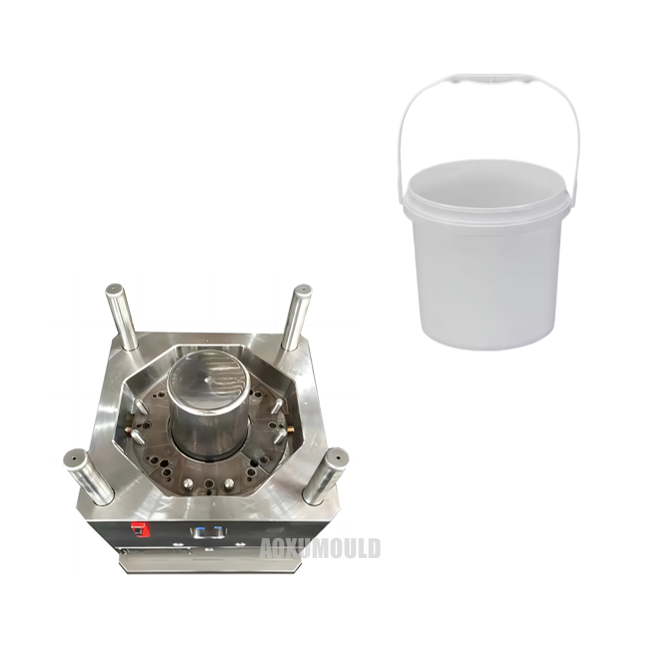
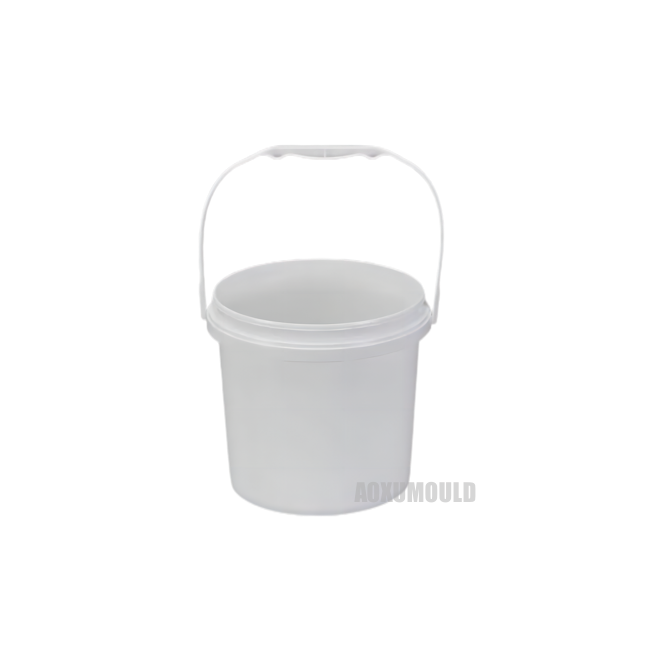
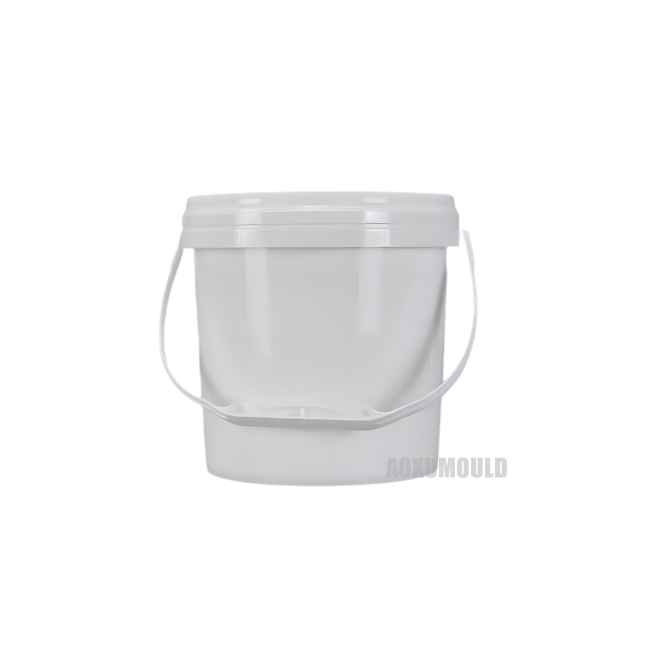
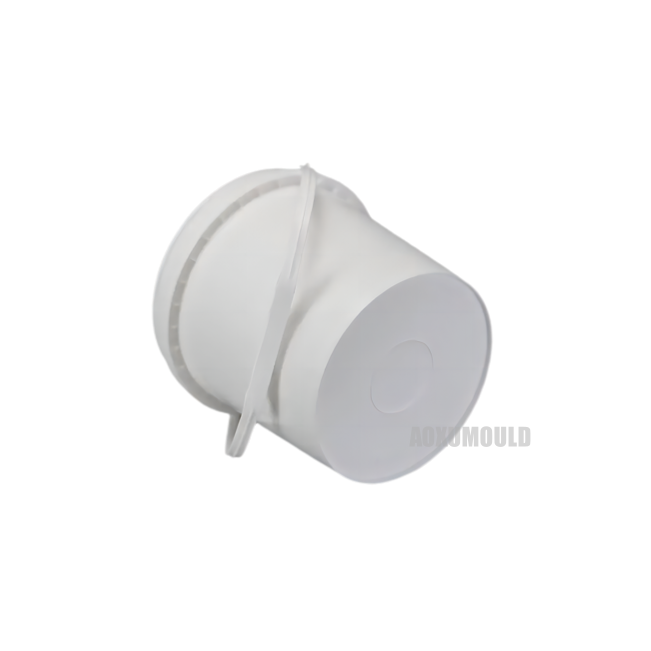
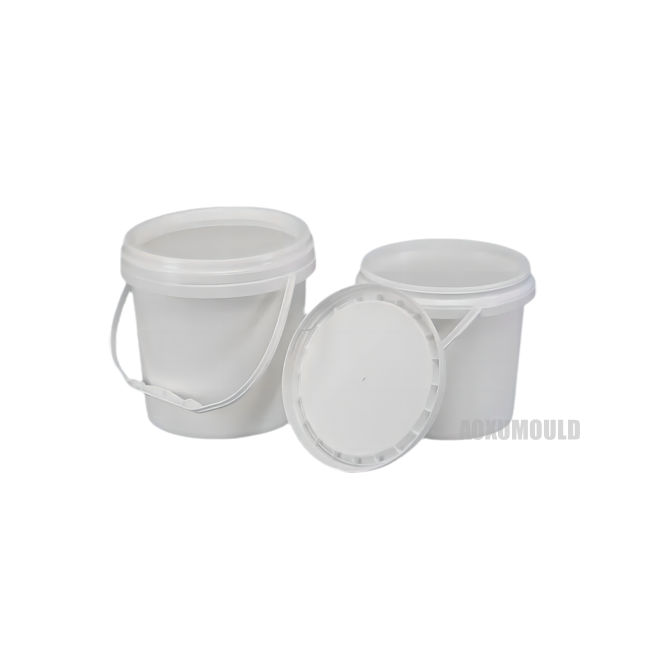
Mould Specifications
|
Mould Name |
Plastic Paint Bucket Mould |
|
Product material |
HDPE |
|
Product Size |
263X310X386mm(Include wheels) |
|
Product Weight |
1kg |
|
Mould Material For Cavity &. Core |
718 |
|
Mould Base |
C45 |
|
Injection System |
Hot runner open gates or valve gates |
|
Suitable Injection Machine |
650T |
|
Mould Size |
510x625x755mm |
|
Mould Lifetime |
more than 300,000pcs |
Design Plastic Paint Bucket Need To Pay Attention To What Problems

1. Material selection
Chemical resistance: Paint often contains corrosive components, the barrel material needs to have good chemical resistance to avoid reaction or degradation.
Mechanical strength: The material should have sufficient impact and compression resistance to prevent deformation or breakage during transportation or stacking.
Environmental protection: Priority is given to recyclable materials to reduce environmental impact.
2. Structural design
Tightness: The lid design should ensure a good seal, prevent paint leakage or volatilization, avoid contamination and safety risks.
Easy to open: The lid should be easy to open and close, while ensuring tightness and improving user experience.
Stability: The bottom design should ensure that the barrel body is stable and prevents tipping, especially for large capacity barrels.
3. Capacity and size
Capacity selection: According to the market demand design of different specifications, common capacity of 1 liter, 5 liters, 20 liters and so on.
Size optimization: The size design should consider transportation and storage efficiency to ensure a solid stack and save space.
4.Security
Non-slip design: The barrel body should be designed with non-slip texture, easy to grip and prevent slipping.
Fire performance: the paint is flammable, and the material should have certain fire performance to reduce the risk of fire.
5. Environmental protection and sustainability
Recyclable design: The barrel body should be easy to recycle and reduce the environmental burden.
Reduce material use: under the premise of ensuring strength, minimize the amount of material, reduce costs and environmental impact.
6. User experience
Portability: Designed handle or handle for easy handling, especially for large capacity drums.
Easy to clean: the inner wall should be smooth, easy to clean and reuse.
7. Cost control
Production costs: Optimize the design to reduce production costs while meeting the premise of functionality and safety.
Transportation costs: The design should be easy to transport and reduce logistics costs.
How To Improve The Cooling Effect Of Plastic Paint Bucket Mould?

Optimize cooling waterway design
Increase the number of waterways: Add more cooling waterways in the mold to ensure even cooling.
Shorten the water distance: make the cooling water closer to the surface of the cavity, improve the cooling efficiency.
Balanced waterway layout: Ensure that the waterway is evenly distributed to avoid local overheating or overheating.
Modified cooling medium
Use efficient coolants: Choose coolants with better thermal conductivity, such as special cooling oils or water-based coolants.
Control the coolant temperature: keep the coolant temperature stable to avoid too high or too low affecting the cooling effect.
Increase coolant flow rate: Increase coolant flow rate to enhance cooling effect.
Optimize mold materials
Choose materials with high thermal conductivity: Use die steels with better thermal conductivity, such as beryllium copper alloy.
Surface treatment: Chrome plating or nitriding treatment on the mold surface to improve thermal conductivity and wear resistance.
Adjust injection molding process parameters
Reduce the melt temperature: appropriately reduce the plastic melt temperature to reduce the cooling time.
Extend the cooling time: Extend the cooling time appropriately to ensure that the plastic is fully cooled.
Optimize the holding pressure: adjust the holding pressure to reduce product shrinkage and deformation.
Regular mold maintenance
Clean up the waterway: regularly remove the scale and impurities in the waterway to keep the waterway smooth.
Check tightness: Make sure the cooling water is well sealed to prevent coolant leakage.
Design For Product &. Mould

Inclined Top Mechanism Of Plastic Paint Bucket Mould
The inclined top mechanism is an important part for release in plastic moulds, especially in products with concave or inverted structure (such as paint buckets). In the paint bucket mold, the inclined top mechanism is used to release the reverse structure at the mouth or bottom of the barrel to ensure smooth release of the product without damage. The following are the main components and working principles of the inclined top mechanism:
1. The main components of the inclined top mechanism
Inclined ejector rod: The ejector rod that is installed at an Angle and is responsible for pushing the product to release the mould.
Diagonal bracket: A base for holding the diagonal bracket, usually mounted on a thimble plate.
Guide block: Ensure that the inclined ejector rod moves at a predetermined Angle to prevent deviation.
Reset spring: helps reset the inclined ejector rod when closing the mould.
Wear-resistant block: reduce the friction between the inclined rod and the die, and extend the service life.
2. How it works
When opening the mould: the thimble plate pushes the inclined ejector rod, and the inclined ejector rod moves along the inclined Angle to push the product out of the reverse buckle area.
When closing the mould: the reset spring makes the inclined ejector rod return to the initial position to ensure the normal closure of the mould.
3. Design essentials
Angle design: The tilt Angle of the inclined rod is usually between 5° and 15°, and the Angle is too large to increase friction, and the demoulding force is insufficient.
Material selection: High hardness and wear-resistant materials, such as SKD61, should be selected for inclined rod and wear-resistant block.
Lubrication: Regular lubrication is required between the tilting rod and the guide block to reduce wear.
Strength calculation: To ensure that the inclined rod can withstand the demoulding force to avoid deformation or fracture.
Plastic Paint Bucket Mould Processing
Package &. Delivery

Mould Components
Mould Steel

Hot Runner System

Standard Parts

Why Choose Us
1. Supplier's professional competence
Experience: Choose a supplier with extensive experience in the field of plastic paint bucket moulds, especially in terms of the type of product you require.
Technical capability: Evaluate the technical level of suppliers, including mold design, manufacturing process and innovation capability.
Equipment: Understand whether the supplier's production equipment is advanced and can meet the requirements of high precision and high efficiency.
2. Quality control
Testing equipment: Suppliers should have perfect testing equipment and processes to ensure the quality of molds and products.
Quality control process: Understand the supplier's quality control process, including raw material inspection, production process control and finished product inspection.
3. Delivery capacity
Lead time: Assess whether the supplier's lead time meets your production schedule.
Production capacity: Understand the production capacity of suppliers to ensure that they can complete large volume orders within the specified time.
4. Cost control
Quote: Compare quotes from multiple suppliers to ensure prices are reasonable and transparent.
Cost control ability: Understand the supplier's ability in cost control, and can reduce costs under the premise of ensuring quality.
Payment terms: Negotiate reasonable payment terms to ensure liquidity and risk control.
5. After-sales service
Technical support: The supplier shall provide comprehensive technical support, including mold maintenance, troubleshooting and process optimization.
Response speed: Evaluate the supplier's after-sales service response speed to ensure that problems can be resolved in time.
Warranty policy: Understand the supplier's warranty policy to ensure timely repair or replacement in case of mold problems.
6. Communicate and collaborate
Communication ability: Evaluate supplier's communication ability to ensure smooth communication of needs and issues.
Cooperative attitude: Choose suppliers who are willing to cooperate for a long time and have a positive attitude.
Flexibility: Suppliers should have some flexibility to adjust and optimize according to customer needs.
Customers' Feedback


