

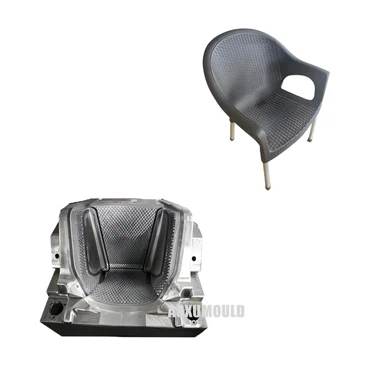
A chair injection mold is a complex, precision tool typically constructed in two halves that meet at the parting line (PL). Its structure ensures molten plastic is shaped, cooled, and ejected to form durable chair components (seat, backrest, base parts). Key structural elements include:

Core &. Cavity Plates (A-Side & B-Side):
Cavity Plate (A-Side / Fixed Half): Mounts to the stationary platen of the injection molding machine. Contains the cavity (female impression) defining the chair part's external shape.
Core Plate (B-Side / Moving Half): Mounts to the moving platen. Contains the core (male protrusion) defining the chair part's internal shape and features. Slides away after molding to open the mold.
Mold Base:
Support Plates: Provide structural rigidity.
Spacer/Support Blocks: Create space for ejection systems.
Ejector Housing: Contains the ejector mechanism.
Injection System:
Sprue Bushing: Receives molten plastic from the machine nozzle.
Runners: Channels distributing plastic from the sprue to the gates.
Gates: Controlled entry points into the cavity (e.g., edge gates, tunnel gates, large fan gates common for chairs).
Cooling System (Temperature Control):
Cooling Channels: Machined passages throughout core, cavity, and plates for circulating coolant (water or oil). Critical for uniform cooling and cycle time reduction in large chair parts.
Ejection System:
Ejector Pins: Most common. Push the solidified part off the core.
Sleeve Ejectors: Used around core pins or bosses.
Blade Ejectors: For thin ribs or long surfaces.
Stripper Plate: Sometimes used for large parts with deep draws or minimal draft angles.
Ejector Retainer Plate & Ejector Plate: Hold and drive the ejector components.
Return Pins: Push the ejector system back after ejection.
Springs: Assist return pin function.
Guiding &. Alignment System:
Leader Pins & Bushings: Precisely align the two mold halves during closing.
Interlocks: Prevent lateral shifting between plates under clamping pressure.
Venting System:
Vent Grooves/Channels: Shallow channels (usually < 0.03mm deep) at the parting line and around ejector pins/slides to allow trapped air/gas to escape during injection.
Porous Metal Vents: Used in deep ribs or problematic areas.
Slide Systems (For Undercuts):
Angle Pins (Cam Pins): Drive slides perpendicular to the mold opening direction.
Slides: Hold cores or inserts forming undercuts (e.g., complex armrests, side details, internal clips).
Wear Plates: Reduce friction on sliding surfaces.
Locks (Heel Blocks): Hold slides securely against injection pressure.
Return Springs/Locks: Ensure slides retract correctly when mold opens/closes.
Lifters (For Internal Undercuts):
Angled mechanisms moving with ejection to form/release internal undercuts (e.g., inside a seat shell).
Insert Systems:
Mold Inserts: Removable blocks (often hardened steel) forming specific high-wear or complex features within the core or cavity.
Chair-Specific Considerations:
Large Surface Area: Requires robust cooling systems for even temperature control and minimized warpage.
Thin Walls: Demands precise mold filling control and venting.
Complex Geometry &. Undercuts: Often necessitates multiple slides, lifters, or complex parting lines.
High Clamping Force: Due to large projected area.
Material Flow: Long flow paths require careful gate placement and runner design.
Durability: chair Molds must withstand high production volumes; hardened steel is common for critical components.