

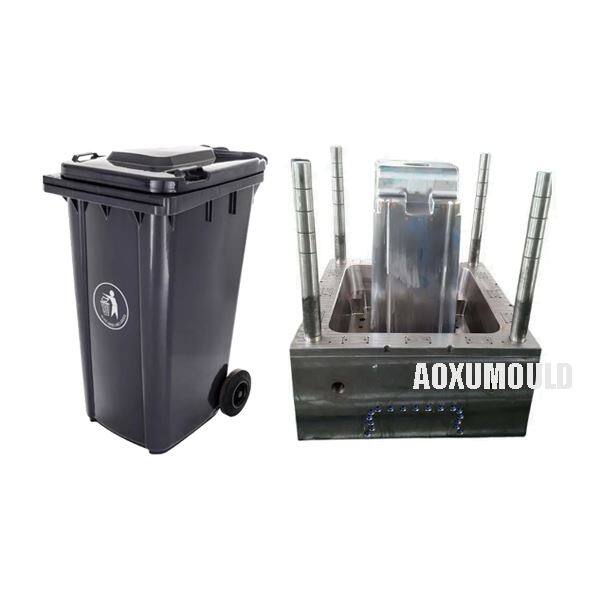
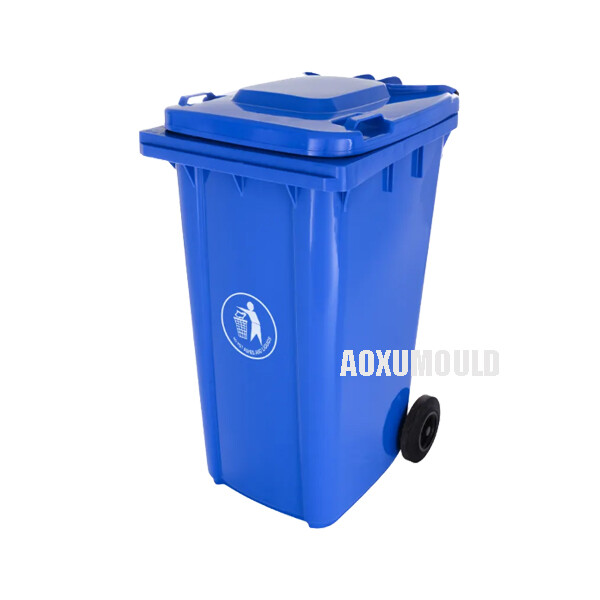
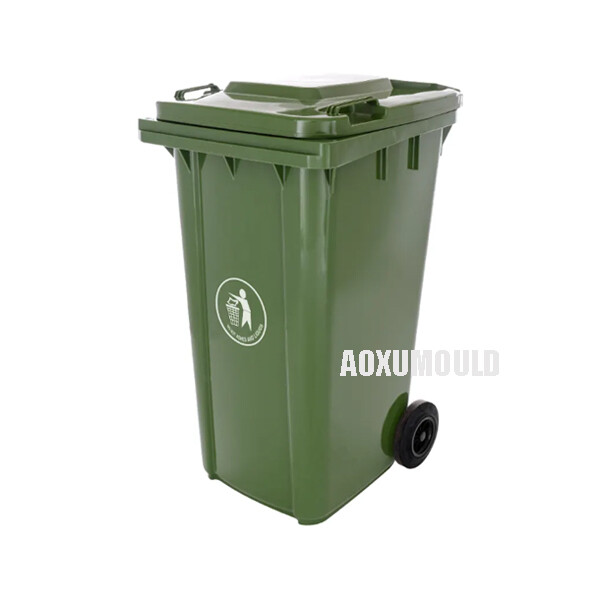
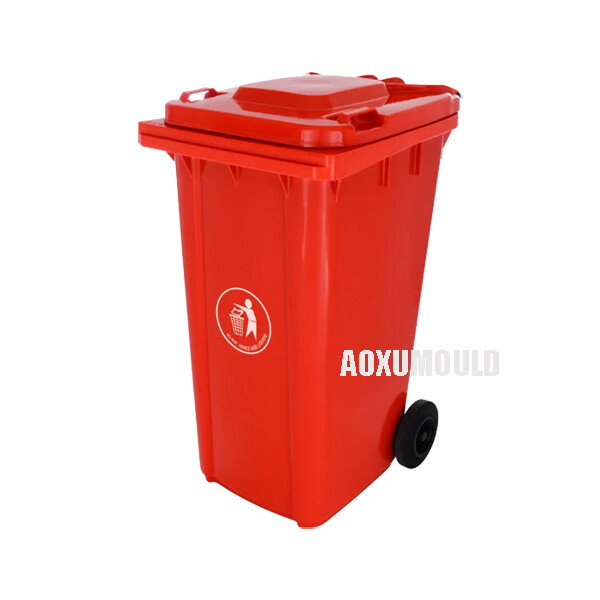
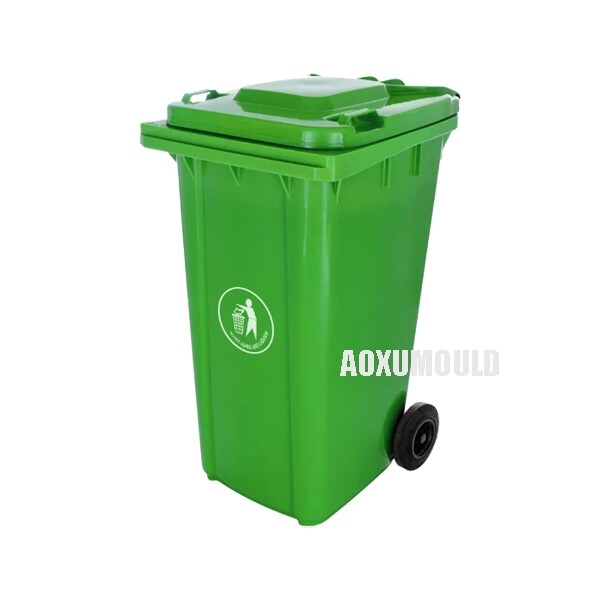
Mould Specifications
|
Mould name |
Plastic Wheel Dustbin Mould |
|
Dustbin material |
HDPE, PP, plastic |
|
Dustbin Size |
740X585X997mm |
|
Dustbin Volume |
240L |
|
Mould material for cavity &. Core |
P20, 718 |
|
Mould base |
P20 |
|
Injection system |
Cold runner/Hot runner |
|
Suitable injection machine |
2400T |
|
Mould size |
1350X1080X1380mm |
|
Mould lifetime |
more than 500,000pcs |
Factors to Consider When Choosing a Plastic Material

Both Polypropylene (PP) and High-Density Polyethylene (HDPE) are the top choices for manufacturing wheeled dustbins due to their durability, cost-effectiveness, and recyclability. Below is a detailed comparison explaining why these plastics dominate the market and which one suits different bin applications best.
1. Key Advantages of PP (Polypropylene)
Best for Lightweight & Cost-Effective Bins
Lighter than HDPE → Easier to tilt, roll, and transport.
Lower material cost → Ideal for budget-friendly bins.
Good flexibility → Less prone to cracking under stress.
Excellent Chemical Resistance
Resists acids, alkalis, and most cleaning agents → Suitable for kitchen & industrial waste bins.
Better for Hinges & Moving Parts
High fatigue resistance → Perfect for pedal-operated lids and wheel mechanisms.
2. Key Advantages of HDPE (High-Density Polyethylene)
Superior Strength & Impact Resistance
Rigid and tough → Withstands drops, impacts, and heavy loads.
Better for large-capacity bins (60L-120L+).
Excellent Weather & UV Resistance
Naturally UV-stable → Ideal for outdoor & industrial wheelie bins.
Performs well in extreme heat/cold (-40°C to 80°C).
Highly Recyclable & Eco-Friendly
#2 Plastic (HDPE) → One of the most recycled plastics.
Can be made from post-consumer recycled (PCR) content.
3. PP vs. HDPE: Direct Comparison
|
Property |
PP |
HDPE |
Winner? |
|
Impact Resistance |
Good |
Excellent |
HDPE |
|
UV Resistance |
Moderate (needs additives) |
High (naturally UV-stable) |
HDPE |
|
Chemical Resistance |
Excellent |
Excellent |
Tie |
|
Weight |
Light |
Moderate |
PP (for lightweight needs) |
|
Rigidity |
Flexible |
Very Rigid |
HDPE (for heavy loads) |
|
Cost |
Lower |
Higher |
PP (budget option) |
|
Recyclability |
♻(#5) |
♻(#2) |
HDPE (more widely recycled) |
How To Make A Quality Plastic Waste Container Mould?
1. Design
3D Modeling (CAD):
Use CAD software (SolidWorks, AutoCAD, or Creo) to design the mould based on the dustbin's dimensions, shape, and features (wheels, handles, lid mechanism).
2. Core & Cavity Machining
CNC Milling & EDM:
Use high-precision CNC machining for core and cavity.
EDM (Electrical Discharge Machining) for fine details (textures, logos).
Polishing to achieve a smooth surface finish (avoiding ejection issues).
3. Mould Testing & Optimization
Trial Run (T0, T1, T2):
Check for short shots, flash, sink marks, or warping.
Adjust injection speed, pressure, and cooling time.
Fine-tune ejection mechanism to prevent sticking.
4. Production & Maintenance
Regular Maintenance:
Clean and lubricate the mould after each run.
Check for wear on ejector pins and cooling channels.
Key Considerations for Wheel Dustbin Moulds:
A.Wheel Mounting Mechanism – Ensure smooth movement and durability.
B.Lid & Handle Integration – Must function without sticking.
C.Draft Angles – Critical for easy demolding (especially for deep bins).
D.Material Flow – Avoid weak spots near handles/wheels.
How Does a Plastic Wheel Dustbin Mould Work?
|
1. Mould Structure & Components The mould consists of two main halves: Core Side (Moving Half) – Attached to the injection machine's ejector system. Cavity Side (Fixed Half) – Mounted on the injection machine's stationary platen. Key Components: Sprue & Runner System – Channels that guide molten plastic into the cavity. Gates – Entry points where plastic flows into the mould. Cooling Channels – Circulate water to solidify the plastic quickly. Ejector Pins – Push the finished dustbin out after cooling. Sliders/Lifters (if needed) – For undercuts like wheel slots or handles. Vents – Allow trapped air to escape. 2. Step-by-Step Injection Moulding Process Step 1: Clamping The mould closes under high pressure (hydraulic or mechanical). Ensures no plastic leaks (flash) during injection. Step 2: Injection Plastic pellets (HDPE/PP) are melted in the barrel (at ~200–250°C). The screw pushes molten plastic into the mould cavity under high pressure (500–1500 bar). Step 3: Packing & Holding Additional pressure is applied to fill every detail (like ribs, logos, and wheel slots). Prevents sink marks and ensures dimensional accuracy. Step 4: Cooling Cooling channels circulate water to solidify the plastic (~20–60 sec, depending on thickness). Critical for warpage control (uneven cooling can deform the dustbin). Step 5: Ejection The mould opens, and ejector pins push the dustbin out. Air blasts or robotic arms may assist in part removal. Step 6: Mould Reset The mould closes, and the cycle repeats (typically 30–90 sec per cycle). |

Design For Product &. Mould
|
|

Package &. Delivery

Mould Components
Mould Steel

Hot Runner System

Standard Parts

How To Maintenance Our Plastic Wheel Dustbin Mould?
|
|
1. Regular Cleaning
After Each Production Run:
Remove plastic residue from cavities, runners, and ejector pins using brass or copper tools (avoid steel scrapers to prevent scratches).
Use specialized mould cleaners (e.g., silicone-based solvents) to dissolve stubborn plastic buildup.
Clean cooling channels to prevent blockages (flush with water or air).
Lubrication of Moving Parts
Ejector Pins & Guide Bushings – Apply high-temperature grease (e.g., molybdenum disulfide) to prevent sticking.
Sliders & Lifters (for wheel/handle mechanisms) – Lubricate with synthetic mould oil to ensure smooth movement.
Sprue Bushing & Runner System – Light oil to prevent friction wear.
Proper Storage When Not in Use
Apply rust inhibitor (e.g., VCI paper or anti-corrosion spray).
Store in a dry, temperature-controlled environment (humidity <60%).
Cover with protective film to prevent dust accumulation.
Why Choose Our Wheel Dustbin Moulds?
1. Customization & Precision
CAD/CAM-designed moulds for exact wheel alignment and structural integrity.
Options for 120L, 240L, 360L standard sizes or custom dimensions.
2. High Durability
Hardened steel (H13, S136) moulds for 500,000+ cycles.
Corrosion-resistant coatings for long-term use.
3. Fast Production Support
50–55 days lead time for new moulds.
24/7 technical support for troubleshooting.
4. Cost-Effective Solutions
Multi-cavity moulds reduce per-unit cost.
Material optimization to minimize waste.
FAQ
|
>1. What's your lead time? Yes! Reputable manufacturers offer: T0 (First Trial) – Initial sample check. T1/T2 Adjustments – Fine-tuning for defects (sink marks, warping). Moldflow Analysis (Optional) – Simulates plastic flow before production. >3. How to approval samples? We could send samples by DHL, >4. How about your quality control? >5. Can You Make a Mould for Different Dustbin Sizes? Yes! Manufacturers can produce moulds for: Small bins (10–30L) – Household use. Medium bins (30–60L) – Office/commercial use. Large bins (60–120L+) – Industrial/wheelie bins.
|
Customers' Feedback


